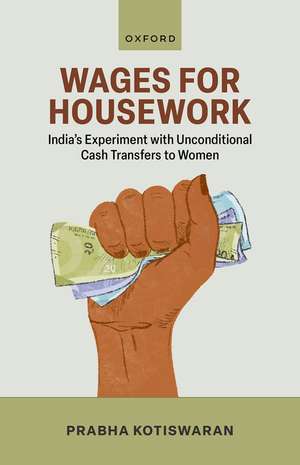
Wages for Housework: India's Experiment with Unconditional Cash Transfers to Women
Autor Prabha Kotiswaranen Limba Engleză Hardback – 7 aug 2026
Preț: 805.18 lei
Preț vechi: 1169.73 lei
-31% Nou
Puncte Express: 1208
Carte tipărită la comandă
Livrare economică 20-25 noiembrie
Livrare prin curier în România Termenul estimat este afișat lângă disponibilitate.
Transport gratuit pentru acest produs Plată online sau ramburs, în funcție de opțiunile comenzii.
Retur gratuit în 14 zile Comandă securizată și suport în română.
Specificații
ISBN-13: 9780198934493
ISBN-10: 0198934491
Pagini: 378
Dimensiuni: 140 x 216 mm
Greutate: 0.57 kg
Editura: OUP OXFORD
Colecția OUP Oxford
Locul publicării:Oxford, United Kingdom
ISBN-10: 0198934491
Pagini: 378
Dimensiuni: 140 x 216 mm
Greutate: 0.57 kg
Editura: OUP OXFORD
Colecția OUP Oxford
Locul publicării:Oxford, United Kingdom
Recenzii
What makes Wages for Housework truly exceptional is that it takes women's lived experiences seriously, listening closely to how women themselves understand cash transfers, autonomy, dignity, labour, and citizenship. At a moment when feminist politics globally is struggling to articulate alternatives to right-wing governance, this book offers a bold, empirically grounded, and theoretically rigorous vision of what a feminist care manifesto might look like. It is an indispensable resource for scholars of feminism, development, law, political science, and economics and vital for anyone seeking to imagine a more just social contract centred on care, dignity, and life-making labour.
In recent years, unconditional cash transfer schemes for women have been rolled out across much of India, reversing an earlier reluctance to join the first wave of cash transfer programmes across the Global South. The political popularity of such schemes has led many commentators to focus on their instrumental usage to mobilize women as voters in India. Kotiswaran's much needed intervention pushes us to ask what it would take to instead visualize these schemes as the foundation of a feminist welfare state. The book offers a compelling feminist perspective on a rapidly feminizing welfare regime.
Does the proliferation of unconditional cash transfers to women in low-, middle- and high-income countries mean that social contracts are being remade at last to recognize the centrality to human well-being of unpaid domestic and care work? Are feminist values and women's realities leading to a new theory of welfare states? Drawing on in-depth investigations into the explosion of such transfers in recent years in India, this brilliant book answers these questions using the theory of social reproduction. It nuances debates about care work and the consequences of its socialization, cutting across political party lines and ideologies. Lucidly and provocatively written and an absolute must-read for all political economists concerned to find new pathways out of current theoretical impasses and policy and action conundrums.
In recent years, unconditional cash transfer schemes for women have been rolled out across much of India, reversing an earlier reluctance to join the first wave of cash transfer programmes across the Global South. The political popularity of such schemes has led many commentators to focus on their instrumental usage to mobilize women as voters in India. Kotiswaran's much needed intervention pushes us to ask what it would take to instead visualize these schemes as the foundation of a feminist welfare state. The book offers a compelling feminist perspective on a rapidly feminizing welfare regime.
Does the proliferation of unconditional cash transfers to women in low-, middle- and high-income countries mean that social contracts are being remade at last to recognize the centrality to human well-being of unpaid domestic and care work? Are feminist values and women's realities leading to a new theory of welfare states? Drawing on in-depth investigations into the explosion of such transfers in recent years in India, this brilliant book answers these questions using the theory of social reproduction. It nuances debates about care work and the consequences of its socialization, cutting across political party lines and ideologies. Lucidly and provocatively written and an absolute must-read for all political economists concerned to find new pathways out of current theoretical impasses and policy and action conundrums.
Notă biografică
Prabha Kotiswaran is Professor of Law and Social Justice at King's College London. Her main research areas include criminal law, transnational criminal law, feminist legal studies, and the sociology of law. She has authored and edited numerous books and journal articles. Select books include Dangerous Sex, Invisible Labour: Sex Work and the Law in India (Princeton, 2011) and Governance Feminism: An Introduction (University of Minnesota Press, 2018). Her research has received funding from the Arts and Humanities Research Council, Economic and Social Research Council, Leverhulme Trust, Journal of Law and Society, and Institute for Global Law & Policy, Harvard Law School. She was awarded the Philip Leverhulme Prize for Law in 2014. She was most recently Principal Investigator for an EU-funded consolidated grant, the Laws of Social Reproduction project.