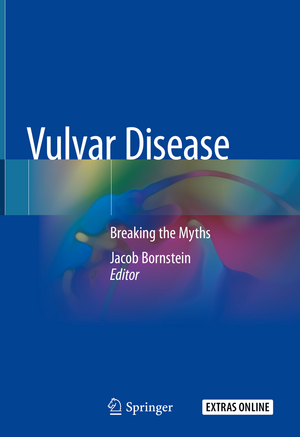
Vulvar Disease
Editat de Jacob Bornsteinen Limba Engleză Hardback – 29 apr 2019
Considerăm ediția de față, Vulvar Disease, un instrument clinic esențial care marchează trecerea de la concepțiile depășite la protocoalele contemporane bazate pe dovezi. Actualizarea ghidurilor de management este fundamentată aici pe terminologia de consens a International Society for the Study of Vulvovaginal Disease (ISSVD), eliminând confuziile terminologice care au fragmentat istoric acest domeniu. Observăm o schimbare de paradigmă în tratamentul durerii vulvare și al leziunilor cronice, unde recomandările recente pun accent pe diagnosticul diferențial riguros și pe intervenția timpurie. Structura volumului este optimizată pentru practica clinică imediată, fiind organizată nu după etiologie, ci după aspectul morfologic al leziunilor. Descoperim capitole dedicate leziunilor eritematoase, albe, papulelor, nodulilor și ulcerelor, o metodă care facilitează triajul rapid în cabinet. Notăm cu interes integrarea unei perspective multidisciplinare; Jacob Bornstein reunește expertiza ginecologilor cu cea a dermatologilor și a terapeuților sexuali, oferind o viziune de 360 de grade asupra patologiei vulvare. Această abordare este o alternativă binevenită la The Vulva de Gayle Fischer pentru rezidenți și specialiști, având avantajul unei organizări vizuale superioare și al accesului la resurse video care detaliază procedurile de tratament. Cele 551 de pagini includ numeroase ilustrații clinice și studii de caz care ancorează teoria în realitatea medicală. Spre deosebire de Vulvar Pathology de Mai P. Hoang, care se concentrează pe indicii histologici și tehnici de laborator, lucrarea de față rămâne ferm ancorată în diagnosticul clinic și managementul terapeutic aplicat, fiind indispensabilă pentru orice medic care dorește să depășească miturile asociate acestor afecțiuni adesea subdiagnosticate.
Preț: 1277.44 lei
Preț vechi: 1344.68 lei
-5%
Carte tipărită la comandă
Livrare economică 30 noiembrie-05 decembrie
Specificații
ISBN-10: 331961620X
Pagini: 428
Ilustrații: XV, 412 p. 290 illus., 284 illus. in color. With online files/update.
Dimensiuni: 183 x 260 x 27 mm
Greutate: 1.03 kg
Ediția:1st edition 2019
Editura: Springer International Publishing
Locul publicării:Cham, Switzerland
V-ar putea interesa
-
 Chorion Villus SamplingMitchell S. Golbus-5%Preț: 362.47 lei381.55 lei
 -
 Atlas of Male Genital DermatologyAnthony Hall-5%Preț: 1604.76 lei1689.22 lei
 -
 -5%Preț: 499.97 lei526.28 lei
 -
 -5%Preț: 373.12 lei392.75 lei
 -
 Secretion and Action of GonadotropinsB. Runnebaum-5%Preț: 361.08 lei380.09 lei
 -
 Psychosomatische Probleme in der Gynäkologie und Geburtshilfe 1984Ortrun Jürgensen-5%Preț: 464.59 lei489.04 lei
 -
 First Trimester Fetal DiagnosisMarco Fraccaro-5%Preț: 694.59 lei731.15 lei
 -
 Endokrine Regulation und FrauenhochleistungssportKurt G. Wurster-5%Preț: 437.94 lei460.99 lei
 -
 Gießener Gynäkologische Fortbildung 1985Wolfgang Künzel-5%Preț: 468.33 lei492.98 lei
 -
 -5%Preț: 438.96 lei462.06 lei
 -
 -5%Preț: 687.41 lei723.59 lei
 -
 -5%Preț: 113.96 lei119.96 lei
 -
 Donogene InseminationWolfgang Meyhöfer-5%Preț: 352.67 lei371.23 lei
 -
 -5%Preț: 441.62 lei464.87 lei
 -
 -5%Preț: 365.26 lei384.48 lei
 -
 Hormonale KontrazeptionB. Runnebaum-5%Preț: 392.42 lei413.08 lei
De ce să citești această carte
Recomandăm această lucrare medicilor ginecologi și dermatologi care caută o metodă sistematică de diagnostic bazată pe aspectul clinic al leziunilor. Cititorul câștigă acces la expertiza de vârf a ISSVD, beneficiind de scheme de tratament actualizate și de o înțelegere profundă a durerii vulvare. Este o resursă pragmatică ce transformă incertitudinea diagnosticului în decizie medicală precisă, susținută de materiale video și cazuri reale.
Despre autor
Jacob Bornstein este o figură de autoritate recunoscută la nivel mondial în ginecologie, servind în trecut ca președinte al Societății Internaționale pentru Studiul Bolilor Vulvovaginale (ISSVD). Expertiza sa clinică și academică se concentrează pe patologia tractului genital inferior și pe oncologia ginecologică. În calitate de editor al acestui volum publicat de Springer, Bornstein a coordonat o echipă internațională de experți pentru a alinia practica medicală curentă la noile standarde de terminologie și tratament, consolidând puntea dintre dermatologie și ginecologie.
Descriere scurtă
The core chapters of the book are arranged in accordance with lesion presentation: red lesions, white lesions, patches and plaques, papules and nodules, erosions and ulcers, blisters, etc. For each lesion, the multidisciplinary management is fully explained, including clarifications of the role of gynecologists, dermatologists, physical therapists, pain specialists, sex therapists, and others. Clinical case presentations and numerous illustrations of treatment procedures are included, supplemented by informative online videos. A separate chapter is devoted to vulvar pain, which is increasingly becoming recognized as a growing problem. Here, again the past approaches are replaced with new paradigms. All of the authors are acknowledged experts in the field and the editor is a past president of the ISSVD. The book will be of value for all vulvar specialists and a wide range of other clinicians.
Cuprins
Notă biografică
Caracteristici
Offers up-to-date guidance on diagnosis and treatment
Employs the contemporary terminology of the ISSVD
Includes informative illustrations and access to online videos