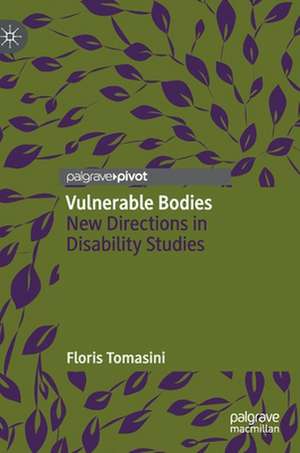
Vulnerable Bodies
Autor Floris Tomasinien Limba Engleză Hardback – 2 sep 2019
This book offers new direction in disability studies, by integrating the medical and social model of disability. The first aim is to provide an integral approach to thinking about impairment and disability through the integrative lens of being vulnerable. The second aim is to transcend the normative trap which impairment and disability debate finds itself locked in.
Disability debate is trapped in a normative struggle to escape oppressive norms. Either, by legitimizing the desire to be free from impairment, where a legitimization identity is promoted through the medical model. Or, by resisting discriminative social norms, where the desire is to be free from oppressive social barriers that exist on top of having impairment. Identifying with one’s vulnerability, or embodied uncertainty, allows for the possibility of forging meaning and building new identity. It allows freedom to express embodied difference, rather than to transform or defend it.
Preț: 393.74 lei
Puncte Express: 591
Carte tipărită la comandă
Livrare economică 23 noiembrie-07 decembrie
Livrare prin curier în România Termenul estimat este afișat lângă disponibilitate.
Transport gratuit de la 400.00 lei Plată online sau ramburs, în funcție de opțiunile comenzii.
Retur gratuit în 14 zile Comandă securizată și suport în română.
Specificații
ISBN-13: 9780230299832
ISBN-10: 0230299830
Pagini: 100
Ilustrații: XI, 87 p. 2 illus.
Dimensiuni: 153 x 216 x 11 mm
Greutate: 0.21 kg
Ediția:1st ed. 2019
Editura: Palgrave MacMillan
Locul publicării:London, United Kingdom
ISBN-10: 0230299830
Pagini: 100
Ilustrații: XI, 87 p. 2 illus.
Dimensiuni: 153 x 216 x 11 mm
Greutate: 0.21 kg
Ediția:1st ed. 2019
Editura: Palgrave MacMillan
Locul publicării:London, United Kingdom
Cuprins
Chapter 1: Introduction.- Chapter 2: Vulnerability.- Chapter 3: Beyond Disability?.- Chapter 4: Narratives of Vulnerability.- Chapter 5: Conclusion.
Notă biografică
Floris Tomasini is an applied philosopher, and recently, a Post-Doctoral Wellcome Trust Fellow. He co-wrote Examining Trust in Healthcare: A Multidisciplinary Perspective with David Pilgrim and Ivo Vassilev. As well as many articles, his last book is called Remembering and Disremembering the Dead: Posthumous Punishment, Harm and Redemption over Time.
Textul de pe ultima copertă
This book offers new direction in disability studies, by integrating the medical and social model of disability. The first aim is to provide an integral approach to thinking about impairment and disability through the integrative lens of being vulnerable. The second aim is to transcend the normative trap which impairment and disability debate finds itself locked in.
Disability debate is trapped in a normative struggle to escape oppressive norms. Either, by legitimizing the desire to be free from impairment, where a legitimization identity is promoted through the medical model. Or, by resisting discriminative social norms, where the desire is to be free from oppressive social barriers that exist on top of having impairment. Identifying with one’s vulnerability, or embodied uncertainty, allows for the possibility of forging meaning and building new identity. It allows freedom to express embodied difference, rather than to transform or defend it.