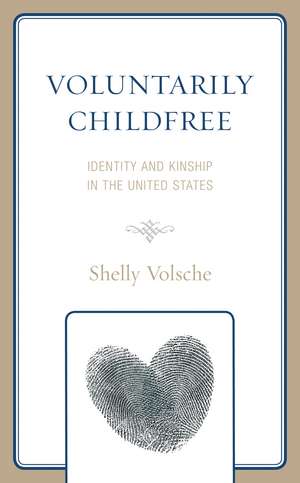
Voluntarily Childfree: Identity and Kinship in the United States: Anthropology of Kinship and the Family
Autor Shelly Volscheen Limba Engleză Paperback – 26 mai 2021
| Toate formatele și edițiile | Preț | Express |
|---|---|---|
| Paperback (1) | 242.15 lei 6-8 săpt. | |
| Bloomsbury Publishing – 26 mai 2021 | 242.15 lei 6-8 săpt. | |
| Hardback (1) | 499.63 lei 6-8 săpt. | |
| Bloomsbury Publishing – 19 noi 2019 | 499.63 lei 6-8 săpt. |


Preț: 242.15 lei
Preț vechi: 329.43 lei
-26%
Puncte Express: 363
Preț estimativ în valută:
42.85€ • 50.08$ • 37.21£
42.85€ • 50.08$ • 37.21£
Carte tipărită la comandă
Livrare economică 19 februarie-05 martie
Preluare comenzi: 021 569.72.76
Specificații
ISBN-13: 9781793602497
ISBN-10: 1793602492
Pagini: 150
Dimensiuni: 153 x 220 x 12 mm
Greutate: 0.24 kg
Editura: Bloomsbury Publishing
Colecția Lexington Books
Seria Anthropology of Kinship and the Family
Locul publicării:New York, United States
ISBN-10: 1793602492
Pagini: 150
Dimensiuni: 153 x 220 x 12 mm
Greutate: 0.24 kg
Editura: Bloomsbury Publishing
Colecția Lexington Books
Seria Anthropology of Kinship and the Family
Locul publicării:New York, United States
V-ar putea interesa
-
 Can You Help Me?: A Guide for ParentsA.H. Brafman-25%Preț: 837.40 lei1111.92 lei
 -
 Preț: 95.46 lei
 -
 Preț: 115.52 lei
 -
 The Icing on the Cake!Greg NicholsonPreț: 71.13 lei
 -
 Put the Baby Back in My TummyMrs Anna GarciaPreț: 131.30 lei
 -
 Be That MomTina O'ConnorPreț: 128.11 lei
 -
 My ChildC. S. HarrisonPreț: 130.81 lei
 -
 Getting to the Heart of Your ChildPeggy HughesPreț: 95.94 lei
 -
 Just Love Him, I GuessBeth WhittenburyPreț: 65.62 lei
 -
 The Authority on Child SafetyGary Martin HaysPreț: 79.76 lei
 -
 Shoebox Letters - Daughters to DadsClay BrizendinePreț: 81.73 lei
 -
 Preț: 41.90 lei
 -
 The Missing Pages of the Parent HandbookChristina BrockettPreț: 97.84 lei
 -
 Whispers Through TimeL.R.KnostPreț: 63.07 lei
 -
 ParentingCoach EdwinPreț: 96.04 lei
 -
 Preț: 95.33 lei
 -
 Your Little GrinAmy ShipleyPreț: 60.04 lei
 -
 Preț: 94.85 lei
 -
 At Home with DyslexiaSascha Roos-28%Preț: 83.56 lei116.21 lei
 -
 Not So MumsyMarcia Leone-24%Preț: 81.78 lei107.41 lei
Cuprins
Chapter One: Who are the childfree?
Chapter Two: Is being childfree a gendered choice?
Chapter Three: What is the childfree conversation?
Chapter Four: Are the childfree selfish?
Chapter Five: How do the childfree practice "family"?
Chapter Six: How do the childfree define "the good life"?
Chapter Seven: What is the future of the childfree?
Chapter Two: Is being childfree a gendered choice?
Chapter Three: What is the childfree conversation?
Chapter Four: Are the childfree selfish?
Chapter Five: How do the childfree practice "family"?
Chapter Six: How do the childfree define "the good life"?
Chapter Seven: What is the future of the childfree?
Recenzii
This study by Volsche (Boise State Univ.) focuses on the growing numbers of American young adults, both heterosexual and homosexual, who have resolved to remain child-free. The author, a cultural anthropologist, conducted in-depth interviews and participant observations with 30 child-free young adults between the ages 18 and 40 to collect her data, most of which were derived from social media sources, primarily Facebook groups. Within these intimate social circles, adults committed to remaining child-free shared their sorrowful stories of confronting stigmatization from parents and friends who disapprove of their anti-natalist values. With precision and thoughtfulness Volsche deeply examines the values and beliefs of this particular social subset, offering a well-written analysis. . . Volshe's book is a helpful contribution. Summing Up: Highly recommended. All readership levels.
Voluntarily Childfree shows us that kinship is not limited to those we've reproduced or even those of our same species, and that whether or not we become parents is at once a most basic and essential piece, and also just a very small part, of the complex that makes up our identities. Readers will delight in coming to know Shelly Volsche's childfree subjects and the full, fascinating, and complete lives they lead.
Voluntarily Childfree is a fascinating and well-written book on an important topic, one that has not been qualitatively investigated by scholars until now. This book will be of considerable interest to anthropologists, but also to a broader American public-not the least, to all of us who are voluntarily childfree and seek to understand our personal decisions in a fuller societal context.
Voluntarily Childfree provides an insightful, timely, and relevant analysis into the experiences of those without children in the United States. Utilizing historical information and drawing on perspectives from anthropology and sociology, Shelly Volshe's contribution to literature is without a doubt highly valuable. Interweaving personal narratives and quotations with previous research, this book serves to help lessen the stigmas and inaccuracies that exist regarding the childfree population. Definitely a book to incorporate into classes related to marriage and the family in a variety of disciplines.
Voluntarily Childfree shows us that kinship is not limited to those we've reproduced or even those of our same species, and that whether or not we become parents is at once a most basic and essential piece, and also just a very small part, of the complex that makes up our identities. Readers will delight in coming to know Shelly Volsche's childfree subjects and the full, fascinating, and complete lives they lead.
Voluntarily Childfree is a fascinating and well-written book on an important topic, one that has not been qualitatively investigated by scholars until now. This book will be of considerable interest to anthropologists, but also to a broader American public-not the least, to all of us who are voluntarily childfree and seek to understand our personal decisions in a fuller societal context.
Voluntarily Childfree provides an insightful, timely, and relevant analysis into the experiences of those without children in the United States. Utilizing historical information and drawing on perspectives from anthropology and sociology, Shelly Volshe's contribution to literature is without a doubt highly valuable. Interweaving personal narratives and quotations with previous research, this book serves to help lessen the stigmas and inaccuracies that exist regarding the childfree population. Definitely a book to incorporate into classes related to marriage and the family in a variety of disciplines.