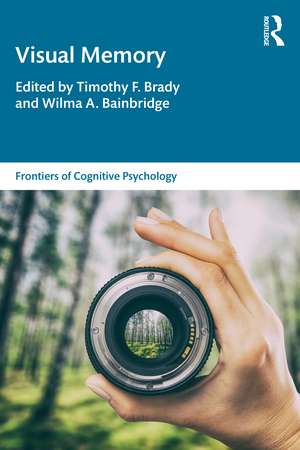
Visual Memory: Frontiers of Cognitive Psychology
Editat de Timothy F. Brady, Wilma A. Bainbridgeen Limba Engleză Paperback – 30 mar 2022
The book makes new connections between the wealth of research from each respective field, developing the idea that visuospatial memory is our best memory system. This volume traverses topics grounded in both empirical study and real-world applications, including working (short-term) memory, long-term memory, the neuroscience of memory, development of memory over the lifespan, autobiographical memories, false memories, and eyewitness testimony. It argues that an increased knowledge of how visuospatial memory works can lead to an improved understanding of the basic features of memory, as well as providing strategies for memory improvement. The book features cutting edge visual memory research, where converging methods in psychophysics, cognitive neuroscience, and computational modeling have been propelling the field forward.
Visual Memory is an essential read for all students and researchers of memory and visual perception. It will also be useful for researchers and students in related fields including human-computer interaction, data visualization, cognitive science, and cognitive enhancement.

Preț: 430.32 lei
Preț vechi: 467.74 lei
-8%
Puncte Express: 645
Carte indisponibilă temporar
Livrare prin curier în România Termenul estimat este afișat lângă disponibilitate.
Transport gratuit pentru acest produs Plată online sau ramburs, în funcție de opțiunile comenzii.
Retur gratuit în 14 zile Comandă securizată și suport în română.
Specificații
ISBN-13: 9780367744878
ISBN-10: 0367744872
Pagini: 380
Ilustrații: 1 Tables, black and white; 49 Line drawings, black and white; 11 Halftones, black and white; 60 Illustrations, black and white
Dimensiuni: 156 x 234 x 27 mm
Greutate: 0.58 kg
Ediția:1
Editura: Taylor & Francis
Colecția Routledge
Seria Frontiers of Cognitive Psychology
Locul publicării:Oxford, United Kingdom
ISBN-10: 0367744872
Pagini: 380
Ilustrații: 1 Tables, black and white; 49 Line drawings, black and white; 11 Halftones, black and white; 60 Illustrations, black and white
Dimensiuni: 156 x 234 x 27 mm
Greutate: 0.58 kg
Ediția:1
Editura: Taylor & Francis
Colecția Routledge
Seria Frontiers of Cognitive Psychology
Locul publicării:Oxford, United Kingdom
V-ar putea interesa
-
 How to Stay Smart in a Smart WorldGerd Gigerenzer-19%Preț: 75.64 lei93.26 lei
 -
 Hysterical: A MemoirElissa Bassist-31%Preț: 131.85 lei189.81 lei
 -
 Preț: 227.51 lei
 -
 Preț: 136.07 lei
 -
 The CBT Journal for Mental HealthJordan A. MadisonPreț: 87.41 lei
 -
 Cognitive Psychology: Mind and BrainJulian Hodges-18%Preț: 763.70 lei931.35 lei
 -
 Cognitive Psychology: Theory, Process and MethodologyDawson Coffey-18%Preț: 738.39 lei900.48 lei
 -
 Cognitive Behavioral Therapy for DepressionMonique ThompsonPreț: 101.82 lei
 -
 Human Perception of Visual InformationBogdan Ionescu-20%Preț: 1088.62 lei1360.77 lei
 -
 Sin ConcienciaRobert HarePreț: 82.98 lei
 -
 Preț: 118.25 lei
 -
 Generacion DopaminaAnna LembkePreț: 125.91 lei
 -
 Los Secretos de la Memoria / The Secrets of MemoryHéctor Ruiz MartínPreț: 138.47 lei
 -
 Le Pouvoir de faire dire oui: Conclure autrement que sur un malentenduGuillermo Di BisottoPreț: 230.72 lei
 -
 Preț: 147.00 lei
Public țintă
PostgraduateCuprins
Introduction
Timothy F. Brady and Wilma A. Bainbridge
Timothy F. Brady and Wilma A. Bainbridge
- Evidence For, and Challenges To, Sensory Recruitment Models of Visual Working MemoryKirsten C.S. Adam, Rosanne L. Rademake, and John T. Serences
- The Architecture of Interaction Between Visual Working Memory and Visual AttentionAndrew Hollingworth
- The Functional Role of Visual Working Memory: A Storage Buffer for Non-Automated Cognitive OperationsOrestis Papaioannou and Steven J. Luck
- Curating the Contents of Working MemoryAllison L. Bruning and Jarrod A. Lewis-Peacock
- Pre-Existing Long-Term Memory Facilitates the Formation of Visual Short-Term Memory.Weizhen Xie and Weiwei Zhang
- Ensemble Representation: Efficient Organizer of Visual MemorySang Chul Chong and Yihwa Baek
- Spatial Statistics in Perception, Learning, and NavigationKathryn N. Graves and Nicholas B. Turk-Browne
- Limited Access to an Unlimited Store: Mechanistic Constraints and Limitations in the Voluntary Control of Visual Long-Term MemoryKeisuke Fukuda, Caitlin J. I. Tozios, and Joseph M. Saito
- How to Induce the Forgetting of PicturesAshleigh M. Maxcey, Elizabeth Mancuso, Paul S. Scotti, Emily Spinelli, and Geoffrey F. Woodman
- Memorability: Reconceptualizing Memory as a Visual AttributeWilma A. Bainbridge
- Neural Representations of Visual Encoding and RetrievalAnisha S. Babu and Brice A. Kuhl
- The Link Between Conceptual and Perceptual Information in MemoryMarc N. Coutanche
- Visual Category-Driven Differences in MemoryAdam Steel & Edward H. Silson
- Medial Temporal Lobe Contributions to the Temporal Structure of Visual MemoryWillem Le Duc, Zhemeng Wu, Qun Ye, Rutsuko Ito, and Andy C. H. Lee
- The Role of Visual Imagery in Constructing Autobiographical Memories and Future EventsSigny Sheldon
- Visual Perspective in Event MemoryPeggy L. St. Jacques
- The Development of Visual MemoryAlicia Forsberg, Eryn J. Adams, and Nelson Cowan
- The Basic Science of Eyewitness IdentificationJohn T. Wixted
- Applying Confidence-Accuracy Characteristic Plots to Recognition MemoryHenry L. Roediger, III, Eylul Tekin, and Wenbo Lin
- Visual False Memories
Notă biografică
Timothy F. Brady is an Associate Professor of Psychology at the University of California San Diego, USA. His research focuses on the nature of visual memory. His lab studies visual perception, attention, working memory and long-term memory, using cognitive and cognitive neuroscience methods and computational models.
Wilma A. Bainbridge is an Assistant Professor of Psychology at the University of Chicago, USA. Her research focuses on the interactions of vision and memory in computation, behavior, and the brain, with recent work exploring the intrinsic memorability of items, and what drawings can show us about visual memory.
Wilma A. Bainbridge is an Assistant Professor of Psychology at the University of Chicago, USA. Her research focuses on the interactions of vision and memory in computation, behavior, and the brain, with recent work exploring the intrinsic memorability of items, and what drawings can show us about visual memory.
Recenzii
"This outstanding book, edited by two prominent stars, features the leading researchers in visual cognition and memory. In an interdisciplinary and integrative manner, the must-read chapters address the most fundamental issues in visual memory, and they set the agenda for the next decade of inquiry and debate. I also applaud the coverage of both basic scientific questions and diverse applications to everyday memory."
Marvin Chun, Yale University, USA"Visual Memory is a timely and exciting book that explores a topic of fundamental importance to anyone interested in the workings of memory. The editors have assembled leading researchers from a variety of perspectives who have written superb chapters that are both engaging and informative. I highly recommend this landmark volume in the study of visual memory."
Daniel L. Schacter, Harvard University, USA
"The topic of visual memory has been exploding in recent years. This book is a vivid snapshot of the fireworks.
It lets us see the current shape of the field while also making us aware of the dynamism that is changing that shape as we watch."
Jeremy Wolfe, Harvard Medical School, USA
Marvin Chun, Yale University, USA"Visual Memory is a timely and exciting book that explores a topic of fundamental importance to anyone interested in the workings of memory. The editors have assembled leading researchers from a variety of perspectives who have written superb chapters that are both engaging and informative. I highly recommend this landmark volume in the study of visual memory."
Daniel L. Schacter, Harvard University, USA
"The topic of visual memory has been exploding in recent years. This book is a vivid snapshot of the fireworks.
It lets us see the current shape of the field while also making us aware of the dynamism that is changing that shape as we watch."
Jeremy Wolfe, Harvard Medical School, USA
Descriere
This book explores the relationship between visual perception and memory. It bridges the traditionally separate fields of vision science and recognition memory and deals with an interdisciplinary set of perspectives combining research in psychology, neuroscience, and artificial intelligence.