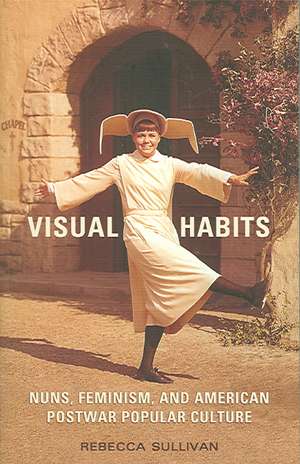
Visual Habits
Autor Rebecca Sullivanen Limba Engleză Paperback – 10 iun 2005
With Visual Habits, Rebecca Sullivan brings this unexamined history of nuns to the fore, revisiting the intersection of three distinct movements - the Second Vatican Council, the second wave of feminism, and the sexual revolution - to explore the pivotal role nuns played in revamping cultural expectations of femininity and feminism.
From The Nun's Story to The Flying Nun to The Singing Nun, nuns were a major presence in the mainstream media. Charting their evolving representation in film and television, popular music, magazines, and girls' literature, Sullivan discusses these images in the context of the period's seemingly unlimited potential for social change. In the process, she delivers a rich cultural analysis of a topic too long ignored.
Preț: 376.71 lei
Puncte Express: 565
Preț estimativ în valută:
66.71€ • 77.91$ • 57.95£
66.71€ • 77.91$ • 57.95£
Carte tipărită la comandă
Livrare economică 21 februarie-07 martie
Preluare comenzi: 021 569.72.76
Specificații
ISBN-13: 9780802037763
ISBN-10: 0802037763
Pagini: 340
Ilustrații: 16 halftones
Dimensiuni: 139 x 216 x 22 mm
Greutate: 0.35 kg
Editura: University of Toronto Press
ISBN-10: 0802037763
Pagini: 340
Ilustrații: 16 halftones
Dimensiuni: 139 x 216 x 22 mm
Greutate: 0.35 kg
Editura: University of Toronto Press
V-ar putea interesa
-
 Preț: 121.15 lei
 -
 Spirit of CommunityAmitai EtzioniPreț: 130.77 lei
 -
 Preț: 307.66 lei
 -
 Wrong Life – Studies in Lifeworld–grounded Critical TheorySteven P. Dandaneau-23%Preț: 786.17 lei1021.00 lei
 -
 Preț: 381.53 lei
 -
 -31%Preț: 458.32 lei664.27 lei
 -
 Preț: 311.38 lei
 -
 Preț: 339.62 lei
 -
 Preț: 73.94 lei
 -
 Preț: 81.29 lei
 -
 The ExecutiveRebecca SullivanPreț: 68.21 lei
 -
 Over the Next HillDavid Reese CountsPreț: 212.91 lei
 -
 Night Owls and Summer SkiesRebecca SullivanPreț: 59.98 lei
Notă biografică
Rebecca Sullivan is a professor in the Department of English at the University of Calgary.
Descriere
From The Nun's Story to The Flying Nun to The Singing Nun, nuns were a major presence in the mainstream media. Sullivan discusses these images in the context of the period's seemingly unlimited potential for social change.