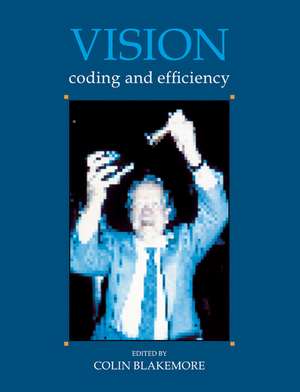
Vision
Autor K. Adler, M. Pointon Editat de Colin Blakemoreen Limba Engleză Paperback – 20 mar 2008
Preț: 464.36 lei
Preț vechi: 521.74 lei
-11%
Puncte Express: 697
Carte tipărită la comandă
Livrare economică 07-21 decembrie
Livrare prin curier în România Termenul estimat este afișat lângă disponibilitate.
Transport gratuit pentru acest produs Plată online sau ramburs, în funcție de opțiunile comenzii.
Retur gratuit în 14 zile Comandă securizată și suport în română.
Specificații
ISBN-13: 9780521447690
ISBN-10: 0521447690
Pagini: 468
Ilustrații: 255 b/w illus. 2 colour illus. 10 tables
Dimensiuni: 189 x 246 x 25 mm
Greutate: 0.9 kg
Ediția:Revised
Editura: Cambridge University Press
Locul publicării:New York, United States
ISBN-10: 0521447690
Pagini: 468
Ilustrații: 255 b/w illus. 2 colour illus. 10 tables
Dimensiuni: 189 x 246 x 25 mm
Greutate: 0.9 kg
Ediția:Revised
Editura: Cambridge University Press
Locul publicării:New York, United States
V-ar putea interesa
-
 ThinkingJohn BrockmanPreț: 115.88 lei
 -
 Woman who Changed Her BrainBarbara Arrowsmith-Young-36%Preț: 77.70 lei121.82 lei
 -
 How to Create a MindRay KurzweilPreț: 108.42 lei
 -
 The Oxford Handbook of Eye MovementsSimon Liversedge-23%Preț: 716.36 lei924.57 lei
 -
 -31%Preț: 716.84 lei1035.60 lei
 -
 Brain Imaging: What it Can (and Cannot) Tell Us About ConsciousnessRobert G. Shulman-32%Preț: 595.06 lei868.89 lei
 -
 -32%Preț: 597.80 lei884.13 lei
 -
 Barrel CortexKevin Fox-5%Preț: 988.54 lei1040.57 lei
 -
 Neurobiology of ObesityJenni Harvey-5%Preț: 588.48 lei619.45 lei
 -
 Computing Brain Activity Maps from fMRI Time-Series ImagesGordon E Sarty-20%Preț: 690.83 lei863.54 lei
 -
 Spiking Neuron ModelsWulfram Gerstner-19%Preț: 613.14 lei756.96 lei
 -
 Neuromarketing in ActionPatrick GeorgesPreț: 263.64 lei
Cuprins
Part I. Concepts of Coding and Efficiency: 1. The quantum efficiency of vision; 2. Coding efficiency and visual processing; 3. Statistical limits to image understanding; 4. The theory of comparative eye design; Part II. Efficiency of the Visual Pathway: 5. The design of compound eyes; 6. The light response of photoreceptors; 7. Is there more than meets the eye?; 8. Quantum efficiency and performance of retinal ganglion cells; 9. Neural interactions underlying direction-selectivity in the rabbit retina; 10. Detection and discrimination mechansims in the striate cortex of the Old-World monkey; Part III. Colour: 11. The two subsystems of colour vision and their roles in wavelength discrimination; 12. The effect of the angle of retinal incidence on the colour of monochromatic light; 13. Fourier interferometric stimulation (FIS): the method and its applications; 14. The chromatic coding of space; Part IV. Brightness, Adaptation and Contrast: 15. The role of photoreceptors in light-adaptation and dark-adaptation of the visual system; 16. Why do we see better in bright light?; 17. Mechanisms for coding luminance patterns: are they really linear?; 18. Feature detection in biological and artificial visual systems; Part V. Development of Vision: 19. On reformation of visual projection: cellular and molecular aspects; 20. Retinal pathways and the developmental basis of binocular vision; 21. Development of visual callosal connections; 22. Sensitive periods in visual development: insights gained from studies of recovery of visual function in cats following early monocular deprivation or cortical lesions; 23. The developmental course of cortical processing streams in the human infant; 24. Maturation of mechanisms for efficient spatial vision in primates; 25. The puzzle of amblyopia; Part VI. Depth and Texture: 26. A single, most-efficient algorithm for stereopsis?; 27. Binocular mechanisms in the normal and abnormal visual cortex of the cat; 28. Viewing geometry and gradients of horizontal disparity; 29. Texture discrimination: radiologist, machine and man; Part VII. Motion: 30. The motion pathways of the visual cortex; 31. The utilitarian theory of perception; Part VIII. From Image to Object: 32. A theory about the functional role and synaptic mechanism of visual after-effects; 33. Spatial and temporal summation in human vision; 34. The efficiency of pictorial noise suppression in image processing; 35. Algotecture of visual cortex; 36. The iconic bottleneck and the tenuous link between early visual processing and perception; 37. Pyramid algorithms for efficient vision; 38. High level visual decision efficiences; Index.
Recenzii
' … the contents are of great interest to those who wish to have a better grasp of the mechanisms of perception …' The British Journal of Visual Impairment
Descriere
Professor Colin Blakemore presents a fascinating insight to all the major topics in visual science research.