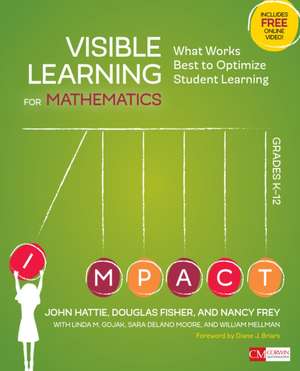
Visible Learning for Mathematics, Grades K-12: What Works Best to Optimize Student Learning: Corwin Mathematics Series
Autor John Hattie, Douglas Fisher, Nancy Frey, Linda M. Gojak, Sara Delano Moore, William Mellmanen Limba Engleză Electronic book text – 28 sep 2016
Din seria Corwin Mathematics Series
-
 Preț: 291.20 lei
 -
 Preț: 271.43 lei
 -
 Preț: 277.31 lei
 -
 Preț: 107.46 lei
 -
 Preț: 289.00 lei
 -
 Preț: 284.00 lei
 -
 Preț: 314.64 lei
 -
 Preț: 285.03 lei
 -
 Preț: 284.46 lei
 -
 Preț: 283.54 lei
 -
 Preț: 308.97 lei
 -
 Preț: 308.29 lei
 -
 Preț: 286.22 lei
 -
 Preț: 296.76 lei
 -
 Preț: 314.71 lei
 -
 Preț: 314.67 lei
 -
 Preț: 294.99 lei
 -
 Preț: 278.20 lei
 -
 Preț: 321.03 lei
 -
 Preț: 319.99 lei
 -
 Preț: 292.31 lei
 -
 Preț: 282.36 lei
 -
 Preț: 260.96 lei
 -
 Preț: 284.80 lei
 -
 Preț: 285.37 lei
 -
 Preț: 281.39 lei
 -
 Preț: 274.16 lei
 -
![Simplifying Stem [6-12]](https://i1.books-express.ro/bs/9781071917060/simplifying-stem-6-12.jpg) Preț: 263.20 lei
Preț: 263.20 lei -
 Preț: 291.55 lei
 -
 Preț: 268.96 lei
 -
 Preț: 277.56 lei
 -
 Preț: 287.57 lei
 -
 Preț: 291.97 lei
 -
![Jackson, C: Simplifying Stem [Prek-5]](https://i0.books-express.ro/bs/9781071917053/jackson-c-simplifying-stem-prek-5.jpg) Preț: 285.11 lei
Preț: 285.11 lei -
![Answers to Your Biggest Questions About Teaching Elementary Math: Five to Thrive [series]](https://i1.books-express.ro/bs/9781071857717/answers-to-your-biggest-questions-about-teaching-elementary-math.jpg) Preț: 288.67 lei
Preț: 288.67 lei -
 Preț: 288.00 lei
 -
 Preț: 259.12 lei
 -
 Preț: 264.28 lei
 -
 Preț: 265.22 lei
 -
![The Five Practices in Practice [High School]: Successfully Orchestrating Mathematics Discussions in Your High School Classroom](https://i3.books-express.ro/bs/9781544321233/the-five-practices-in-practice-high-school.jpg) Preț: 283.13 lei
Preț: 283.13 lei -
 Preț: 191.12 lei
 -
 Preț: 191.12 lei
 -
 Preț: 183.41 lei
 - 34%
 Preț: 211.38 lei
 -
 Preț: 191.12 lei
 -
 Preț: 183.41 lei
 -
 Preț: 191.12 lei
 -
 Preț: 198.80 lei
Preț: 206.50 lei
Puncte Express: 310
Indisponibil temporar
Doresc să fiu notificat când acest titlu va fi disponibil:
Se trimite...
Specificații
ISBN-13: 9781506362977
ISBN-10: 1506362974
Pagini: 304
Dimensiuni: 187 x 232 mm
Ediția:1
Editura: SAGE Publications
Colecția Corwin
Seria Corwin Mathematics Series
Locul publicării:Thousand Oaks, United States
ISBN-10: 1506362974
Pagini: 304
Dimensiuni: 187 x 232 mm
Ediția:1
Editura: SAGE Publications
Colecția Corwin
Seria Corwin Mathematics Series
Locul publicării:Thousand Oaks, United States
Cuprins
List
of
Figures
List of Videos
About the Teachers Featured in the Videos
Foreword
About the Authors
Acknowledgments
Preface
Chapter 1. Make Learning Visible in Mathematics
Forgetting the Past
What Makes for Good Instruction?
The Evidence Base
Meta-Analyses
Effect Sizes
Noticing What Does and Does Not Work
Direct and Dialogic Approaches to Teaching and Learning
The Balance of Surface, Deep, and Transfer Learning
Surface Learning
Deep Learning
Transfer Learning
Surface, Deep, and Transfer Learning Working in Concert
Conclusion
Reflection and Discussion Questions
Chapter 2. Making Learning Visible Starts With Teacher Clarity
Learning Intentions for Mathematics
Student Ownership of Learning Intentions
Connect Learning Intentions to Prior Knowledge
Make Learning Intentions Inviting and Engaging
Language Learning Intentions and Mathematical Practices
Social Learning Intentions and Mathematical Practices
Reference the Learning Intentions Throughout a Lesson
Success Criteria for Mathematics
Success Criteria Are Crucial for Motivation
Getting Buy-In for Success Criteria
Preassessments
Conclusion
Reflection and Discussion Questions
Chapter 3. Mathematical Tasks and Talk That Guide Learning
Making Learning Visible Through Appropriate Mathematical Tasks
Exercises Versus Problems
Difficulty Versus Complexity
A Taxonomy of Tasks Based on Cognitive Demand
Making Learning Visible Through Mathematical Talk
Characteristics of Rich Classroom Discourse
Conclusion
Reflection and Discussion Questions
Chapter 4. Surface Mathematics Learning Made Visible
The Nature of Surface Learning
Selecting Mathematical Tasks That Promote Surface Learning
Mathematical Talk That Guides Surface Learning
What Are Number Talks, and When Are They Appropriate?
What Is Guided Questioning, and When Is It Appropriate?
What Are Worked Examples, and When Are They Appropriate?
What Is Direct Instruction, and When Is It Appropriate?
Mathematical Talk and Metacognition
Strategic Use of Vocabulary Instruction
Word Walls
Graphic Organizers
Strategic Use of Manipulatives for Surface Learning
Strategic Use of Spaced Practice With Feedback
Strategic Use of Mnemonics
Conclusion
Reflection and Discussion Questions
Chapter 5. Deep Mathematics Learning Made Visible
The Nature of Deep Learning
Selecting Mathematical Tasks That Promote Deep Learning
Mathematical Talk That Guides Deep Learning
Accountable Talk
Supports for Accountable Talk
Teach Your Students the Norms of Class Discussion
Mathematical Thinking in Whole Class and Small Group Discourse
Small Group Collaboration and Discussion Strategies
When Is Collaboration Appropriate?
Grouping Students Strategically
What Does Accountable Talk Look and Sound Like in Small Groups?
Supports for Collaborative Learning
Supports for Individual Accountability
Whole Class Collaboration and Discourse Strategies
When Is Whole Class Discourse Appropriate?
What Does Accountable Talk Look and Sound Like in Whole Class Discourse?
Supports for Whole Class Discourse
Using Multiple Representations to Promote Deep Learning
Strategic Use of Manipulatives for Deep Learning
Conclusion
Reflection and Discussion Questions
Chapter 6. Making Mathematics Learning Visible Through Transfer Learning
The Nature of Transfer Learning
Types of Transfer: Near and Far
The Paths for Transfer: Low-Road Hugging and High-Road Bridging
Selecting Mathematical Tasks That Promote Transfer Learning
Conditions Necessary for Transfer Learning
Metacognition Promotes Transfer Learning
Self-Questioning
Self-Reflection
Mathematical Talk That Promotes Transfer Learning
Helping Students Connect Mathematical Understandings
Peer Tutoring in Mathematics
Connected Learning
Helping Students Transform Mathematical Understandings
Problem-Solving Teaching
Reciprocal Teaching
Conclusion
Reflection and Discussion Questions
Chapter 7. Assessment, Feedback, and Meeting the Needs of All Learners
Assessing Learning and Providing Feedback
Formative Evaluation Embedded in Instruction
Summative Evaluation
Meeting Individual Needs Through Differentiation
Classroom Structures for Differentiation
Adjusting Instruction to Differentiate
Intervention
Learning From What Doesn’t Work
Grade-Level Retention
Ability Grouping
Matching Learning Styles With Instruction
Test Prep
Homework
Visible Mathematics Teaching and Visible Mathematics Learning
Conclusion
Reflection and Discussion Questions
Appendix A. Effect Sizes
Appendix B. Standards for Mathematical Practice
Appendix C. A Selection of International Mathematical Practice or Process Standards
Appendix D- Eight Effective Mathematics Teaching Practices
Appendix E. Websites to Help Make Mathematics Learning Visible
References
Index
List of Videos
About the Teachers Featured in the Videos
Foreword
About the Authors
Acknowledgments
Preface
Chapter 1. Make Learning Visible in Mathematics
Forgetting the Past
What Makes for Good Instruction?
The Evidence Base
Meta-Analyses
Effect Sizes
Noticing What Does and Does Not Work
Direct and Dialogic Approaches to Teaching and Learning
The Balance of Surface, Deep, and Transfer Learning
Surface Learning
Deep Learning
Transfer Learning
Surface, Deep, and Transfer Learning Working in Concert
Conclusion
Reflection and Discussion Questions
Chapter 2. Making Learning Visible Starts With Teacher Clarity
Learning Intentions for Mathematics
Student Ownership of Learning Intentions
Connect Learning Intentions to Prior Knowledge
Make Learning Intentions Inviting and Engaging
Language Learning Intentions and Mathematical Practices
Social Learning Intentions and Mathematical Practices
Reference the Learning Intentions Throughout a Lesson
Success Criteria for Mathematics
Success Criteria Are Crucial for Motivation
Getting Buy-In for Success Criteria
Preassessments
Conclusion
Reflection and Discussion Questions
Chapter 3. Mathematical Tasks and Talk That Guide Learning
Making Learning Visible Through Appropriate Mathematical Tasks
Exercises Versus Problems
Difficulty Versus Complexity
A Taxonomy of Tasks Based on Cognitive Demand
Making Learning Visible Through Mathematical Talk
Characteristics of Rich Classroom Discourse
Conclusion
Reflection and Discussion Questions
Chapter 4. Surface Mathematics Learning Made Visible
The Nature of Surface Learning
Selecting Mathematical Tasks That Promote Surface Learning
Mathematical Talk That Guides Surface Learning
What Are Number Talks, and When Are They Appropriate?
What Is Guided Questioning, and When Is It Appropriate?
What Are Worked Examples, and When Are They Appropriate?
What Is Direct Instruction, and When Is It Appropriate?
Mathematical Talk and Metacognition
Strategic Use of Vocabulary Instruction
Word Walls
Graphic Organizers
Strategic Use of Manipulatives for Surface Learning
Strategic Use of Spaced Practice With Feedback
Strategic Use of Mnemonics
Conclusion
Reflection and Discussion Questions
Chapter 5. Deep Mathematics Learning Made Visible
The Nature of Deep Learning
Selecting Mathematical Tasks That Promote Deep Learning
Mathematical Talk That Guides Deep Learning
Accountable Talk
Supports for Accountable Talk
Teach Your Students the Norms of Class Discussion
Mathematical Thinking in Whole Class and Small Group Discourse
Small Group Collaboration and Discussion Strategies
When Is Collaboration Appropriate?
Grouping Students Strategically
What Does Accountable Talk Look and Sound Like in Small Groups?
Supports for Collaborative Learning
Supports for Individual Accountability
Whole Class Collaboration and Discourse Strategies
When Is Whole Class Discourse Appropriate?
What Does Accountable Talk Look and Sound Like in Whole Class Discourse?
Supports for Whole Class Discourse
Using Multiple Representations to Promote Deep Learning
Strategic Use of Manipulatives for Deep Learning
Conclusion
Reflection and Discussion Questions
Chapter 6. Making Mathematics Learning Visible Through Transfer Learning
The Nature of Transfer Learning
Types of Transfer: Near and Far
The Paths for Transfer: Low-Road Hugging and High-Road Bridging
Selecting Mathematical Tasks That Promote Transfer Learning
Conditions Necessary for Transfer Learning
Metacognition Promotes Transfer Learning
Self-Questioning
Self-Reflection
Mathematical Talk That Promotes Transfer Learning
Helping Students Connect Mathematical Understandings
Peer Tutoring in Mathematics
Connected Learning
Helping Students Transform Mathematical Understandings
Problem-Solving Teaching
Reciprocal Teaching
Conclusion
Reflection and Discussion Questions
Chapter 7. Assessment, Feedback, and Meeting the Needs of All Learners
Assessing Learning and Providing Feedback
Formative Evaluation Embedded in Instruction
Summative Evaluation
Meeting Individual Needs Through Differentiation
Classroom Structures for Differentiation
Adjusting Instruction to Differentiate
Intervention
Learning From What Doesn’t Work
Grade-Level Retention
Ability Grouping
Matching Learning Styles With Instruction
Test Prep
Homework
Visible Mathematics Teaching and Visible Mathematics Learning
Conclusion
Reflection and Discussion Questions
Appendix A. Effect Sizes
Appendix B. Standards for Mathematical Practice
Appendix C. A Selection of International Mathematical Practice or Process Standards
Appendix D- Eight Effective Mathematics Teaching Practices
Appendix E. Websites to Help Make Mathematics Learning Visible
References
Index
Descriere
Discover
the
right
mathematics
strategy
to
use
at
each
learning
phase
so
all
students
demonstrate
more
than
a
year's
worth
of
learning
per
school
year.