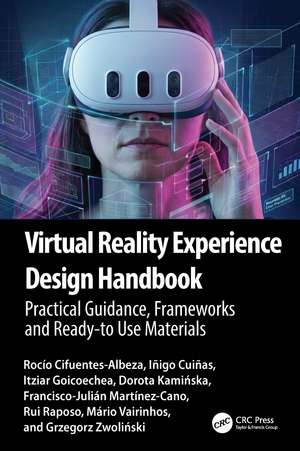
Virtual Reality Experience Design Handbook: Heuristics, Patterns, and Practices for Immersive Applications
Autor Rocío Cifuentes-Albeza, Iñigo Cuiñas, Itziar Goicoechea, Dorota Kamińska, Francisco-Julián Martínez-Cano, Rui Raposo, Mário Vairinhos, Grzegorz Zwolińskien Limba Engleză Hardback – 16 sep 2026
Focused on the needs of designers, developers, and product teams, the book bridges the gap between traditional 2D design principles and the unique challenges of embodied interaction. It moves beyond theoretical concepts, providing actionable tools such as a VR-specific heuristic framework, checklists, and templates to simplify complex design problems. Readers will gain insights into translating familiar 2D patterns into spatial equivalents, integrating accessibility features, and leveraging elements like spatial audio, lighting, and animation to guide user attention effectively.
This handbook equips professionals with the knowledge and practical tools needed to deliver high-quality immersive experiences. Whether refining existing products for spatial interfaces or developing new immersive applications, readers will find practical strategies and a clear framework for addressing the distinctive challenges of virtual reality design.
Preț: 1466.41 lei
Preț vechi: 1833.01 lei
-20% Nou
Puncte Express: 2200
Carte tipărită la comandă
Livrare economică 20 noiembrie-04 decembrie
Livrare prin curier în România Termenul estimat este afișat lângă disponibilitate.
Transport gratuit pentru acest produs Plată online sau ramburs, în funcție de opțiunile comenzii.
Retur gratuit în 14 zile Comandă securizată și suport în română.
Specificații
ISBN-13: 9781041333746
ISBN-10: 1041333749
Pagini: 258
Ilustrații: 168
Dimensiuni: 178 x 254 mm
Greutate: 0.67 kg
Ediția:1
Editura: CRC Press
Colecția CRC Press
ISBN-10: 1041333749
Pagini: 258
Ilustrații: 168
Dimensiuni: 178 x 254 mm
Greutate: 0.67 kg
Ediția:1
Editura: CRC Press
Colecția CRC Press
Public țintă
Postgraduate, Professional Practice & Development, Professional Reference, and Undergraduate AdvancedCuprins
Introduction to VR Design: Historical Milestones in VR Design
Part I Foundations of Presence
1 Presence and Visual Depth Perception in Virtual Reality
2 Gestalt and Spatial Composition
3 Scenography, Scale, and Lighting in VR
4 Spatial Audio for VR
Part II Interaction, Locomotion, and UI
5 Interaction Modes
6 Locomotion and Comfort
7 Animation and Motion in VR
8 UI in VR: Diegetic and World‑Locked Interfaces
Part III Narrative, Social, Ethics, and Accessibility
9 Narrative and Storytelling in Virtual Reality
10 Social Virtual Reality
11 Ethics and Sustainability
12 Accessibility and Inclusive Design
Part IV Heuristics, Performance, and Validation
13 VR Heuristics
14 Performance and Optimization
15 Usability Testing and Iterative Development in VR—Methods for Conducting Usability Testing in VR
16 Design Translation Patterns for Virtual Reality
Part I Foundations of Presence
1 Presence and Visual Depth Perception in Virtual Reality
2 Gestalt and Spatial Composition
3 Scenography, Scale, and Lighting in VR
4 Spatial Audio for VR
Part II Interaction, Locomotion, and UI
5 Interaction Modes
6 Locomotion and Comfort
7 Animation and Motion in VR
8 UI in VR: Diegetic and World‑Locked Interfaces
Part III Narrative, Social, Ethics, and Accessibility
9 Narrative and Storytelling in Virtual Reality
10 Social Virtual Reality
11 Ethics and Sustainability
12 Accessibility and Inclusive Design
Part IV Heuristics, Performance, and Validation
13 VR Heuristics
14 Performance and Optimization
15 Usability Testing and Iterative Development in VR—Methods for Conducting Usability Testing in VR
16 Design Translation Patterns for Virtual Reality
Notă biografică
Rocío Cifuentes-Albeza - Ph.D. Associate Professor of Audiovisual Communication and Advertising at Miguel Hernández University (UMH), Spain. She holds a Bachelor’s Degree in Fine Arts from the Polytechnic University of Valencia (1999) and was awarded the Extraordinary Doctorate Award (UMH) in 2017. Since 2002, she has been a member of the faculty, teaching across the Bachelor’s degrees in Fine Arts, Audiovisual Communication, and Journalism. Associate Dean of the BA degree program in Audiovisual Communication at UMH (2019-2023).
Iñigo Cuiñas - Ph.D. Professor and the Head of the Department of Signal Theory and Communications at the University of Vigo. He teaches courses on Remote Sensing and the Social Links of Engineering at the School of Telecommunication Engineering. Besides, he is involved in promoting Design Thinking methodology among lecturers at different Universities, by means of workshops and speeches. He has joined or led different Erasmus+ projects focused on Design Thinking, soft skills, virtual reality in education, Engineering for Peace, outdoor learning activities and other social and/or transversal issues.
Itziar Goicoechea - Ph.D. Associate Professor of Project Management in the Department of Engineering Design at Vigo University, Spain. She holds a Bachelor’s Degree in Industrial Engineering specializing in Enterprise Organization from the School of Engineering at the University of Vigo (1996) and earned his Ph.D. degree from the same institution in 2006. Additionally, she has a Master´s in Language and Communication in Business and is a member of the Spanish Association of Project Engineering (AEIPRO). She has extensive expertise in project management, with over 15 years of experience in this field in private companies in the automotive industry and construction industries. Her specialties include predictive and agile methodologies in project management as well as design thinking methodology.
Dorota Kamińska - Ph.D. Associate Professor and researcher at the Institute of Mechatronics and Information Systems, Lodz University of Technology and founder of the Voxel Research Lab. Her work focuses on virtual and augmented reality, human–computer interaction, and AI-supported learning, with particular interest in well-being, accessibility, and immersive technologies in education and healthcare.
Francisco-Julián Martínez-Cano - Ph.D. serves as a Professor of Audiovisual Direction and Production and Associate Dean of the BA degree program in Audiovisual Communication at Miguel Hernández University, Spain. He has been the recipient of several research fellowships and awards, including the José Castillejo Research Grant from the Spanish Ministry of Universities (2022) and Eng. Fernando Gonçalves Lavrador’s Honourable Mention for Best Research Paper at the Avanca Cinema International Conference (2020). He directs the OCAP research group, the Audiovisual Communication and Advertising Observatory at UMH. His research explores the intersection of virtual and augmented reality, AI, cinema, and video games by analysing the effects and interconnectedness of immersive experiences within prosocial VR, gaming, and narrative structures.
Rui Raposo Ph.D. is an Associate Professor, in the field of Science and Communication Technologies, at the Department of Communication and Art from the University of Aveiro. His current research interests focus on issues related to the use of Extended Reality technologies and experiences (VR, AR, MR and XR) in various contexts of use such as: well-being, e-tourism, and cybermuseology. He also teaches, researches and supervises activities in the field of audiovisual content production.
Mario Vairinhos - Phd. D. Associate Professor and researcher in the area of Human-Computer Interaction (HCI) and Extended Reality. He is an integrated member of DigiMedia - Digital Media and Interaction at the University of Aveiro. He is the coordinator of the Research Group in Immersive Play at the host institution of DigiMedia. He is the Co-Director of the Master’s in Digital Game Development at the University of Aveiro.
Grzegorz Zwoliński PhD and researcher at the Institute of Mechatronics and Information Systems, Lodz University of Technology. His research focuses on virtual and augmented reality, immersive systems, interaction design, and usability, with applications in education, training, and simulation-based environments supporting user-centered development of VR technologies.
Iñigo Cuiñas - Ph.D. Professor and the Head of the Department of Signal Theory and Communications at the University of Vigo. He teaches courses on Remote Sensing and the Social Links of Engineering at the School of Telecommunication Engineering. Besides, he is involved in promoting Design Thinking methodology among lecturers at different Universities, by means of workshops and speeches. He has joined or led different Erasmus+ projects focused on Design Thinking, soft skills, virtual reality in education, Engineering for Peace, outdoor learning activities and other social and/or transversal issues.
Itziar Goicoechea - Ph.D. Associate Professor of Project Management in the Department of Engineering Design at Vigo University, Spain. She holds a Bachelor’s Degree in Industrial Engineering specializing in Enterprise Organization from the School of Engineering at the University of Vigo (1996) and earned his Ph.D. degree from the same institution in 2006. Additionally, she has a Master´s in Language and Communication in Business and is a member of the Spanish Association of Project Engineering (AEIPRO). She has extensive expertise in project management, with over 15 years of experience in this field in private companies in the automotive industry and construction industries. Her specialties include predictive and agile methodologies in project management as well as design thinking methodology.
Dorota Kamińska - Ph.D. Associate Professor and researcher at the Institute of Mechatronics and Information Systems, Lodz University of Technology and founder of the Voxel Research Lab. Her work focuses on virtual and augmented reality, human–computer interaction, and AI-supported learning, with particular interest in well-being, accessibility, and immersive technologies in education and healthcare.
Francisco-Julián Martínez-Cano - Ph.D. serves as a Professor of Audiovisual Direction and Production and Associate Dean of the BA degree program in Audiovisual Communication at Miguel Hernández University, Spain. He has been the recipient of several research fellowships and awards, including the José Castillejo Research Grant from the Spanish Ministry of Universities (2022) and Eng. Fernando Gonçalves Lavrador’s Honourable Mention for Best Research Paper at the Avanca Cinema International Conference (2020). He directs the OCAP research group, the Audiovisual Communication and Advertising Observatory at UMH. His research explores the intersection of virtual and augmented reality, AI, cinema, and video games by analysing the effects and interconnectedness of immersive experiences within prosocial VR, gaming, and narrative structures.
Rui Raposo Ph.D. is an Associate Professor, in the field of Science and Communication Technologies, at the Department of Communication and Art from the University of Aveiro. His current research interests focus on issues related to the use of Extended Reality technologies and experiences (VR, AR, MR and XR) in various contexts of use such as: well-being, e-tourism, and cybermuseology. He also teaches, researches and supervises activities in the field of audiovisual content production.
Mario Vairinhos - Phd. D. Associate Professor and researcher in the area of Human-Computer Interaction (HCI) and Extended Reality. He is an integrated member of DigiMedia - Digital Media and Interaction at the University of Aveiro. He is the coordinator of the Research Group in Immersive Play at the host institution of DigiMedia. He is the Co-Director of the Master’s in Digital Game Development at the University of Aveiro.
Grzegorz Zwoliński PhD and researcher at the Institute of Mechatronics and Information Systems, Lodz University of Technology. His research focuses on virtual and augmented reality, immersive systems, interaction design, and usability, with applications in education, training, and simulation-based environments supporting user-centered development of VR technologies.
Descriere
Aimed at designers, developers, and product teams, this book bridges the gap between traditional 2D design and the challenges of embodied interaction. Moving beyond theory, it provides actionable tools - including a VR-specific heuristic framework, checklists, and templates - to simplify complex design decisions.