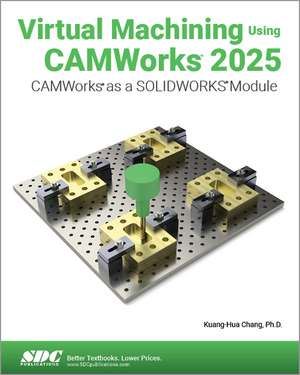
Virtual Machining Using CAMWorks 2025: CAMWorks as a SOLIDWORKS Module
Autor Kuang-Hua Changen Limba Engleză Paperback – 7 ian 2026
În domeniul proiectării asistate de calculator (CAD) și al fabricației (CAM), integrarea fluxurilor de lucru este esențială pentru eficiența industrială. Virtual Machining Using CAMWorks 2025 abordează această necesitate prin prisma utilizării CAMWorks ca modul nativ în SOLIDWORKS. Observăm o abordare tehnică riguroasă, menită să transforme un utilizator novice într-unul de nivel intermediar, capabil să simuleze operații complexe înainte ca piesa să ajungă pe mașina CNC.
Structura volumului este organizată progresiv în zece lecții practice. Descoperim aici parcursul complet de la extracția trăsăturilor prelucrabile (machinable features) și selectarea sculelor, până la definirea parametrilor de așchiere și generarea traiectoriilor. Complementar volumului Machining Simulation Using SOLIDWORKS CAM 2025, această lucrare se concentrează pe funcționalitățile specifice CAMWorks, oferind un nivel suplimentar de control prin verificarea datelor CL (cutter location) și analiza codurilor G generate. În timp ce alte resurse precum SolidWorks CAM 2020 Black Book (Colored) pun accent pe metodologia pas-cu-pas generală, Kuang-Hua Chang insistă asupra validării tehnice a post-procesării.
Autorul continuă linia metodologică stabilită în lucrările sale anterioare, precum Motion Simulation and Mechanism Design with SOLIDWORKS Motion 2024, păstrând un stil de prezentare tip tutorial. Reținem atenția deosebită acordată atât frezării pe mai multe axe, cât și strunjirii, elemente care permit inginerilor să identifice coliziunile sculei sau erorile de suprafață încă din faza de design. Finalitatea practică este dublată de capacitatea software-ului de a estima costurile de producție pe baza timpului de prelucrare simulat, un aspect critic în managementul industrial modern.
Preț: 421.11 lei
Preț vechi: 526.40 lei
-20%
Carte disponibilă
Livrare economică 23 octombrie-06 noiembrie
Livrare express 08-14 octombrie pentru 29.41 lei
Specificații
ISBN-10: 1630577227
Pagini: 200
Dimensiuni: 210 x 280 mm
Greutate: 0.42 kg
Ediția:1
Editura: SDC Publications
Colecția SDC Publications
Public țintă
Undergraduate AdvancedDe ce să citești această carte
Recomandăm această resursă studenților de la facultățile de inginerie și specialiștilor care utilizează SOLIDWORKS și doresc să stăpânească CAMWorks pentru simulări virtuale. Cititorul câștigă competențe practice în generarea de coduri G și optimizarea proceselor de fabricație, reducând riscul de erori costisitoare pe podeaua de producție. Este un ghid esențial pentru tranziția de la designul teoretic la prelucrarea mecanică aplicată.
Descriere scurtă
The book covers the basic concepts and frequently used commands and options you’ll need to know to advance from a novice to an intermediate level CAMWorks user. Basic concepts and commands introduced include extracting machinable features (such as 2.5 axis features), selecting machine and tools, defining machining parameters (such as feed rate), generating and simulating toolpaths, and post processing CL data to output G-codes for support of CNC machining. The concepts and commands are introduced in a tutorial style presentation using simple but realistic examples. Both milling and turning operations are included.
One of the unique features of this book is the incorporation of the CL (cutter location) data verification by reviewing the G-codes generated from the toolpaths. This helps you understand how the G-codes are generated by using the respective post processors, which is an important step and an ultimate way to confirm that the toolpaths and G-codes generated are accurate and useful.
This book is intentionally kept simple. It primarily serves the purpose of helping you become familiar with CAMWorks in conducting virtual machining for practical applications. This is not a reference manual of CAMWorks. You may not find everything you need in this book for learning CAMWorks. But this book provides you with basic concepts and steps in using the software, as well as discussions on the G-codes generated. After going over this book, you will develop a clear understanding in using CAMWorks for virtual machining simulations, and should be able to apply the knowledge and skills acquired to carry out machining assignments and bring machining consideration into product design in general.
Who this book is for
This book should serve well for self-learners. A self-learner should have a basic physics and mathematics background. We assume that you are familiar with basic manufacturing processes, especially milling and turning. In addition, we assume you are familiar with G-codes. A self-learner should be able to complete the ten lessons of this book in about forty hours.
This book also serves well for class instructions. Most likely, it will be used as a supplemental reference for courses like CNC Machining, Design and Manufacturing, Computer-Aided Manufacturing, or Computer-Integrated Manufacturing. This book should cover four to five weeks of class instructions, depending on the course arrangement and the technical background of the students.
What is virtual machining?
Virtual machining is the use of simulation-based technology, in particular, computer-aided manufacturing (CAM) software, to aid engineers in defining, simulating, and visualizing machining operations for parts or assembly in a computer, or virtual, environment. By using virtual machining, the machining process can be defined and verified early in the product design stage. Some, if not all, of the less desirable design features in the context of part manufacturing, such as deep pockets, holes or fillets of different sizes, or cutting on multiple sides, can be detected and addressed while the product design is still being finalized. In addition, machining-related problems, such as undesirable surface finish, surface gouging, and tool or tool holder colliding with stock or fixtures, can be identified and eliminated before mounting a stock on a CNC machine at shop floor. In addition, manufacturing cost, which constitutes a significant portion of the product cost, can be estimated using the machining time estimated in the virtual machining simulation.
Virtual machining allows engineers to conduct machining process planning, generate machining toolpaths, visualize and simulate machining operations, and estimate machining time. Moreover, the toolpaths generated can be converted into NC codes to machine functional parts as well as die or mold for part production. In most cases, the toolpath is generated in a so-called CL data format and then converted to G-codes using respective post processors.