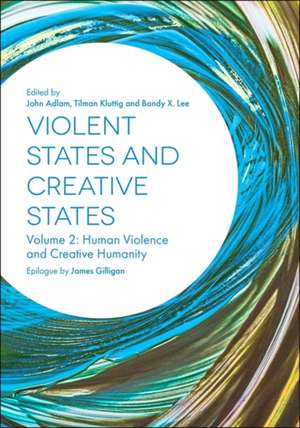
Violent States and Creative States (Volume 2): Human Violence and Creative Humanity
Editat de John Adlam, Tilman Kluttig, Bandy Leeen Limba Engleză Paperback – 3 mai 2018
Other research often stops short at examining the causes and risk factors for violence, without considering the opposite states that may not only mitigate, but allow for a different unfolding of individual and societal evolution. As a potential antidote to violence, the authors prescribe an understanding of these 'creative states' with their psychological origins, and their importance in human behaviour and meaning-seeking. Making a call to move beyond merely mitigating violence to the opposite direction of fostering creative potential, this book is foundational in its capacity to cultivate social consciousness and effect positive change in areas of governance, policy-making, and collective responsibility.
Volume 2: Human Violence and Creative Humanity explores violent states of mind, behavioural or subjective, interpersonal violence (including self-injury) and the fine distinctions between violent and creative states of mind.
Preț: 315.24 lei
Preț vechi: 417.73 lei
-25%
Puncte Express: 473
Carte disponibilă
Livrare economică 16-30 noiembrie
Livrare prin curier în România Termenul estimat este afișat lângă disponibilitate.
Transport gratuit de la 400.00 lei Plată online sau ramburs, în funcție de opțiunile comenzii.
Retur gratuit în 14 zile Comandă securizată și suport în română.
Specificații
ISBN-13: 9781785925658
ISBN-10: 1785925652
Pagini: 264
Dimensiuni: 176 x 247 x 15 mm
Greutate: 0.47 kg
Editura: JESSICA KINGSLEY PUBLISHERS
Colecția Jessica Kingsley Publishers
Locul publicării:London, United Kingdom
ISBN-10: 1785925652
Pagini: 264
Dimensiuni: 176 x 247 x 15 mm
Greutate: 0.47 kg
Editura: JESSICA KINGSLEY PUBLISHERS
Colecția Jessica Kingsley Publishers
Locul publicării:London, United Kingdom
Recenzii
In this superbly informative and inspiring collection, various forms and manifestations of violence and of violent states of mind and of society are analyzed and countered by creative alternatives. Volume 2 focuses on the origins and aftermath of individual violent states of mind and violence directed towards self or others and describes how psychotherapeutic, psychosocial and activist interventions can provide and promote creative alternatives. This volume is a treasure trove for everybody in all the many fields of violence reduction.
This is a magnificent book. In the introduction there is a half apology that it is not aiming to be encyclopaedic, but it is amongst the most encyclopaedic accounts of violence, its many threads, and especially its structural roots, that I have encountered. Diverse, experienced, expert and coherent chapters moving from the political/structural to the intrapsychic, and back and forth between violence, and its proposed antidote, creativity. I thoroughly recommend this book, not just to those whose interest is therapeutic, but to those who really ought to be reading it because their hands are on levers of power.
How does healthy aggression become pathological violence? How do victims become perpetrators? In part two of Violent and Creative States leading experts in the field focus on developmental and clinical aspects of human violence and show how therapeutic, not punitive, interventions can lead to rehabilitation, recovery and restitution. I highly recommend this book to all those working with violent individuals and groups in health, social and legal settings.
Violence is vital for human survival - protective as well as destructive. But violence begets violence, the cycle only being defeated by love's power, as Martin Luther King Jr. reminded. The editors have selected contributors who have axes to grind, in protecting matters close to their hearts. Contributions model creative, non-violent, responses to violent attacks, via channelling their authors' violent impulses into rational arguments and urgings. Do not skim-read this book. Dip in; pick out; read; muse; rest; and repeat.
This is a magnificent book. In the introduction there is a half apology that it is not aiming to be encyclopaedic, but it is amongst the most encyclopaedic accounts of violence, its many threads, and especially its structural roots, that I have encountered. Diverse, experienced, expert and coherent chapters moving from the political/structural to the intrapsychic, and back and forth between violence, and its proposed antidote, creativity. I thoroughly recommend this book, not just to those whose interest is therapeutic, but to those who really ought to be reading it because their hands are on levers of power.
How does healthy aggression become pathological violence? How do victims become perpetrators? In part two of Violent and Creative States leading experts in the field focus on developmental and clinical aspects of human violence and show how therapeutic, not punitive, interventions can lead to rehabilitation, recovery and restitution. I highly recommend this book to all those working with violent individuals and groups in health, social and legal settings.
Violence is vital for human survival - protective as well as destructive. But violence begets violence, the cycle only being defeated by love's power, as Martin Luther King Jr. reminded. The editors have selected contributors who have axes to grind, in protecting matters close to their hearts. Contributions model creative, non-violent, responses to violent attacks, via channelling their authors' violent impulses into rational arguments and urgings. Do not skim-read this book. Dip in; pick out; read; muse; rest; and repeat.
Cuprins
Part I: Introductorily and Theoretically. 1. The Microcosm of Aggression: Early Parent-Child Interaction and the Struggle for Separation, Reinmar Du Bois. 2. Bad to the Bone or Breaking Bad?: A Developmental View of Violent States of Mind, Maggie McAlister. 3. The Pathological Third, Violence and Reality: Psychological Pathways to Violence in Psychosis and Narcissism, Clinton Van Der Walt. Part II: Violent States of Mind. 4. Is There a Murderer Here? : The Language of Agency and Violence in Homicide Perpetrators, Gwen Adshead, Zoe Berko, Sarita Bose, Martha Ferrito and Martina Mindang. 5. Forever Hungry for Her Eyes: The Pain of Maternal Absence, Anna Motz. 6. Violent States in Feeding Distress: The Antigone Paradigm and the Creative Possibilities of Collective Re-Imagining, John Adlam. 7. Anorexia Mirabilis: Voluntary Self Starvation and the Role of Spirituality as a Legitimate Response to Sexual Violence, Robyn Timoclea. 8. Violence, Rage and Creativity, Deborah J. Cohan. Part III: Terror in the Private Sphere. 9. Breaking into a Sacred, Bloodier Speech: The Healing Role of Monsters in Child Development, Trauma Play, and the Cultural Imagination, Claude Barbre and Jill Barbre. 10. 'You be the murderer now', Tamsin Cottis. 11. Into the Labyrinth: Working with Bizarre, Unspeakable and Extreme Violence, Sarita Bose, Martha Ferrito, Alex Maguire, Martina Mindang and Andrew Ware. 12. Treat Me Nice: Music Therapy and Extreme Violence, Alex Maguire. Part IV: Creative Approaches - From the Global to the Individual. 13. Restorative Justice Applications in Mental Health Settings: Pathways to Recovery and Restitution, Gerard Drennan. 14. Violent Acts and Creative Responses: Resilience Building Through Art Psychotherapy, Kate Rothwell and Simon Hackett. 15. Spiritual Movements as Creative Forms of Response to Structural Violence, James S. Vrettos. 16. Violent states and existential-therapeutic work in Mexican ex voto painting, Wayne Martin. Epilogue, James Gilligan.