Descriere scurtă
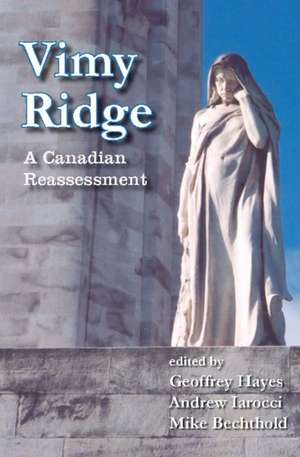
On the morning of April 9, 1917, troops of the Canadian Corps under General Julian Byng attacked the formidable German defences of Vimy Ridge. Since then, generations of Canadians have shared a deep emotional attachment to the battle, inspired partly by the spectacular memorial on the battlefield. Although the event is considered central in Canadian military history, most people know very little about what happened during that memorable Easter in northern France. Vimy Ridge: A Canadian Reassessment draws on the work of a new generation of scholars who explore the battle from three perspectives. The first assesses the Canadian Corps within the wider context of the Western Front in 1917. The second explores Canadian leadership, training, and preparations and details the story of each of the four Canadian divisions. The final section concentrates on the commemoration of Vimy Ridge, both for contemporaries and later generations of Canadians. This long-overdue collection, based on original research, replaces mythology with new perspectives, new details, and a new understanding of the men who fought and died for the remarkable achievement that was the Battle of Vimy Ridge. Co-published with the Laurier Centre for Military, Strategic and Disarmament Studies
Cuprins
Table of Contents for Vimy Ridge: A Canadian Reassessment , edited by Geoffrey Hayes, Andrew Iarocci, and Mike Bechthold List of Illustrations Foreword Acknowledgements Introduction Part I: The Strategic Background 1. Vimy Ridge and the Battle of Arras: A British Perspective | Gary Sheffield 2. The End of the Beginning: The Canadian Corps in 1917 | Paul Dickson 3. Vimy Ridge: The Battlefield before the Canadians, 19141916 | Michael Boire Part II: The Battle for Vimy Ridge, 912 April 1917 4. Old Wine in New Bottles: A Comparison of British and Canadian Preparations for the Battle of Arras | Mark Osborne Humphries 5. Julian Byng and Leadership in the Canadian Corps | Patrick Brennan 6. The Gunners at Vimy: We are Hammering Fritz to Pieces | Tim Cook 7. The Sappers of Vimy: Specialized Support for the Assault of 9 April 1917 | Bill Rawling 8. The Canadian Army Medical Corps at Vimy Ridge | Heather Moran 9. The 1st Canadian Division: An Operational Mosaic | Andrew Iarocci 10. The 2nd Canadian Division: A Most Spectacular Battle | David Campbell 11. The 3rd Canadian Division: Forgotten Victory | Geoffrey Hayes 12. The 4th Canadian Division: Trenches Should Never be Saved | Andrew Godefroy 13. The German Army at Vimy Ridge | Andrew Godefroy 14. In the Shadow of Vimy Ridge: The Canadian Corps in April and May 1917 | Mike Bechthold Part III: Aftermath and Memory 15. Battle Verse: Poetry and Nationalism after Vimy Ridge | Jonathan Vance 16. After the Agony in Stony Places The Meaning and Significance of the Vimy Monument | Jacqueline Hucker 17. Safeguarding Sanctity: Canada and the Vimy Memorial during the Second World War | Serge Durflinger 18. Afterthoughts | The Editors Appendices 1. Order of BattleVimy Ridge 2. Lest We Forget: The Men of Vimy Ridge Selected Bibliography Contributors Index Contributors Bios Mike Bechthold is the managing editor of Canadian Military History and the Communications Director of the Laurier Centre for Military Strategic and Disarmament Studies. He teaches military history at Wilfrid Laurier University. Michael Boire is a graduate of Loyola College, Montral, the Royal Military College of Canada, Kingston and the Ecole suprieure de Guerre, Paris. He teaches Canadian military history at the Royal Military College. Patrick Brennan earned his PhD from York University. He is an associate professor in the history department at the University of Calgary, where he is a fellow in the Centre for Military and Strategic Studies. His research interests focus on the Canadian Expeditionary Force. He is currently working on a study of senior commanders in the Canadian Corps Curries and Byngs Commanders: A Study in Military Leadership during the Great War . David Campbell completed his graduate studies in history at the University of Calgary where he specialized in military history. His major area of research is the social and operational history of the Canadian Expeditionary Force during the First World War. He currently resides and teaches in Halifax, Nova Scotia. Tim Cook is the First World War historian at the Canadian War Museum, where he recently curated the South African and First World War permanent gallery. His first book, No Place To Run: The Canadian Corps and Gas Warfare in the First World War (2000) won the C.P. Stacey award for the best book on military history published in Canada or written by a Canadian that year. His second book, Clios Warriors: Canadian Historians and the Writing of the World Wars was published in 2006. Paul Dickson is a strategic analyst and military historian with the Centre for Operational Research and Analysis at the Department of National Defence. He has published articles on leadership and operations during the First and Second World Wars in, among others, The Journal of Military History , War and Society and Canadian Military History . Serge Durflinger is an assistant professor in the Department of History at the University of Ottawa. From 1998 to 2003 he served as an historian at the Canadian War Museum in Ottawa. He is the author of Lest We Forget , a history of the Last Post Fund of Canada and Fighting From Home (2006) an exploration of the Second World Wars impact on the bilingual community of Verdun, Qubec. Andrew B. Godefroy is a strategic analyst working with the Canadian Armys Directorate of Land Strategic Concepts, as well as Director of the Fort Frontenac Army Library and Managing Editor of The Canadian Army Journal and The Canadian Army Reading List . A military field engineer officer of sixteen years service, he is currently completing a study of the conceptual and doctrinal evolution of the Canadian Army after the Korean War. Geoffrey Hayes is an associate professor of history at the University of Waterloo. He is the author of The Lincs: A History of the Lincoln and Welland Regiment at War, 19391945 (1986) and Waterloo County: An Illustrated History (1997). He is also the associate director of the Laurier Centre for Military Strategic and Disarmament Studies at Wilfrid Laurier University. Hayes has led many Canadians on tours of the battlefields of Northwest Europe, including Vimy Ridge. Jacqueline Hucker holds a BA in art history from Queens University and an MA in Canadian Studies from Carleton University, with a concentration on First World War art. She is the manager of the Federal Heritage Buildings Review Office, Parks Canada, and is also the historian on the conservation team that restored the Vimy Monument in France. Mark Osborne Humphries is a doctoral candidate and the Sir John A. Macdonald Graduate Fellow in Canadian History at the University of Western Ontario. His dissertation is titled The Horror at Home: Canadians and the Great Influenza Pandemic of 19181919. He has also completed a study of shell shock in the Canadian Expeditionary Force during the First World War. Andrew Iarocci recently completed an R.B. Byers Postdoctoral Research Fellowship with the Department of National Defence and now teaches military history at Wilfrid Laurier University and the University of Western Ontario. His publications include Canadian Forces Base Petawawa: The First Century (2005). Currently he is writing a monograph on the overseas training and combat operations of 1st Canadian Division during 191415. Iarocci has directed several tours of Canadas First and Second World War battlefields in recent years. Heather Moran is a graduate of the University of Waterloo and Wilfrid Laurier University. She is currently a doctoral candidate at the University of Western Ontario studying the Canadian medical services during the First World War. Bill Rawling, a graduate of the University of Ottawa and the University of Toronto, is the author of Surviving Trench Warfare: Technology and the Canadian Corps, 19141918 ; Technicians of Battle: Canadian Field Engineering from Pre-Confederation to the Post-Cold War Era , and Canadas Sappers: A History of 3rd Field Engineer Squadron . He is currently a researcher for the Department of National Defence in Ottawa. Gary Sheffield is a professor of war studies at the University of Birmingham, in the United Kingdom. He previously taught modern history at King&38217;s College London, based at the Joint Services Command and Staff College, Shrivenham. His most recent book, co-edited with John Bourne, is Douglas Haig: War Diaries and Letters 19141918 (2005). Sheffield is working on a biography of Douglas Haig and a book on the experience of the British soldier in the Second World War. Jonathan Vance holds the Canada Research Chair in Conflict and Culture in the Department of History at The University of Western Ontario. He is the author of numerous books and articles, including Death So Noble: Memory, Meaning, and the First World War (1997), High Flight: Aviation and the Canadian Imagination (2002), A Gallant Company: The True Story of The Great Escape (2003), and Building Canada: People and Projects that Shaped the Nation (2006).
 Myths & Legends of the First World WarJames Hayward-27%Preț: 66.14 lei91.14 lei
 Forgotten Battlefronts of the First World WarMartin Marix EvansPreț: 131.36 lei
 Washington SquareHenry JamesPreț: 28.01 lei
 Benny and Penny in the Big No-No!Geoffrey HayesPreț: 42.17 lei