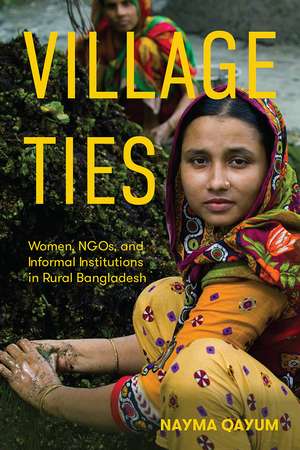
Village Ties: Women, NGOs, and Informal Institutions in Rural Bangladesh
Autor Nayma Qayumen Limba Engleză Paperback – 12 noi 2021 – vârsta ani
Preț: 244.12 lei
Puncte Express: 366
Carte disponibilă
Livrare economică 02-16 noiembrie
Livrare express 16-22 octombrie pentru 26.95 lei
Livrare prin curier în România Termenul estimat este afișat lângă disponibilitate.
Transport gratuit de la 400.00 lei Plată online sau ramburs, în funcție de opțiunile comenzii.
Retur gratuit în 14 zile Comandă securizată și suport în română.
Specificații
ISBN-13: 9781978816442
ISBN-10: 1978816448
Pagini: 230
Ilustrații: 15 b-w images, 9 tables
Dimensiuni: 152 x 229 x 18 mm
Greutate: 0.34 kg
Editura: Rutgers University Press
Colecția Rutgers University Press
ISBN-10: 1978816448
Pagini: 230
Ilustrații: 15 b-w images, 9 tables
Dimensiuni: 152 x 229 x 18 mm
Greutate: 0.34 kg
Editura: Rutgers University Press
Colecția Rutgers University Press
Notă biografică
NAYMA QAYUM is an associate professor of Asian studies and global and international studies at Manhattanville College in Purchase, New York.
Cuprins
List of Figures
List of Tables
List of Abbreviations
Prologue
PART I Setting the Stage
1 Institutions
2 A Gendered Story
3 Poor Women’s Politics
PART II Formal and Informal Institutions
4 Clients, Rules, and Transactions
5 Rule of Law
PART III Negotiating with State and Society
6 Changing Distributive Politics
7 Negotiating Justice
8 Governing Locally
Conclusion
Appendix
Acknowledgments
Glossary of Terms
Notes
Bibliography
Index
List of Tables
List of Abbreviations
Prologue
PART I Setting the Stage
1 Institutions
2 A Gendered Story
3 Poor Women’s Politics
PART II Formal and Informal Institutions
4 Clients, Rules, and Transactions
5 Rule of Law
PART III Negotiating with State and Society
6 Changing Distributive Politics
7 Negotiating Justice
8 Governing Locally
Conclusion
Appendix
Acknowledgments
Glossary of Terms
Notes
Bibliography
Index
Descriere
Village Ties argues that grassroots women’s mobilization programs can empower poor women to challenge oppressive informal institutions – the rules of the game – that govern relationships between actors in the rural global South. By exploring the activities of women who belong to Polli Shomaj, an initiative of the development organization BRAC, Village Ties challenges stereotypes of poor Muslim women as backward, subservient, oppressed, and in need of saving.