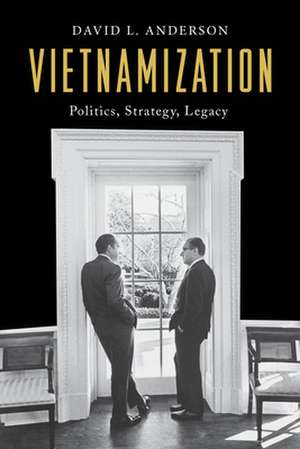
Vietnamization: Politics, Strategy, Legacy: Vietnam: America in the War Years
Autor David L. Andersonen Limba Engleză Hardback – 31 oct 2019



Preț: 273.13 lei
Preț vechi: 354.40 lei
-23%
Puncte Express: 410
Carte tipărită la comandă
Livrare economică 27 noiembrie-11 decembrie
Livrare prin curier în România Termenul estimat este afișat lângă disponibilitate.
Transport gratuit de la 400.00 lei Plată online sau ramburs, în funcție de opțiunile comenzii.
Retur gratuit în 14 zile Comandă securizată și suport în română.
Specificații
ISBN-13: 9781538129364
ISBN-10: 1538129361
Pagini: 208
Ilustrații: 8 b/w photos
Dimensiuni: 154 x 232 x 18 mm
Greutate: 0.45 kg
Editura: Bloomsbury Publishing
Colecția Rowman & Littlefield
Seria Vietnam: America in the War Years
Locul publicării:New York, United States
ISBN-10: 1538129361
Pagini: 208
Ilustrații: 8 b/w photos
Dimensiuni: 154 x 232 x 18 mm
Greutate: 0.45 kg
Editura: Bloomsbury Publishing
Colecția Rowman & Littlefield
Seria Vietnam: America in the War Years
Locul publicării:New York, United States
Recenzii
An outstanding blend of memoir and historical research from one of the nation's leading scholars on the American war in Vietnam. David Anderson had produced a one-of-a-kind book on Nixon's Vietnamization policy that initiated the withdrawal of US forces from Southeast Asia. It is an immensely insightful read that is both personal and fair, a work that will become indispensable for understanding why and how the United States departed from the longest, most unsatisfactory conflict of the Cold War era.
Based on recently declassified records, the latest scholarship, and his own experience serving in Vietnam, David Anderson's Vietnamization, is an original and welcome study of President Richard Nixon's Vietnam policy and how the Vietnam War ended. Anderson analysis of Nixon's policy demonstrates that Vietnamization did not work and could not work given the realities of the war. In the process, he successfully rebuts the "revisionists" claims about victory. Moreover, Anderson shows the parallels with Iraq and the misunderstanding of the lessons about counterinsurgency from the Vietnam War. Vietnamization should be read by scholars and students of the Vietnam War, and practitioners of American foreign policy, alike.
David Anderson solidified long ago his renown as one of the best Vietnam War scholars of his generation. This latest book is a testament to his erudition. It sheds revealing new light on a critical aspect of the war on the basis of an impressive array of pertinent sources. It also reminds us that despite the passage of time, the Vietnam War still matters a great deal to American civilian and military decision-makers
.
In this authoritative study, David Anderson reveals both the deep roots and the lasting costs of Richard Nixon's failed attempts to "Vietnamize" the Vietnam War. By combining extensive archive research with his own experiences in Vietnam as a sergeant in the U.S. Army Signal Corps, Anderson shows that Vietnamization was neither innovative nor militarily effective. But the myths that Nixon and his supporters spun about Vietnamization had a long half-life, as shown by their later re-emergence in America's counterinsurgency wars in Afghanistan and Iraq. A masterful re-interpretation by a leading scholar of Vietnam War history.
Students and scholars of the Vietnam War have long benefitted from David Anderson, a leading authority on American intervention in Southeast Asia. Now we are once again in his debt. The history of Vietnamization has not been told like this. Tapping into archival sources in the Nixon era and his own personal experience serving during this critical period, Anderson has written a powerful history on the fraught withdrawal of U.S. forces from Vietnam, and what that complicated process means for U.S. intervention today.
Based on recently declassified records, the latest scholarship, and his own experience serving in Vietnam, David Anderson's Vietnamization, is an original and welcome study of President Richard Nixon's Vietnam policy and how the Vietnam War ended. Anderson analysis of Nixon's policy demonstrates that Vietnamization did not work and could not work given the realities of the war. In the process, he successfully rebuts the "revisionists" claims about victory. Moreover, Anderson shows the parallels with Iraq and the misunderstanding of the lessons about counterinsurgency from the Vietnam War. Vietnamization should be read by scholars and students of the Vietnam War, and practitioners of American foreign policy, alike.
David Anderson solidified long ago his renown as one of the best Vietnam War scholars of his generation. This latest book is a testament to his erudition. It sheds revealing new light on a critical aspect of the war on the basis of an impressive array of pertinent sources. It also reminds us that despite the passage of time, the Vietnam War still matters a great deal to American civilian and military decision-makers
.
In this authoritative study, David Anderson reveals both the deep roots and the lasting costs of Richard Nixon's failed attempts to "Vietnamize" the Vietnam War. By combining extensive archive research with his own experiences in Vietnam as a sergeant in the U.S. Army Signal Corps, Anderson shows that Vietnamization was neither innovative nor militarily effective. But the myths that Nixon and his supporters spun about Vietnamization had a long half-life, as shown by their later re-emergence in America's counterinsurgency wars in Afghanistan and Iraq. A masterful re-interpretation by a leading scholar of Vietnam War history.
Students and scholars of the Vietnam War have long benefitted from David Anderson, a leading authority on American intervention in Southeast Asia. Now we are once again in his debt. The history of Vietnamization has not been told like this. Tapping into archival sources in the Nixon era and his own personal experience serving during this critical period, Anderson has written a powerful history on the fraught withdrawal of U.S. forces from Vietnam, and what that complicated process means for U.S. intervention today.