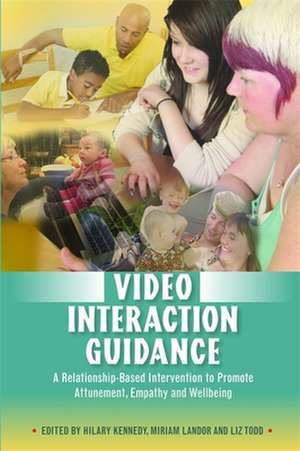
Video Interaction Guidance: A Relationship-Based Intervention to Promote Attunement, Empathy and Wellbeing
Contribuţii de Katerina Silhánová, Ruth Cave, Rubin Fukkink, Michelle Sancho, Maria Doria, Jacqueline Bristow, Denise McCartan, Henk Vermeulen, Carole S. Chasle Editat de Miriam Landor Contribuţii de Colwyn Trevarthen, Katarina Silhanova, Richard Young, Nelleke Polderman, Jenny Jarvis, Carole Chasle, Calum Strathie, Heather Sked, Mariska Klein Klein Velderman, Maria V. Doria, Sandra Strathie, Ruben Fukkink Editat de Liz Todd Contribuţii de Penny Forsyth, Wilma Barrow Editat de Hilary Kennedy Contribuţii de Angela Roger, Jenny Cross, Deborah James, David Gavineen Limba Engleză Paperback – 15 aug 2011
Bringing together contributions from researchers and practitioners across a range of professions, this book provides a definitive introduction to VIG. The book explains the theory behind the approach, reviews research evidence, and offers case studies that document how VIG has been successfully applied to family relationships, schools and higher education, individuals with communication and developmental disorders, and as a reflective professional development tool. The approach is then discussed from a range of theoretical perspectives and within the contexts of narrative therapy, infant and attachment interventions, positive psychology and mindfulness.
This authoritative and comprehensive guide to VIG will be an important text for psychologists, psychiatrists, counsellors, social workers, therapists, and mental health and education professionals, as well as students and academics in these fields.
Preț: 317.90 lei
Preț vechi: 396.74 lei
-20%
Puncte Express: 477
Carte disponibilă
Livrare economică 06-20 noiembrie
Livrare prin curier în România Termenul estimat este afișat lângă disponibilitate.
Transport gratuit de la 400.00 lei Plată online sau ramburs, în funcție de opțiunile comenzii.
Retur gratuit în 14 zile Comandă securizată și suport în română.
Specificații
ISBN-13: 9781849051804
ISBN-10: 1849051801
Pagini: 336
Ilustrații: Illustrations
Dimensiuni: 150 x 228 x 20 mm
Greutate: 0.5 kg
Editura: JESSICA KINGSLEY PUBLISHERS
Colecția Jessica Kingsley Publishers
Locul publicării:London, United Kingdom
ISBN-10: 1849051801
Pagini: 336
Ilustrații: Illustrations
Dimensiuni: 150 x 228 x 20 mm
Greutate: 0.5 kg
Editura: JESSICA KINGSLEY PUBLISHERS
Colecția Jessica Kingsley Publishers
Locul publicării:London, United Kingdom
V-ar putea interesa
-
 -5%Preț: 320.59 lei337.46 lei
 -
 Islamic Counselling: An Introduction to theory and practiceG. Hussein Rassool-5%Preț: 446.80 lei470.31 lei
 -
 Couple, Marriage, and Family Therapy SupervisionKarin B. Jordan-5%Preț: 609.56 lei641.64 lei
 -
 The School-To-Prison Pipeline: A Comprehensive AssessementChristopher A. MallettPreț: 376.62 lei
 -
 -5%Preț: 280.73 lei295.50 lei
 -
 Evidence-based Approaches to Relationship and Marriage EducationJr. James J. Ponzetti-17%Preț: 437.43 lei525.78 lei
 -
 Preț: 337.78 lei
 -
 Preț: 308.85 lei
 -
 Group Work in SchoolsBradley T Erford-15%Preț: 491.84 lei578.63 lei
 -
 -5%Preț: 482.64 lei508.04 lei
 -
 -5%Preț: 316.32 lei332.97 lei
 -
 Coming Through the WhirlwindMichael Eigen-5%Preț: 138.53 lei145.82 lei
 -
 -29%Preț: 204.98 lei289.58 lei
 -
 -30%Preț: 174.59 lei248.93 lei
 -
 Passionate SupervisionAnna Chesner-26%Preț: 185.05 lei249.73 lei
 -
 -26%Preț: 215.61 lei290.03 lei
 -
 Evidence-based Parenting Education: A Global PerspectiveJames Ponzetti, Jr.-5%Preț: 1815.55 lei1911.11 lei
 -
 Evidence-based Parenting Education: A Global PerspectiveJames Ponzetti, Jr.-5%Preț: 567.18 lei597.02 lei
 -
 Preț: 179.27 lei
 -
 -23%Preț: 266.42 lei347.97 lei
 -
 -26%Preț: 186.37 lei250.56 lei
 -
 -30%Preț: 168.65 lei239.43 lei
 -
 -21%Preț: 142.10 lei179.94 lei
 -
 -24%Preț: 259.13 lei339.22 lei
 -
 Being and AwesomenessTiffany TuttlePreț: 82.77 lei
Recenzii
This book is the first to offer a comprehensive introduction to Video Interaction Guidance (VIG), together with an accessible account of the strands of theory and research underpinning the approach. It provides a much needed resource for both practitioners and trainers in the fields of psychology, social work and education. Particular strengths are the wide range of applications that are described in detail and the illustration provided throughout the book by case studies and session transcript material. Connections with other perspectives and approaches are explored and encouraged in a book that is likely to inspire further development and research in VIG, as well as stimulating interest and engagement more broadly among practitioners.
This is a book of hope. It shows us a way out of the despair of social dysfunction, a way out of continuing with relationship patterns that have become jagged and draining. The contributors to this volume show us repeatedly that, when we are supported to look anew at the way we relate to others, then we come to see both ourselves and our partners in a new light. Joy and growth can be restored to relationships from this reflexive stance. The range of evidence that Kennedy, Landor and Todd have been able to gather together provides a convincing case for Video Interaction Guidance as a therapeutic approach that nurtures lasting behavioural change. It also becomes clear that VIG requires only a modest investment of time or money. The reader begins to feel that VIG is best described not as a method for nurturing behavioural change, but as a method for nurturing compassion.
A therapy that promotes interactive attunement between adults and children is taking the world of therapy by surprise. With the help of a simple video camera focusing on the good moments of human interaction, however limited these may be, its practitioners empower their clients, bring a smile to their wary faces and achieve real positive changes in the attachment of their children. Not only is it accessible to all who wish to train under supervision, it is also cost effective and cross-culturally applicable. If you are now curious to know more don't hesitate to buy this exciting new book on Video Interaction Guidance written by eminent practitioners and researchers in what is a promising new development in the therapeutic field of change through mentalisation.
This excellent book on Video Interaction Guidance, edited by leading experts, should be read by everyone interested in promoting sensitive parent-infant interaction in infancy and supporting vulnerable families. It provides highly accessible descriptions of the approach, its application across a range of settings, and the evidence about its effectiveness. Video Interaction Guidance is undoubtedly an intervention whose time has arrived, and we need wide-ranging groups of practitioners including midwives, health visitors and social workers, to develop the necessary knowledge and skills to intervene with families using this highly effective method of working to bring about change. This book will be an important first step in achieving that.
This is an inspiring book for anyone engaged in working with young children with disabilities and their families, and should serve to broaden the understanding of how powerful this approach can be. However, regardless of our field of work, anyone whose life and work involves interaction and communication with people we care about, including our children, partners, friends and colleagues, might benefit from reading a few chapters from it.
This is a book of hope. It shows us a way out of the despair of social dysfunction, a way out of continuing with relationship patterns that have become jagged and draining. The contributors to this volume show us repeatedly that, when we are supported to look anew at the way we relate to others, then we come to see both ourselves and our partners in a new light. Joy and growth can be restored to relationships from this reflexive stance. The range of evidence that Kennedy, Landor and Todd have been able to gather together provides a convincing case for Video Interaction Guidance as a therapeutic approach that nurtures lasting behavioural change. It also becomes clear that VIG requires only a modest investment of time or money. The reader begins to feel that VIG is best described not as a method for nurturing behavioural change, but as a method for nurturing compassion.
A therapy that promotes interactive attunement between adults and children is taking the world of therapy by surprise. With the help of a simple video camera focusing on the good moments of human interaction, however limited these may be, its practitioners empower their clients, bring a smile to their wary faces and achieve real positive changes in the attachment of their children. Not only is it accessible to all who wish to train under supervision, it is also cost effective and cross-culturally applicable. If you are now curious to know more don't hesitate to buy this exciting new book on Video Interaction Guidance written by eminent practitioners and researchers in what is a promising new development in the therapeutic field of change through mentalisation.
This excellent book on Video Interaction Guidance, edited by leading experts, should be read by everyone interested in promoting sensitive parent-infant interaction in infancy and supporting vulnerable families. It provides highly accessible descriptions of the approach, its application across a range of settings, and the evidence about its effectiveness. Video Interaction Guidance is undoubtedly an intervention whose time has arrived, and we need wide-ranging groups of practitioners including midwives, health visitors and social workers, to develop the necessary knowledge and skills to intervene with families using this highly effective method of working to bring about change. This book will be an important first step in achieving that.
This is an inspiring book for anyone engaged in working with young children with disabilities and their families, and should serve to broaden the understanding of how powerful this approach can be. However, regardless of our field of work, anyone whose life and work involves interaction and communication with people we care about, including our children, partners, friends and colleagues, might benefit from reading a few chapters from it.
Cuprins
Preface. Hilary Kennedy, Educational Psychologist and Co-founder of the VEROC Centre, University of Dundee, UK. Part 1. Video Interaction Guidance. 1.What is Video Interaction Guidance (VIG)? Hilary Kennedy. 2. VIG and the Supervision Process. Kateøina Šilhánová, SPIN, Czech Republic and Michelle Sancho, Senior Educational Psychologist, West Berkshire Council and Honorary Lecturer, University College London, UK. 3. How and Why Does VIG Work? Jenny Cross, Freelance Educational Psychologist, VIG Supervisor and Coach, UK and Hilary Kennedy. 4. What is the Evidence that VIG is Effective? Ruben Fukkink, Researcher, University of Amsterdam, The Netherlands, Hilary Kennedy and Liz Todd, Professor of Educational Inclusion, Newcastle University, UK. Part 2. Applications of VIG. 5. VIG as a Method to Promote Sensitive Parent-Child Interaction in Infancy. Mariska Klein Velderman, TNO (Netherlands Organisation for Applied Scientific Research) Quality of Life, The Netherlands. 6. Supporting Vulnerable Families to Change through VIG. Maria V. Doria, Post-doctoral Researcher, University of Lisbon, Portugal and Honorary Research Fellow, University of East Anglia, UK, Calum Strathie, VIGuk Supervisor, UK and Sandra Strathie, VIGuk Supervisor and Social Worker, UK. 7. Use of VIG in Schools. David Gavine, formerly Principal Educational Psychologist, Dundee City Council, UK and Penny Forsyth, Senior Educational Psychologist, Dundee City Council and Co-founder of the VEROC Centre, University of Dundee, UK. 8. VIG when Working with Children and Adults on the Autistic Continuum. Penny Forsyth and Heather Sked, Educational Psychologist, The Highland Council, UK. 9. How VIG can Develop Partnerships with Parents/Educators in the Context of Childhood Hearing Impairment. Deborah James, National Institute of Health Research, Biomedical Research Unit in Hearing, Nottingham University, UK. 10. Video Enhanced Reflective Practice. Sandra Strathie, Calum Strathie and Hilary Kennedy. 11. Enhancing Teacher and Student Interactions in Higher Education through Video-Enhanced Reflection on Practice. Ruth Cave, Lecturer, University of Dundee, UK, Angela Roger, Senior Lecturer, University of Dundee, UK, and Richard Young, Professional Development Manager, Newcastle University, UK. Part 3. Connections. 12. Confirming Companionship in Interests, Intentions and Emotions: How VIG Works. Colwyn Trevarthen, Department of Psychology, University of Edinburgh, UK. 13. VIG and Attachment: Theory, Practice and Research. Jenny Jarvis, Chartered Counselling Psychologist and VIG Supervisor, South Lowestoft Children's Centres, UK and Nelleke Polderman, Founder and Director of Basic Trust, The Netherlands. 14. Video Feedforward: Towards a Preferred Future. Miriam Landor, Educational Psychologist, West Lothian Council and Lecturer, University of Dundee, UK and Calum Strathie. 15. Reflecting on VIG Practice from a Relational Systemic Perspective. Carole S. Chasle, Senior Educational Psychologist, Derbyshire County Council, UK. 16. Narrative Therapy and VIG: Windows into Preferred Identities. Denise McCartan, Stockton-on-Tees Educational Psychology Service, UK and Liz Todd. 17. Mindfulness, Attunement and VIG: Being Fully Present while Communicating. Henk Vermeulen, Mental Health Psychologist, Max Ernst GGZ, The Netherlands, Jacqueline Bristow, Chartered Educational Psychologist, UK, and Miriam Landor. 18. Beyond Therapy: Supporting a Culture of Relational Democracy. Wilma Barrow, Newcastle University and Scottish Borders Council, UK and Liz Todd. Glossary. References. The Contributors.