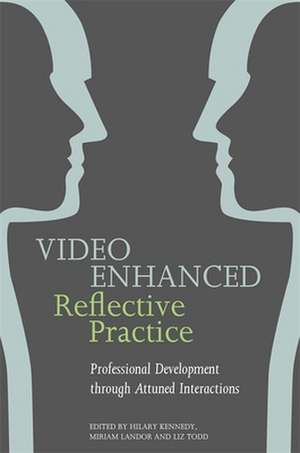
Video Enhanced Reflective Practice: Professional Development through Attuned Interactions
Contribuţii de Jo Birbeck, Emma Cartwright, Nancy Ferguson, Stephanie Satariano, Ruben Fukkink, Terri Pease, Kaisa Martikainen, Martin Elliott, Anna-Greta Ledin, Emily Archer, Clare Webster Editat de Liz Todd, Miriam Landor Contribuţii de Monika Celebi, Michelle Sancho, Joanna Begley, Fiona Williams, Carole Chasle, Bev Jowett, Cyril Hellier, Helen Upton, Robin Sen, Kirsty Quinn, Wilma Barrow, Helen Gibson, Alex Greene, Ben Hayes, Jenny Jarvis, Angela Underdown, Lucy Browne, Sandra Strathie, Susan Lyon, Jane Nestel-Patt, Maria V. Doria Editat de Hilary Kennedy Contribuţii de Katja Burakoff, Karen Williams, Lia van van Rosmalen, Sheridan Forster, Joanne Hewitt, Annemie Wetzelsen Limba Engleză Paperback – 21 apr 2015
This book brings together international researchers and practitioners from a range of professions to define VERP, present its theoretical basis and review the current research evidence. Increasing in popularity, VERP is used as a reflective professional development tool for a wide range of professionals and employees, supporting them to analyse and reflect on moments of their effective interaction on video, in situ in the professional environment. The VERP approach is optimistic and empowering, focusing on strength and potential rather than problems or weaknesses.
This book provides examples of VERP's application in a wide range of sectors and will be of interest to trainers, CPD providers, managers, psychologists, social workers, higher education educators, health visitors, early years professionals, teachers, counsellors, therapists, and professionals in the private, voluntary, government and local authority sectors.
Preț: 310.28 lei
Preț vechi: 389.71 lei
-20%
Puncte Express: 465
Carte disponibilă
Livrare economică 09-23 noiembrie
Livrare prin curier în România Termenul estimat este afișat lângă disponibilitate.
Transport gratuit de la 400.00 lei Plată online sau ramburs, în funcție de opțiunile comenzii.
Retur gratuit în 14 zile Comandă securizată și suport în română.
Specificații
ISBN-13: 9781849054102
ISBN-10: 184905410X
Pagini: 336
Ilustrații: B&w figures
Dimensiuni: 150 x 228 x 20 mm
Greutate: 0.49 kg
Editura: JESSICA KINGSLEY PUBLISHERS
Colecția Jessica Kingsley Publishers
Locul publicării:London, United Kingdom
ISBN-10: 184905410X
Pagini: 336
Ilustrații: B&w figures
Dimensiuni: 150 x 228 x 20 mm
Greutate: 0.49 kg
Editura: JESSICA KINGSLEY PUBLISHERS
Colecția Jessica Kingsley Publishers
Locul publicării:London, United Kingdom
V-ar putea interesa
-
 -15%Preț: 452.80 lei532.71 lei
 -
 Preț: 458.19 lei
 -
 TeacherTom Bennett-46%Preț: 124.91 lei229.99 lei
 -
 -24%Preț: 261.16 lei343.45 lei
 -
 Assessment as LearningLorna M. EarlPreț: 274.04 lei
 -
 Preț: 230.48 lei
Recenzii
Video Enhanced Reflective Practice is a dynamic 'complex and creative dance' in Landor, Kennedy and Todd's hands. They tell how videos create challenging 'retrospective mirrors', bringing practitioners face to face with themselves and previously unperceived elements, including unfounded assumptions. Hard questions are asked, helping practitioners develop greater understanding, trust in, and respect for, themselves and their clients.
What will strike any reader of this book is the diversity of contexts in which VERP has been developed. Instead of pigeon-holing the practice to a specific sector or desired outcomes the case studies illustrate both its core qualities and its dynamic flexibility. Unlike many new interventions, VERP has a genuine and authentic history of sustained development meaning that practices have become theorised and nuanced. VERP allows users to make change visible and thus persuades them that it is possible.
Video Enhanced Reflective Practice applies a new idea concerning how respectful responses to an individual's expressions of their purposes and concerns sustain thriving relationships; from infants and parents in families, through to the successful management of roles in a school, corporation or city. This path-finding book reports and explains the successes of VERP for many relationships across many countries.
I wish that this book had been around when we started to implement the VIG model in the area of helping professions. Reading the book brought back to me all the excitement I experienced when confronted with these ideas for the very first time. This same excitement was always present when I witnessed individuals change through using VERP. I hope the reader will find, in the breadth and depths of the projects described and in the enthusiasm of the participants, encouragement to start the VERP journey and inspiration for those readers already on it.
What will strike any reader of this book is the diversity of contexts in which VERP has been developed. Instead of pigeon-holing the practice to a specific sector or desired outcomes the case studies illustrate both its core qualities and its dynamic flexibility. Unlike many new interventions, VERP has a genuine and authentic history of sustained development meaning that practices have become theorised and nuanced. VERP allows users to make change visible and thus persuades them that it is possible.
Video Enhanced Reflective Practice applies a new idea concerning how respectful responses to an individual's expressions of their purposes and concerns sustain thriving relationships; from infants and parents in families, through to the successful management of roles in a school, corporation or city. This path-finding book reports and explains the successes of VERP for many relationships across many countries.
I wish that this book had been around when we started to implement the VIG model in the area of helping professions. Reading the book brought back to me all the excitement I experienced when confronted with these ideas for the very first time. This same excitement was always present when I witnessed individuals change through using VERP. I hope the reader will find, in the breadth and depths of the projects described and in the enthusiasm of the participants, encouragement to start the VERP journey and inspiration for those readers already on it.
Cuprins
Preface. Miriam Landor, AVIGuk supervisor and VIG, VERP and Video Feedforward trainer. Part 1. Video Enhanced Reflective Practice (VERP). 1. VERP: Introduction. Hilary Kennedy, educational psychologist and leading developer of VIG within AVIGuk, and Miriam Landor. 2. What makes VERP successful for system change? Views of participants from a primary school. Jenny Jarvis, counselling psychologist and National VIG supervisor, and Susan Lyon, speech and language therapist. 3. From the beginnings of VERP to today: a collaborative journey between Eindhoven and Tayside. Lia van Rosmalen, Manager of Human Resource and Development at Combinatie Jeugdzorg, Eindhoven, and Hilary Kennedy. 4. How and why VERP works – the theory underpinning the practice. Miriam Landor. Part 2. Applications of VERP. 5. Perinatal and infant mental health: using VERP. Angela Underdown, VIG and VERP supervisor and Deputy Director of Warwick Infant and Family Wellbeing Unit. 6. Getting to the heart of nurturing relationships in schools: exploring teacher mind-mindedness through VERP. Kirsty Quinn, senior educational psychologist. 7. Making sure that teaching assistants can make a difference: training that uses VERP. Joanna Hewitt, educational psychologist, Stephanie Satariano, educational and child psychologist, and Liz Todd, Professor of Educational Inclusion, Newcastle University. 8. Connect, reflect and grow – VERP development in the early years. Jo Birbeck, senior educational psychologist, Hampshire, Karen Williams, inclusion team leader for Services for Young Children, Monika Celebi, parent-infant psychotherapist and movement therapist, and Annemie Wetzels, developer of a video feedback coaching programme for lower grade teachers and PhD student, University of Groningen. 9. VERP as a leadership development tool in the banking industry. Maria V. Doria, chartered psychologist and VIG/VERP guider. Part 3. Profound and Multiple Learning Disabilities. 10. Supporting interactions with adults who have profound intellectual and multiple disabilities as their skills deteriorate. Sheridan Forster, speech pathologist and researcher. 11. OIVA – supporting staff for better interaction with people with complex communication needs. Katja Burakoff, speech and language therapist, and Kaisa Martikainen, speech and language therapist. 12. The indispensable moments of relating: Marte Meo in dementia care. Anna-Greta Ledin, senior psychologist and specialist in clinical psychology. Part 4. Higher Education. 13. Just Conversations – VERP as a tool for the development of communicative skills in social work practice. Robin Sen, social work lecturer, University of Sheffield, Carole Chasle, senior educational psychologist, Derbyshire County Council, and Bev Jowett, university teacher, Department of Sociological Studies, University of Sheffield. 14. Integrating VERP into medical education. Alex Greene, medical anthropologist, Dundee University, Emma Cartwright, health psychology postgraduate student, and Clare Webster, paediatric registrar, NHS Tayside. 15. Turning the lens on the professional learning and development of trainee educational psychologists. Michelle Sancho, assistant principal educational psychologist, West Berkshire, Helen Upton, senior educational psychologist, Wandsworth Schools and Community Psychology Service, and Joanna Begley, trainee educational psychologist, Institute of Education, London. Part 5. Systematic Approaches. 16. Systematic change in schools using VERP. Ben Hayes, senior educational psychologist, Kent Educational Psychology Service, Lucy Browne, educational psychologist, and Liz Todd. 17. Evolving the delivery of children's services: VIG and VERP supporting organizational change in Glasgow. Sandra Strathie, national VIG supervisor, Fiona Williams, senior educational psychologist, Glasgow City Council, and Liz Todd. 18. Supporting Supporting professional and organizational development in post-school work. Cyril Hellier, Health Profession Council registered psychologist and a Fellow of the British Psychology Society. 19. Sustaining change in complex systems: VERP and the SPIN® Systems Change AssetsTM. Jane P. Nestel-Patt, founder, director, certified master trainer for SPIN®USA: National Training Institute for VIG, USA, Terri E. Pease, Director of Research and a master trainer at SPIN®USA. Part 6. Evidence. 20. Effects of video-enhanced reflective practice: Current evidence and future challenges. Ruben Fukkink, professor (lector), University of Applied Sciences of Amsterdam and professor, Early Childhood Education and Care, University of Amsterdam, Sanne Huijbregts, teacher and researcher, Department of Education, University of Applied Sciences of Amsterdam, and Liz Todd. 21. Improving interactions improving literacy in early years: an evaluation of a VERP / literacy pilot. Nancy Ferguson, deputy principal educational psychologist, North Lanarkshire Council, Scotland. 22. 'Containing conversations': introducing VERP into a secure forensic service for adolescents. Helen Gibson, systematic psychotherapist and supervisor, Martin Eliott, clinical nurse specialist and clinical team manager, Wiltshire, and Emily Archer, Psychological Practitioner within primary care. Part 7. Conclusion. 23. Reflections on the potential of VERP to support agency in professional reflection and development. Wilma Barrow, educational psychologist, Scottish Borders Council, and Liz Todd. References. Glossary. Author Information.