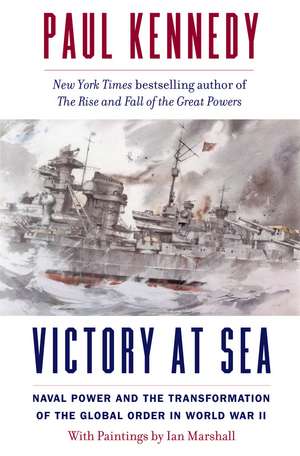
Victory at Sea: Naval Power and the Transformation of the Global Order in World War II
Autor Paul Kennedy Ilustrat de Ian Marshallen Limba Engleză Paperback – 14 mai 2024
Considerăm că Victory at Sea reprezintă o resursă fundamentală pentru studenții și specialiștii în studii strategice, istorie militară și relații internaționale, fiind esențială pentru înțelegerea modului în care logistica navală și capacitatea economică dictează rezultatele geopolitice. Paul Kennedy nu oferă doar o cronică a bătăliilor, ci analizează transformarea structurală a ordinii mondiale între 1936 și 1946, oferind un suport analitic riguros pentru examenele de istorie universală și acreditările din domeniul apărării.
Subliniem faptul că această lucrare se distinge prin sinteza dintre rigoarea academică și estetica vizuală, fiind îmbogățită de picturile în culori ale lui Ian Marshall. Această abordare umanizează datele tehnice despre convoaie, debarcări amfibii și lovituri maritime, transformând volumul într-o narațiune fluidă despre declinul vechilor puteri și ascensiunea hegemoniei americane. Cartea este comparabilă cu The Last Century of Sea Power, Volume 2 de H. P. Willmott în rigurozitatea documentării, dar este actualizată pentru a evidenția modul în care „sfârșitul erei tunului mare” a remodelat fundamental peisajul strategic global.
În contextul operei sale, Victory at Sea continuă tezele din The Rise and Fall of the Great Powers, unde Paul Kennedy argumenta că ponderea diplomatică este indisolubil legată de baza economică. Dacă în Engineers of Victory autorul se concentra pe inovațiile tactice care au întors soarta războiului, aici el revine la viziunea sa de ansamblu — „Grand Strategy” — explorând cum flota a devenit instrumentul principal al puterii de stat. Este o completare necesară pentru cei care au parcurs The Rise And Fall of British Naval Mastery, mutând focusul de la declinul britanic către noul echilibru global dominat de forțele navale ale Statelor Unite.
Preț: 170.05 lei
Carte disponibilă
Livrare economică 23 iulie-06 august
Livrare express 08-14 iulie pentru 66.10 lei
Specificații
ISBN-10: 0300276788
Pagini: 644
Ilustrații: 83 color illus.
Dimensiuni: 178 x 254 x 31 mm
Greutate: 1.2 kg
Editura: Yale University Press
Colecția Yale University Press
V-ar putea interesa
-
 Hell on the Way to Heaven (16pt Large Print Edition)Chrissie FosterPreț: 313.12 lei
 -
 Endgame: Britain, Russia and the Final Struggle for Central AsiaJennifer Siegel-28%Preț: 225.94 lei313.32 lei
 -
 Beast in the RingPaul KennedyPreț: 136.04 lei
 -
 ShudergayMR James F. ChristPreț: 67.40 lei
 -
 Using an Intratheater Regional Hub Heuristic in IraqMajor Usaf Robert L. CharlesworthPreț: 83.06 lei
 -
 Volver a Empezar - Venezuela y Sus Militares -Ca Gustavo Sosa LarrazabalPreț: 109.61 lei
 -
 Explosive Ordinance Disposal (Eod) ProgramDevelopment Of the NavyPreț: 102.55 lei
 -
 Vom Nuklearen Abgrund Zur Nuklearen Abrustung 1981-1987Dr Michael SchmidPreț: 107.18 lei
 -
 All One GivesDavid W. McGheePreț: 72.21 lei
 -
 Modeling and Assessment of Alternative Cooling Methods of the Combat Operation CenterNaval Postgraduate SchoolPreț: 93.67 lei
 -
 United States Coast Guard HeroesSterner, C. DouglasPreț: 196.99 lei
 -
 La Guerra Senza RadarGiacinto MasciaPreț: 86.88 lei
 -
 Still StandingChrissie Foster-20%Preț: 103.34 lei128.57 lei
 -
 Preț: 438.38 lei
 -
 ARTISTS RIFLES. Regimental Roll of Honour and War Record 1914-1919Compiled and Ed by S Stagoll Higham-8%Preț: 450.32 lei489.48 lei
 -
 History of the Baloch Regiment 1820-1939Raffiudin AhmedPreț: 341.88 lei
 -
 Stories of the Crimean WarW J TaitPreț: 412.46 lei
 -
 For Valour, the V.C.E Muddock J E MuddockPreț: 350.01 lei
 -
 With Kitchener to KhartumW Steevens G W SteevensPreț: 357.16 lei
 -
 From Midshipman to Field MarshalEvelyn Wood-8%Preț: 461.12 lei501.21 lei
 -
 Preț: 360.96 lei
 -
 Royal Fusiliers in the Great WarC O'Neill H C O'NeillPreț: 414.10 lei
 -
 Preț: 303.86 lei
De ce să citești această carte
Recomandăm această carte oricărui pasionat de istorie navală sau strategie care dorește să înțeleagă nu doar „ce” s-a întâmplat în Al Doilea Război Mondial, ci și „de ce” structura puterii globale s-a schimbat iremediabil. Cititorul câștigă o perspectivă clară asupra legăturii dintre economie și forța militară, totul într-un format grafic deosebit care face ca detaliile tehnice despre flote să fie ușor de asimilat și vizualizat.
Despre autor
Paul Kennedy (n. 1945) este un istoric britanic de prestigiu, profesor la Universitatea Yale, specializat în istoria relațiilor internaționale și a strategiilor globale. Este recunoscut la nivel mondial pentru analizele sale privind ascensiunea și declinul marilor puteri, punând un accent deosebit pe fundamentele economice care susțin forța militară. Prin lucrări precum The Rise and Fall of the Great Powers, Kennedy a redefinit modul în care istoricii și decidenții politici privesc echilibrul de putere, argumentând că supraextinderea militară fără un suport economic solid duce inevitabil la declin diplomatic.
Descriere scurtă
“When he is at his best, as he often is in these pages, Kennedy can be dazzling.”—Ian W. Toll, New York Times
“The book makes for enjoyable reading, owing to the author’s easygoing style. . . . Kennedy is an academic who does not write like one; he writes a story, not a treatise.”—Robert D. Kaplan, Washington Post
“Engrossing.”—Brendan Simms, Wall Street Journal
In this engaging narrative, brought to life by marine artist Ian Marshall’s beautiful full‑color paintings, historian Paul Kennedy grapples with the rise and fall of the Great Powers during World War II. Tracking the movements of the six major navies of the Second World War—the allied navies of Britain, France, and the United States and the Axis navies of Germany, Italy, and Japan—Kennedy tells a story of naval battles, maritime campaigns, convoys, amphibious landings, and strikes from the sea. From the elimination of the Italian, German, and Japanese fleets and almost all of the French fleet, to the end of the era of the big‑gunned surface vessel, the advent of the atomic bomb, and the rise of an American economic and military power larger than anything the world had ever seen, Kennedy shows how the strategic landscape for naval affairs was completely altered between 1936 and 1946.
Recenzii
“Engrossing. . . . Alongside the pacey narrative, ranging across both the European and Pacific theaters of the war, are evocative battle-themed paintings by the late British artist Ian Marshall. . . . Kennedy convincingly shows that World War II was won, ultimately, by superior American industrial capacity. . . . A new world had been born. It was indeed, as Kennedy terms it, ‘the age of Pax Americana,’ and it originated in the American naval supremacy he so vividly chronicles in Victory at Sea.”—Brendan Simms, Wall Street Journal
“An authoritative global narrative [and] lavishly illustrated with watercolour paintings by the fine marine artist Ian Marshall, together with excellent maps and graphs. . . . I believe the Royal Navy and US navy to have been the outstanding wartime fighting services of their respective nations. Kennedy offers them a fitting tribute and a penetrating analysis.”—Max Hastings, Sunday Times
“For the illustrations alone, Victory at Sea is worth the hardcover price. . . . When he is at his best, as he often is in these pages, Kennedy can be dazzling. His prose never fails him; he is always graceful and lucid on the page.”—Ian W. Toll, New York Times
“Kennedy, the author of the epochal The Rise and Fall of the Great Powers, brings his wide-ranging historical vision to this hugely authoritative history of the 1939–45 war at sea. Much conventional wisdom—about the role of the German U-boats, for instance—goes out of the window in his penetrating analysis.”—Sunday Times, “50 Best Books for the Sunlounger”
“There is no shortage of histories of naval warfare, not least on World War II. What Kennedy’s book brings is a broader perspective on the role—sometimes decisive, sometimes desultory—that naval power would play not just in breaking the power of imperial Japan, Italy, and Nazi Germany but in creating a world that would last.”—Alexander Wooley, Foreign Policy
“Victory at Sea is a tour de force. It is sweeping naval history of the Second World War, delightful in its relating of facts and lucid in its presentation of arguments. . . . Victory at Sea is capable of inspiring a new generation of military historians to study sea power in the tradition of their forerunners.”—Daniel J. Samet, American Purpose
“A great read, Kennedy’s book encourages one to think and think again, and not only about the events of World War II but also why that conflict is so totally atypical of warfare as a whole, past and present.”—Jeremy Black, New Criterion
“Essential reading for anyone generally interested in the Second World War. . . . Kennedy’s expansive work provides a wonderful strategic overview of the naval conflicts during the Second World War. It is also an analysis, utilizing the navy as an exemplar, of the shift in global fortunes and global power.”—Rob Clemm, Journal of Indo-Pacific Affairs
“Marshall’s art is one of this book’s many delights. . . . Marshall’s meticulously detailed paintings illustrate Kennedy’s point that, although the production statistics tell part of the war’s story, ‘the deficit in all deterministic explanations—the substructure alters, therefore the superstructure is changed—is that they lack human agency.’”—Mike Watson, Washington Free Beacon
“This is not just a book about navies in wartime—it is a book that examines the naval war in the wider context of a changing world and looks at landscapes, both military and political.”—Sarah Miller, Aspects of History
“While a previous century found Mahan’s Influence of Sea Power on the bridges and wardrooms of many of the world’s fleets, Victory at Sea is worthy of similar treatment. . . . Marshall’s art combined with Kennedy’s prose makes this volume a most desirable acquisition.”—David F. Winkler, Naval History
“Kennedy packs an enormous amount of information into Victory at Sea.”—A. A. Nofi, NYMAS Review
“The wealth of material on the naval war [in World War II] would appear to preclude any new insights into its origins, conduct, or eventual outcome. Yet Kennedy does just that. . . . The breadth of his approach to his subject distinguishes Kennedy’s book among its peers.”—Dov S. Zakheim, Orbis
“This handsome book by a distinguished historian is a sweeping history . . . to be valued for its art as much as for its narrative.”—Seapower
“The 53 paintings . . . are some of the most beautiful depictions of ships of war ever produced. . . . Marshall’s paintings and the scale of Kennedy’s ambition and understanding make this a book that should be widely read not just here but perhaps even more diligently in the war colleges of our pacing threat.”— John A. Nagl, Parameters
"A magnificent strategic-level look at World War II. Kennedy’s exploration of sea power . . . cannot be topped. Similarly, Marshall’s paintings offer a breathtaking view of World War II at sea.”—Mark Lardas, Nautical Research Journal
“This is a brilliant and original work of history, literature, and art—a rare combination.”—Admiral James Stavridis, Yale Alumni Magazine
“A brilliant and gripping book by a master historian working at the top of his powers.”—Fredrik Logevall, Harvard University
“Paul Kennedy has written a classic in this sweeping narrative account of the desperate struggle to command the seas and America’s rise as a superpower during the Second World War.”—John H. Maurer, U.S. Naval War College
“This extraordinary work of both global history and nautical art brings two brilliant minds together in Paul Kennedy’s luminous prose and Ian Marshall’s lovely paintings.”—Admiral James Stavridis, author of 2034: A Novel of the Next World War
“In Victory at Sea, Paul Kennedy demonstrates why he is the world’s leading scholar on naval strategy. For serious students of World War II or naval history, this book is a must read.”—John J. Mearsheimer, University of Chicago