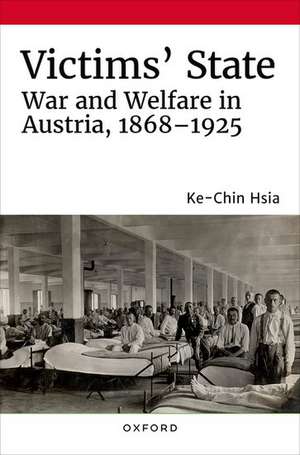
Victims' State: War and Welfare in Austria, 1868-1925
Autor Ke-Chin Hsiaen Limba Engleză Hardback – 21 dec 2022
Preț: 380.54 lei
Preț vechi: 468.90 lei
-19%
Puncte Express: 571
Carte tipărită la comandă
Livrare economică 20 noiembrie-01 decembrie
Livrare express 20-24 octombrie pentru 133.02 lei
Livrare prin curier în România Termenul estimat este afișat lângă disponibilitate.
Transport gratuit de la 400.00 lei Plată online sau ramburs, în funcție de opțiunile comenzii.
Retur gratuit în 14 zile Comandă securizată și suport în română.
Specificații
ISBN-13: 9780197582374
ISBN-10: 0197582370
Pagini: 362
Ilustrații: 8 black and white illustrations
Dimensiuni: 237 x 163 x 30 mm
Greutate: 0.68 kg
Editura: Oxford University Press
Colecția OUP USA
Locul publicării:New York, United States
ISBN-10: 0197582370
Pagini: 362
Ilustrații: 8 black and white illustrations
Dimensiuni: 237 x 163 x 30 mm
Greutate: 0.68 kg
Editura: Oxford University Press
Colecția OUP USA
Locul publicării:New York, United States
Recenzii
An exciting new interpretation of welfare practices in Habsburg Central Europe that spans the Imperial and Republican periods. Hsia's pioneering arguments demonstrate that innovative welfare practices rarely came solely from the state but developed as much from claims by socially diverse groups of actors and interest groups from below. Readers may be surprised to learn that in the multinational Habsburg empire, when it came to popular demands for welfare programs, nationalist concerns apparently took a back seat to more pressing social, economic, and regional interests.
An impressive, original study of the neglected history of the emergence of the Austrian welfare state out of World War I and its centrality to the transition from the elite Habsburg Empire to the cohesive, democratic Austrian Republic, permanently transforming its politics and culture, an experience more similar to other European states than is usually recognized. Thoroughly researched and accessibly written, it is a major contribution to the history of Austria and of European welfare states.
This meticulously researched study offers a new and compelling interpretation of wartime and postwar politics. Centering social welfare as an integral part of total war, Ke-Chin Hsia reconceptualizes links between imperial Austria and the postwar republic. He reveals continuities in late Habsburg and early republican welfare policies without defaulting to the nationalities prism. As such, the book is a pioneering 'next generation' work that extends the recent historiographical re-examination of the significance of 1918 in Austrian history.
Ke-Chin Hsia's excellent book energetically addresses these strands of scholarship, as he explores the ebbs and flows of the making and unmaking of Austria's welfare mechanisms vis-à-vis war victims. [This study] is an ideal example of this tight and mutually informing and reinforcing relationship between state and society, as he pays attention to the war victims' own leverage in welfare reform-making.
Without a doubt, Hsia's book pushes for further reflection on the story of welfare,...the book lives up to the promise outlined in the title and in its introduction.
Hsia... provid[es] a thoroughly researched and sharply written book examining Austria's welfare system for war-wounded veterans...The succinct arguments and ambitions scope of Victims' State makes it a welcome addition to recent scholarship on the Habsburg Monarchy and Austria....While the primary beneficiaries of his work will obviously be historians of Austria, it is also valuable to those interested in the development of the European welfare state, the development of European democratic institutions, and the history of the World War I. Moreover, because the book is written in clear, approachable prose, it could easily be assigned to both graduate and upper-level undergraduate students.
If previous generations saw the monarchy's 1918 disintegration as the product of long-term decline, recent historiography has found more persuasive explanations for collapse in the short-term exigencies of war and, above all, the government's myopic response to them. Ke-Chin Hsia's admirable monograph on "war victims" enriches this general interpretation with welcome nuance and fresh insights. ...readers of this carefully argued, painstakingly researched book will find that although the sweeping reforms undertaken in wartime in the field of war victim welfare had fundamental flaws, they presaged more comprehensive and successful implementation in the early years of the Austrian First Republic. ...Victims' State sets a high bar for all future investigations on the subject.
An impressive, original study of the neglected history of the emergence of the Austrian welfare state out of World War I and its centrality to the transition from the elite Habsburg Empire to the cohesive, democratic Austrian Republic, permanently transforming its politics and culture, an experience more similar to other European states than is usually recognized. Thoroughly researched and accessibly written, it is a major contribution to the history of Austria and of European welfare states.
This meticulously researched study offers a new and compelling interpretation of wartime and postwar politics. Centering social welfare as an integral part of total war, Ke-Chin Hsia reconceptualizes links between imperial Austria and the postwar republic. He reveals continuities in late Habsburg and early republican welfare policies without defaulting to the nationalities prism. As such, the book is a pioneering 'next generation' work that extends the recent historiographical re-examination of the significance of 1918 in Austrian history.
Ke-Chin Hsia's excellent book energetically addresses these strands of scholarship, as he explores the ebbs and flows of the making and unmaking of Austria's welfare mechanisms vis-à-vis war victims. [This study] is an ideal example of this tight and mutually informing and reinforcing relationship between state and society, as he pays attention to the war victims' own leverage in welfare reform-making.
Without a doubt, Hsia's book pushes for further reflection on the story of welfare,...the book lives up to the promise outlined in the title and in its introduction.
Hsia... provid[es] a thoroughly researched and sharply written book examining Austria's welfare system for war-wounded veterans...The succinct arguments and ambitions scope of Victims' State makes it a welcome addition to recent scholarship on the Habsburg Monarchy and Austria....While the primary beneficiaries of his work will obviously be historians of Austria, it is also valuable to those interested in the development of the European welfare state, the development of European democratic institutions, and the history of the World War I. Moreover, because the book is written in clear, approachable prose, it could easily be assigned to both graduate and upper-level undergraduate students.
If previous generations saw the monarchy's 1918 disintegration as the product of long-term decline, recent historiography has found more persuasive explanations for collapse in the short-term exigencies of war and, above all, the government's myopic response to them. Ke-Chin Hsia's admirable monograph on "war victims" enriches this general interpretation with welcome nuance and fresh insights. ...readers of this carefully argued, painstakingly researched book will find that although the sweeping reforms undertaken in wartime in the field of war victim welfare had fundamental flaws, they presaged more comprehensive and successful implementation in the early years of the Austrian First Republic. ...Victims' State sets a high bar for all future investigations on the subject.
Notă biografică
Ke-Chin Hsia is Assistant Professor of History at Indiana University Bloomington and faculty affiliate with the Russian and East European Institute and the Institute for European Studies of Indiana University.