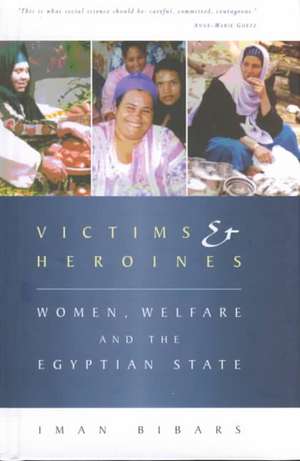
Victims and Heroines
Autor Iman Bibarsen Limba Engleză Hardback – iun 2001
Preț: 370.63 lei
Preț vechi: 457.56 lei
-19%
Puncte Express: 556
Preț estimativ în valută:
65.53€ • 77.33$ • 57.39£
65.53€ • 77.33$ • 57.39£
Carte indisponibilă temporar
Doresc să fiu notificat când acest titlu va fi disponibil:
Se trimite...
Specificații
ISBN-13: 9781856499347
ISBN-10: 1856499340
Pagini: 224
Dimensiuni: 138 x 216 x 20 mm
Greutate: 0.4 kg
Editura: ZED BOOKS
Locul publicării:United Kingdom
ISBN-10: 1856499340
Pagini: 224
Dimensiuni: 138 x 216 x 20 mm
Greutate: 0.4 kg
Editura: ZED BOOKS
Locul publicării:United Kingdom
V-ar putea interesa
-
 The Woman's Encyclopedia of Myths and SecretsBarbara G WalkerPreț: 220.83 lei
 -
 How To Be a WomanCaitlin Moran-20%Preț: 55.38 lei68.89 lei
 -
 Charity and Sylvia: A Same-Sex Marriage in Early AmericaRachel Hope Cleves-25%Preț: 110.38 lei146.79 lei
 -
 -19%Preț: 95.30 lei117.56 lei
 -
 Preț: 188.90 lei
 -
 Words of Wisdom from Women to WatchBusiness InsurancePreț: 129.25 lei
 -
 Fantastically Great Women Who Changed The WorldKate Pankhurst-36%Preț: 35.79 lei55.86 lei
 -
 Bad Girls Throughout HistoryAnn Shen-23%Preț: 98.66 lei128.36 lei
 -
 Campbell, R: Rise Sister RiseRebecca Campbell-19%Preț: 84.27 lei104.08 lei
 -
 The Aftermath: Women in Post-conflict TransformationMeredeth Turshen-14%Preț: 264.18 lei305.82 lei
 -
 -17%Preț: 247.32 lei296.58 lei
 -
 -17%Preț: 245.63 lei295.05 lei
 -
 -13%Preț: 316.54 lei361.83 lei
 -
 States of Conflict: Gender, Violence and ResistanceDoctor Susie Jacobs-17%Preț: 244.09 lei294.82 lei
Cuprins
1. Introduction: Gendering the State
2. The Feminist Researcher Among the Women
3. Defining Female Headship
4. Women, Welfare and the State
5. The Politics of Exclusion
6. Beyond the Veil: Religion and Welfare
7. Women as Victims, Women as Survivors?
8. Conclusion
2. The Feminist Researcher Among the Women
3. Defining Female Headship
4. Women, Welfare and the State
5. The Politics of Exclusion
6. Beyond the Veil: Religion and Welfare
7. Women as Victims, Women as Survivors?
8. Conclusion
Recenzii
A gripping investigation into the causes and conditions of female household headship in low-income communities in Egypt. This is what social science should be: careful, committed, and courageous.
It is both original and sensitively researched and a must for all those interested in what is happening to women in societies in transition in the Middle East. Also very relevant to those teaching courses on women, the state and the feminization of poverty.
Raises important and thought provoking questions on the interface between state policies and the social construction of gender in Egypt. By focusing on female-headed households, it highlights both mechanisms of resistance and survival and processes of discrimination and exclusion.Its implications reach far beyond the Egyptian context.
It is both original and sensitively researched and a must for all those interested in what is happening to women in societies in transition in the Middle East. Also very relevant to those teaching courses on women, the state and the feminization of poverty.
Raises important and thought provoking questions on the interface between state policies and the social construction of gender in Egypt. By focusing on female-headed households, it highlights both mechanisms of resistance and survival and processes of discrimination and exclusion.Its implications reach far beyond the Egyptian context.