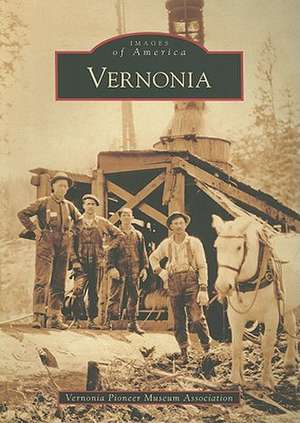
Vernonia
Autor Vernonia Pioneer Museum Association, Tobie Finzelen Limba Engleză Paperback – 2010
Preț: 134.92 lei
Puncte Express: 202
Carte tipărită la comandă
Livrare economică 08-22 decembrie
Livrare prin curier în România Termenul estimat este afișat lângă disponibilitate.
Transport gratuit de la 400.00 lei Plată online sau ramburs, în funcție de opțiunile comenzii.
Retur gratuit în 14 zile Comandă securizată și suport în română.
Specificații
ISBN-13: 9780738580418
ISBN-10: 0738580414
Pagini: 128
Dimensiuni: 163 x 231 x 10 mm
Greutate: 0.32 kg
Editura: Arcadia Publishing (SC)
ISBN-10: 0738580414
Pagini: 128
Dimensiuni: 163 x 231 x 10 mm
Greutate: 0.32 kg
Editura: Arcadia Publishing (SC)
V-ar putea interesa
-
 Preț: 272.46 lei
 -
 Troy and the Great Flood of 1913Troy Historical SocietyPreț: 133.38 lei
 -
 Preț: 247.59 lei
 -
 The Intellectual Construction of AmericaJack P. GreenePreț: 315.15 lei
 -
 Les Sauvages AméricainsGordon M. SayrePreț: 380.83 lei
 -
 Lyndon Johnson's WarMichael H. HuntPreț: 87.02 lei
 -
 Teodore Moscoso and Puerto Rico's Operation BootstrapA. W. MaldonadoPreț: 445.28 lei
 -
 A Circle of Trust: Remembering SNCCCheryl Lynn GreenbergPreț: 303.16 lei
 -
 The Jefferson Image in the American MindMerrill D. PetersonPreț: 383.41 lei
 -
 Crude DreamsJack RoderickPreț: 141.76 lei
 -
 Preț: 281.98 lei
 -
 Preț: 218.51 lei
 -
 Alamo Sourcebook 1836Timothy J. TodishPreț: 150.80 lei
 -
 The Waldemar StorySue Van Noy WillettPreț: 150.01 lei
 -
 Preț: 279.03 lei
 -
 The Native American Almanac: A Portrait of Native America TodayArlene B. HirschfelderPreț: 142.25 lei
 -
 Preț: 106.82 lei
 -
 BowmanvilleWilliam HumberPreț: 93.87 lei
Notă biografică
Housed in the former mill headquarters, the Vernonia Pioneer Museum Association preserves photographs, oral histories, and artifacts of the town and surrounding Columbia County. The volunteer museum board obtained the photographs in this volume from its own collection, current and former residents, and descendants of the early settlers.
Descriere
Nestled in the Upper Nehalem Valley in the foothills of the Oregon Coast Range, Vernonia still reflects its pioneer virtues of hard work and independence. The area was first homesteaded in 1874 by Clark Parker and John Van Blaricom. The earliest settlers saw the dense old-growth firs and cedars as an obstacle to overcome in establishing farms, but those big trees soon became the lifeblood of the town's economy. Incorporated in 1891, Vernonia remained a small settlement with family-run farms, sawmills, and supporting businesses until the arrival of the long-awaited railroad in 1922. The Oregon-American Lumber Mill--at the time one of the largest of its kind--was built in 1923. The mill provided jobs and business opportunities for hundreds of people until 1957 when it closed. The population rapidly declined as people left to find work elsewhere. Vernonia has proved resilient, however, and continues to be home to over 2,000 residents who appreciate small-town life in a forested setting.