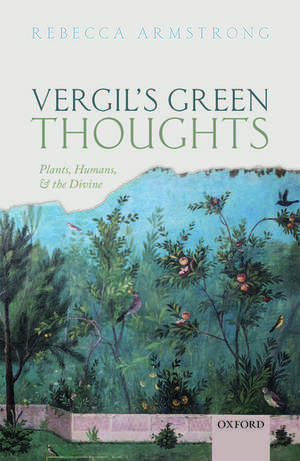
Vergil's Green Thoughts: Plants, Humans, and the Divine
Autor Rebecca Armstrongen Limba Engleză Hardback – 24 iul 2019
Preț: 774.95 lei
Preț vechi: 1124.25 lei
-31%
Puncte Express: 1162
Carte tipărită la comandă
Livrare economică 20-25 noiembrie
Livrare prin curier în România Termenul estimat este afișat lângă disponibilitate.
Transport gratuit pentru acest produs Plată online sau ramburs, în funcție de opțiunile comenzii.
Retur gratuit în 14 zile Comandă securizată și suport în română.
Specificații
ISBN-13: 9780199236688
ISBN-10: 0199236682
Pagini: 342
Dimensiuni: 160 x 242 x 25 mm
Greutate: 0.64 kg
Editura: OUP OXFORD
Colecția OUP Oxford
Locul publicării:Oxford, United Kingdom
ISBN-10: 0199236682
Pagini: 342
Dimensiuni: 160 x 242 x 25 mm
Greutate: 0.64 kg
Editura: OUP OXFORD
Colecția OUP Oxford
Locul publicării:Oxford, United Kingdom
Recenzii
... Vergil's Green Thoughts will be valuable for scholars interested in the many ways of thinking about plants and their significance in Vergil, and about the botanical connections among his three works.
Notă biografică
Rebecca Armstrong is Associate Professor in Classical Languages and Literature at the Faculty of Classics of the University of Oxford, and Mary Bennett Fellow and Tutor in Classics at St Hilda's College. She grew up in rural north Devon before coming to Oxford to study, and took up her current posts in 2004. She now lives in rural north Oxfordshire.
Cuprins
- 0: Introduction
- 0.1. Ancient botany and ways of seeing plants
- 0.1.1. Definitions of nature
- 0.2. Humans and plants: from anthropocentrism to ecocriticism
- 0.2.1. Plants and an anthropocentric world-view
- 0.2.2. Ancient environmentalisma
- 0.2.3. Ecocriticism and ancient literature
- 0.3. Gods and plants
- 0.3.1. Approaches to numen
- 0.3.2. Plants and everyday religion
- 0.3.3. Forms of association: nymphs and trees
- 0.4. Plants as symbol and metaphor
- 0.4.1. Plants, people, and analogy
- 0.4.2. Plants and politics
- 0.5. Poetic plants
- 0.5.1. Poetic plants before and beside Vergil
- 0.5.2. Plants and poetics in Vergil (a glimpse of a road not much taken)
- I: Numen
- I: Numinous Habitats
- I.1. Forests and woodland areas (silua, saltus, nemus, lucus)
- I.1.1. Backgrounds
- I.1.2. Habitarunt di quoque siluas: gods and woods in the Eclogues
- I.1.3. Present and absent numen in the woods of the Georgics
- I.1.4. Religio dira loci: the Aeneid's woodland numen
- I.1.4.1. Underworld woods: numen and confusion
- I.1.4.2. Echoes of the underworld: Aeaea, Tiber, Albunea, Amsanctus
- I.1.4.3. Woodland numen and the city
- I.2. Numen and plants in cultivated land: fields, meadows, plantations, and gardens (ager, aruus, campus, nouale /-is, pratum, rus, seges, arbusta, hortus)
- I.2.1. Expected and unexpected agricultural divinity in the Eclogues and Aeneid
- I.2.2. Ceres, Bacchus, corn, and vines in the Georgics
- I.2.3. Plants and divine metonymy
- II: Gods' Special Species
- II.1. Oak (aesculus, quercus, robur, and ilex)
- II.1.1. The oak transformed: votive tree and trophy
- II.2. Poplar (populus)
- II.3. Pine (pinus, picea)
- II.4. Olive and wild olive (oliua, oleaster)
- II.5. Laurel / bay (laurus)
- II.6. Myrtle (myrtus)
- II.7. Cypress (cupressus, cyparissus)
- II.8. Ivy (hedera)
- II.9. The borderline divine: magical and medicinal plants
- II: Homo
- III: Tame Plants
- III.1. Symbiosis
- III.1.1. Harmonious work in the Eclogues
- III.1.2. The locus amoenus and other harmonious habitats
- III.1.3. Grain and other field crops: shared endeavour and shared suffering
- III.1.4. Useful trees
- III.1.4.1. Useful trees and the exotic
- III.1.5. Productivity at a price: the vine
- III.2. Conflict
- III.2.1. Too much of a good thinga Farming as restraint of nature
- III.2.2. Farming as violence
- III.2.2.1. Vines and violence
- III.2.2.2. Grafting: art or abusea
- III.2.2.3. Cultivation and violence: metaphor in reverse
- IV: Wild Plants
- IV.1. Defining the wild
- IV.1.1. Flowers: wild yet tame, tame yet wild
- IV.1.1.1. Flowers and bees
- IV.1.1.2. Flowers and people: beauty, sex, and death
- IV.1.2. Wildness and spontaneous production in trees
- IV.1.3. Degeneration and degeneracy
- IV.2. Weeds
- IV.2.1. Weeds and further questions of definition
- IV.2.2. Characterizing weeds
- IV.2.3. Intermediate weeds
- IV.2.4. Crossing (and making) boundaries with brambles
- IV.2.5. Grass: from harmony to danger
- IV.3. Fighting and felling: a coda
- V: Conclusions
- Endmatter
- Works cited
- Index of plants
- Index of passages discussed
- General index