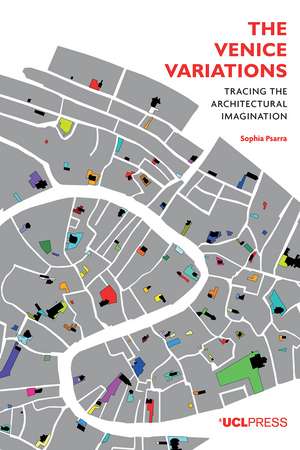
Venice Variations: Tracing the Architectural Imagination
Autor Sophia Psarraen Limba Engleză Paperback – 14 aug 2018
From
the
myth
of
Arcadia
through
to
the
twenty-first
century,
ideas
about
sustainability—how
we
imagine
better
urban
environments—remain
persistently
relevant
and
raise
recurring
questions.
How
do
cities
evolve
as
complex
spaces
nurturing
both
urban
creativity
and
the
fortuitous
art
of
discovery,
and
by
which
mechanisms
do
they
foster
imagination
and
innovation?
While
past
utopias
were
conceived
in
terms
of
an
ideal
geometry,
contemporary
exemplary
models
of
urban
design
seek
technological
solutions
of
optimal
organization. The
Venice
Variations explores
Venice
as
a
prototypical
city
that
may
hold
unique
answers
to
the
ancient
narrative
of
utopia.
Venice
was
not
the
result
of
a
preconceived
ideal
but
the
pragmatic
outcome
of
social
and
economic
networks
of
communication.
Its
urban
creativity,
though,
came
to
represent
the
quintessential
combination
of
place
and
institutions
of
its
time.
Through a discussion of Venice and two other works owing their inspiration to this city—Italo Calvino’s Invisible Cities and Le Corbusier’s Venice Hospital—Sophia Psarra describes Venice as a system that starts to resemble a highly probabilistic "algorithm." The rapidly escalating processes of urban development around our big cities share many of the motivations for survival, shelter, and trade that brought Venice into existence. Rather than seeing these places as problems to be solved, we need to understand how urban complexity can evolve, as happened from its unprepossessing origins in the marshes of the Venetian lagoon to the "model city" enduring a thousand years. This book frees Venice from stereotypical representations, revealing its generative capacity to inform potential other "Venices" for the future.
Through a discussion of Venice and two other works owing their inspiration to this city—Italo Calvino’s Invisible Cities and Le Corbusier’s Venice Hospital—Sophia Psarra describes Venice as a system that starts to resemble a highly probabilistic "algorithm." The rapidly escalating processes of urban development around our big cities share many of the motivations for survival, shelter, and trade that brought Venice into existence. Rather than seeing these places as problems to be solved, we need to understand how urban complexity can evolve, as happened from its unprepossessing origins in the marshes of the Venetian lagoon to the "model city" enduring a thousand years. This book frees Venice from stereotypical representations, revealing its generative capacity to inform potential other "Venices" for the future.
Preț: 369.41 lei
Puncte Express: 554
Carte disponibilă
Livrare economică 05-19 noiembrie
Livrare prin curier în România Termenul estimat este afișat lângă disponibilitate.
Transport gratuit de la 400.00 lei Plată online sau ramburs, în funcție de opțiunile comenzii.
Retur gratuit în 14 zile Comandă securizată și suport în română.
Specificații
ISBN-13: 9781787352407
ISBN-10: 1787352404
Pagini: 288
Ilustrații: 149 illustrations
Dimensiuni: 152 x 235 x 28 mm
Greutate: 0.73 kg
Editura: UCL Press
Colecția UCL Press
ISBN-10: 1787352404
Pagini: 288
Ilustrații: 149 illustrations
Dimensiuni: 152 x 235 x 28 mm
Greutate: 0.73 kg
Editura: UCL Press
Colecția UCL Press
V-ar putea interesa
-
 -15%Preț: 423.91 lei498.71 lei
 -
 Theorien der Sozialen MorphologieJosephine KönigshausenPreț: 76.26 lei
Notă biografică
Sophia
Psarrais
a
reader
at
the
Bartlett
School
of
Architecture,
UCL,
and
a
practicing
architect
who
has
been
part
of
prize-winning
teams
in
international
architectural
competitions.