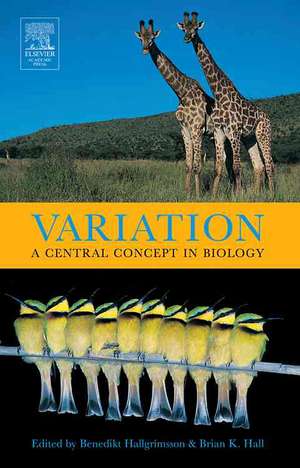
Variation
Editat de Benedikt Hallgrímsson, Brian K. Hallen Limba Engleză Hardback – iun 2005
·Provides an overview of current thinking on variation in evolutionary biology, functional morphology, and evolutionary developmental biology
·Written by a team of leading scholars specializing on the study of variation
·Reviews of statistical analysis of variation by leading authorities
·Key chapters focus on the role of the study of phenotypic variation for evolutionary, developmental, and post-genomic biology
Preț: 624.72 lei
Preț vechi: 701.93 lei
-11%
Puncte Express: 937
Carte disponibilă
Livrare economică 06-20 noiembrie
Livrare prin curier în România Termenul estimat este afișat lângă disponibilitate.
Transport gratuit pentru acest produs Plată online sau ramburs, în funcție de opțiunile comenzii.
Retur gratuit în 14 zile Comandă securizată și suport în română.
Specificații
ISBN-13: 9780120887774
ISBN-10: 0120887770
Pagini: 592
Ilustrații: Approx. 100 illustrations
Dimensiuni: 158 x 232 x 26 mm
Greutate: 0.89 kg
Editura: ELSEVIER SCIENCE
ISBN-10: 0120887770
Pagini: 592
Ilustrații: Approx. 100 illustrations
Dimensiuni: 158 x 232 x 26 mm
Greutate: 0.89 kg
Editura: ELSEVIER SCIENCE
Public țintă
Intended for scholars, advanced undergraduate students, and graduates in evolutionary biology, biological anthropology, paleontology, morphology, developmental biology, genomics and other related disciplines.Cuprins
Foreword
Chapter 1. Variation and Variability: Central Concepts in Biology
Chapter 2. Variation from Darwin to the Modern Synthesis
Chapter 3. The Statistics of Variation
Chapter 4. Landmark Morphometrics and the Analysis of Variation
Chapter 5. Variation in Ontogeny
Chapter 6. Constraints on Variation from Genotype through Phenotype to Fitness
Chapter 7. Developmental Origins of Variation
Chapter 8. Canalization, Cryptic Variation and Developmental Buffering: A Critical Examination and Analytical Perspective
Chapter 9. Mutation and Phenotypic Variation: Where is the connection Capacitators, Stressors, Phenotypic Variability and Evolutionary Change
Chapter 10. Within Individual Variation: Developmental Noise versus Developmental Stability
Chapter 11. Developmental Constraints, Modules and Evolvability
Chapter 12. Developmental Regulation of Variability
Chapter 13. Role of Stress in Evolution: From Individual Adaptability to Evolutionary Adaptation
Chapter 14. Environmentally Contingent Variation: Phenotypic Plasticity and Norms of Reaction
Chapter 15. Variation and Life History Evolution
Chapter 16. Antisymmetry
Chapter 17. Variation in Structure and its Relationship to Function: Correlation, Explanation and Extrapolation
Chapter 18. A Universal Generative Tendency Toward Increased Organismal Complexity
Chapter 19. Variation and Versatility in Macroevolution
Chapter 20. Variation and Developmental Biology: Prospects for the Future
Chapter 21. Phenogenetics: Genotypes, Phenotypes, and Variation
Chapter 22. The Study of Phenotypic Variability
Index
Chapter 1. Variation and Variability: Central Concepts in Biology
Chapter 2. Variation from Darwin to the Modern Synthesis
Chapter 3. The Statistics of Variation
Chapter 4. Landmark Morphometrics and the Analysis of Variation
Chapter 5. Variation in Ontogeny
Chapter 6. Constraints on Variation from Genotype through Phenotype to Fitness
Chapter 7. Developmental Origins of Variation
Chapter 8. Canalization, Cryptic Variation and Developmental Buffering: A Critical Examination and Analytical Perspective
Chapter 9. Mutation and Phenotypic Variation: Where is the connection Capacitators, Stressors, Phenotypic Variability and Evolutionary Change
Chapter 10. Within Individual Variation: Developmental Noise versus Developmental Stability
Chapter 11. Developmental Constraints, Modules and Evolvability
Chapter 12. Developmental Regulation of Variability
Chapter 13. Role of Stress in Evolution: From Individual Adaptability to Evolutionary Adaptation
Chapter 14. Environmentally Contingent Variation: Phenotypic Plasticity and Norms of Reaction
Chapter 15. Variation and Life History Evolution
Chapter 16. Antisymmetry
Chapter 17. Variation in Structure and its Relationship to Function: Correlation, Explanation and Extrapolation
Chapter 18. A Universal Generative Tendency Toward Increased Organismal Complexity
Chapter 19. Variation and Versatility in Macroevolution
Chapter 20. Variation and Developmental Biology: Prospects for the Future
Chapter 21. Phenogenetics: Genotypes, Phenotypes, and Variation
Chapter 22. The Study of Phenotypic Variability
Index
Recenzii
"...Variation: A Central Concept in Biology, is sure to spark the interest of nearly all ecologists and evolutionary biologists...How does this variation arise? How do new variants evolve? What contrains variation? The answers are incomplete. However, the chapters of this book provide a glimpse at our current understanding of phenotypic variation."
- James A. Fordyce, University of Tenessee, Department of Ecology and Evolutionary Biology, in ECOLOGY
"Variation is certainly a topic of central interest in evolutionary biology and this new book offers an unusually inclusive array of perspectives on the topic. I especially enjoyed the breadth of coverage. Novel features are found that one might not have expected in a book of this nature, such as structural, functional and developmental variation, as contrasted with the expected emphases on genetic variation, canalization and phenotypic plasticity, and their relation to life history evolution. Palmer’s stimulating chapter on antisymmetry is particularly noteworthy for its originality. Another unusual treatment is Badyaev’s focus on the role of stress in evolution, which is examined from a different perspective by Hoffmann and McKenzie. On the whole this is an assemblage of excellent chapters by many of the central figures in the fields covered and will be a welcome addition to my library." - David B. Wake, University of California, Berkeley, U.S.A.
"This comprehensive, diverse and stimulating volume is a must-read for anyone interested in development and evolution. Never has the critical subject of variation been so well treated in terms of how to analyze variation, how developmental processes induce and constrain its properties, and the complex relationships between genotypic, environmental and phenotypic variation. This is a tour-de-force treatment of a critical subject." - Daniel E. Lieberman, Harvard University, U.S.A.
"Where do genetic and phenotypic diversity come from and how are they are maintained? Do the same processes link the differences within species to the stable differences between species? These are the big questions about the diversity of life on Earth and Hallgrimsson and Hall’s book provides the latest views from leading scientists of diversity and form." - Mark Pagel, University of Reading, England
"“Variation is the basic material of evolution. At last we have a book that takes a modern approach to variation in all its forms—populational, developmental, genetic, morphological—and links it to the processes that generate the variation itself. This is not a collection of bland reviews, but a vital compendium of novel perspectives that begin to meld the new data of evo-devo with the accepted body of Modern Synthesis work. A must for any evolutionist’s library. - Kevin Padian, University of California, Berkeley, U.S.A.
Listed in NEW TITLES in BIOSCIENCE (April 2006)
"...chapters are authoritative and well written, and graduate students and scientists will find much here that is thought-provoking."
- Carl D. Schlichting, Professor, Department of Ecology and Evolutionary Biology, University of Connecticut, in BIOSCIENCE
- James A. Fordyce, University of Tenessee, Department of Ecology and Evolutionary Biology, in ECOLOGY
"Variation is certainly a topic of central interest in evolutionary biology and this new book offers an unusually inclusive array of perspectives on the topic. I especially enjoyed the breadth of coverage. Novel features are found that one might not have expected in a book of this nature, such as structural, functional and developmental variation, as contrasted with the expected emphases on genetic variation, canalization and phenotypic plasticity, and their relation to life history evolution. Palmer’s stimulating chapter on antisymmetry is particularly noteworthy for its originality. Another unusual treatment is Badyaev’s focus on the role of stress in evolution, which is examined from a different perspective by Hoffmann and McKenzie. On the whole this is an assemblage of excellent chapters by many of the central figures in the fields covered and will be a welcome addition to my library." - David B. Wake, University of California, Berkeley, U.S.A.
"This comprehensive, diverse and stimulating volume is a must-read for anyone interested in development and evolution. Never has the critical subject of variation been so well treated in terms of how to analyze variation, how developmental processes induce and constrain its properties, and the complex relationships between genotypic, environmental and phenotypic variation. This is a tour-de-force treatment of a critical subject." - Daniel E. Lieberman, Harvard University, U.S.A.
"Where do genetic and phenotypic diversity come from and how are they are maintained? Do the same processes link the differences within species to the stable differences between species? These are the big questions about the diversity of life on Earth and Hallgrimsson and Hall’s book provides the latest views from leading scientists of diversity and form." - Mark Pagel, University of Reading, England
"“Variation is the basic material of evolution. At last we have a book that takes a modern approach to variation in all its forms—populational, developmental, genetic, morphological—and links it to the processes that generate the variation itself. This is not a collection of bland reviews, but a vital compendium of novel perspectives that begin to meld the new data of evo-devo with the accepted body of Modern Synthesis work. A must for any evolutionist’s library. - Kevin Padian, University of California, Berkeley, U.S.A.
Listed in NEW TITLES in BIOSCIENCE (April 2006)
"...chapters are authoritative and well written, and graduate students and scientists will find much here that is thought-provoking."
- Carl D. Schlichting, Professor, Department of Ecology and Evolutionary Biology, University of Connecticut, in BIOSCIENCE