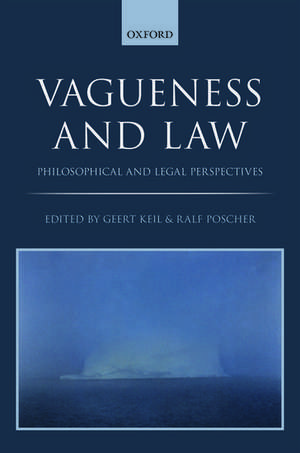
Vagueness and Law: Philosophical and Legal Perspectives
Editat de Geert Keil, Ralf Poscheren Limba Engleză Hardback – 8 dec 2016
Preț: 713.94 lei
Preț vechi: 1026.91 lei
-30%
Puncte Express: 1071
Carte tipărită la comandă
Livrare economică 27 noiembrie-08 decembrie
Livrare prin curier în România Termenul estimat este afișat lângă disponibilitate.
Transport gratuit pentru acest produs Plată online sau ramburs, în funcție de opțiunile comenzii.
Retur gratuit în 14 zile Comandă securizată și suport în română.
Specificații
ISBN-13: 9780198782889
ISBN-10: 0198782888
Pagini: 350
Dimensiuni: 176 x 239 x 26 mm
Greutate: 0.68 kg
Editura: OUP OXFORD
Colecția OUP Oxford
Locul publicării:Oxford, United Kingdom
ISBN-10: 0198782888
Pagini: 350
Dimensiuni: 176 x 239 x 26 mm
Greutate: 0.68 kg
Editura: OUP OXFORD
Colecția OUP Oxford
Locul publicării:Oxford, United Kingdom
V-ar putea interesa
-
 Religious Convictions and Political ChoiceKent Greenawalt-22%Preț: 508.36 lei649.27 lei
 -
 Law and ObjectivityKent Greenawalt-11%Preț: 374.49 lei422.77 lei
 -
 Pardons: Justice, Mercy, and the Public InterestKathleen Dean Moore-21%Preț: 371.48 lei472.70 lei
 -
 Law, Morality and Society: Essays in Honour of H.L.A HartP. M. S. Hacker-33%Preț: 978.14 lei1456.10 lei
 -
 Human Dignity in Bioethics and BiolawDeryck Beyleveld-33%Preț: 1026.10 lei1527.45 lei
 -
 A Short History of Western Legal TheoryJ. M. Kelly-22%Preț: 449.09 lei577.67 lei
 -
 Law and Literature: Journeys From Her to EternityMaria Aristodemou-33%Preț: 621.48 lei921.01 lei
 -
 -21%Preț: 365.78 lei460.57 lei
 -
 In Defense of Natural LawRobert George-28%Preț: 511.58 lei715.13 lei
 -
 Markets, Morals, and the LawJules L. Coleman-31%Preț: 629.73 lei911.29 lei
 -
 Institutions of Law: An Essay in Legal TheoryNeil MacCormick-21%Preț: 374.58 lei474.50 lei
 -
 -31%Preț: 681.46 lei986.10 lei
 -
 -18%Preț: 363.54 lei440.96 lei
 -
 Events: The Force of International LawFleur JohnsPreț: 469.66 lei
 -
 Aristotle's AnthropologyGeert Keil-11%Preț: 721.21 lei810.34 lei
 -
 Deen's ListJr. Braswell D. DeenPreț: 120.59 lei
 -
 Interpretation of Legal DiscourseSarah Patricia Condor EsqPreț: 158.18 lei
 -
 La Jurisprudencia Prevista En La Nueva Ley de AmparoJuan Carlos Gonzalez Cancino-23%Preț: 718.15 lei932.66 lei
 -
 Therapeutic Jurisprudence and Overcoming Violence Against WomenDebarati Halder-18%Preț: 1300.85 lei1586.41 lei
 -
 Chance Oder Untergang 3Christian Lukas-AltenburgPreț: 125.57 lei
 -
 La Personnalité moraleGabriel de Labr de Vareilles-SommièresPreț: 79.99 lei
 -
 Kritik des NaturalismusGeert Keil-23%Preț: 1440.60 lei1870.91 lei
 -
 Willensfreiheit und DeterminismusGeert KeilPreț: 56.43 lei
 -
 Handbuch des VerfassungsrechtsMatthias Herdegen-15%Preț: 1542.19 lei1814.34 lei
Recenzii
...each chapter is eminently readable and worthy of thoughtful consideration. I found it to be fascinating and it opened up new pathways in how I consider legislation. The chapters are filled with interesting theoretical and practical examples on the use, abuse and interpretation of legislation. For anyone with an interest in legislation, it should make us stop and consider, in a more profound way, how vagueness is affecting our endeavours.
Keil and Poscher, have usefully brought together leading scholars working on the topic of vagueness in philosophy and in law, this book fosters a dialogue between philosophers and legal scholars by examining how philosophers conceive vagueness in law from their theoretical perspective and how legal theorists make use of philosophical theories of vagueness... It is a great contribution to the continuing debate.
Keil and Poscher, have usefully brought together leading scholars working on the topic of vagueness in philosophy and in law, this book fosters a dialogue between philosophers and legal scholars by examining how philosophers conceive vagueness in law from their theoretical perspective and how legal theorists make use of philosophical theories of vagueness... It is a great contribution to the continuing debate.
Notă biografică
Prof. Dr. Ralf Poscher is Professor of Public Law and Legal Philosophy at Albert-Ludwigs-University of Freiburg and managing director of the Centre for Security and Society of the University of Freiburg. Prof. Poscher has been a Fernand Braudel Senior Fellow at the European University Institute in Florence (2013), a guest researcher of the "Program in Law and Public Affairs" at Princeton University (2012), a member of the Institute for Advanced Study in Princeton, USA (2007-2008), and a visiting professor at the University of Osaka (2007). His areas of research cover legal theory, fundamental rights and national security law. Geert Keil is Professor of Philosophy at Humboldt University of Berlin. His main areas of research are the philosophy of mind and action, epistemology, philosophical anthropology and metaphysics. Awarded with a Heisenberg scholarship of the German Research Foundation (DFG) and a Feodor Lynen scholarship of the Alexander von Humboldt Foundation, he researched at the Universities of Trondheim, Stanford, and Basel. From 2005 to 2010 he held a chair in theoretical philosophy at RWTH Aachen University.
Cuprins
- Introduction
- Part I: Theories of Vagueness and Their Impact on Jurisprudence
- 1: Stephen Schiffer: Philosophical and Jurisprudential Issues of Vagueness
- 2: Diana Raffman: Vagueness in Law: Placing the Blame Where It's Due
- 3: Ralf Poscher: An Intentionalist Account of Vagueness: A Legal Perspective
- 4: Hrafn Asgeirsson: Can Legal Practice Adjudicate Between Theories of Vagueness?
- 5: Michael S. Moore: Semantics, Metaphysics, and Objectivity in the Law
- Part II: Vagueness Phenomena in Law
- 6: Andrei Marmor: Pragmatic Vagueness in Statutory Law
- 7: Frederick Schauer: Second-Order Vagueness in the Law
- 8: Marc Andree Weber: The Non-Conservativeness of Legal Definitions
- 9: Nikola Kompa: The Role of Vagueness and Context Sensitivity in Legal Interpretation
- Part III: Dealing with Vagueness in Law
- 10: Lawrence M. Solan: Why It Is So Difficult to Resolve Vagueness in Legal Interpretation
- 11: Brian Bix: Vagueness and Political Choice in Law
- 12: Leo Katz: Non-Epistemic Uncertainty and the Problem of Legal Line-Drawing
- 13: Adam Kolber: Smoothing Vague Laws
- 14: Roy Sorensen: How Vagueness Makes Judges Lie
- 15: Jeremy Waldron: Clarity, Thoughtfulness, and the Rule of Law