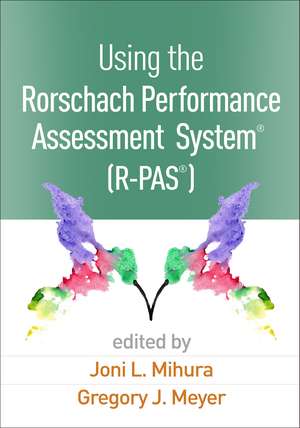
Using the Rorschach Performance Assessment System® (R-PAS®)
Editat de Joni L. Mihura, Gregory J. Meyeren Limba Engleză Hardback – 17 ian 2018
From codevelopers of the Rorschach Performance Assessment System (R-PAS), this essential casebook illustrates the utility of R-PAS for addressing a wide range of common referral questions with adults, children, and adolescents. Compelling case examples from respected experts cover clinical issues (such as assessing psychosis, personality disorders, and suicidality); forensic issues (such as insanity and violence risk assessments, child custody proceedings, and domestic violence); and use in neuropsychological, educational, and other settings. Each tightly edited chapter details R-PAS administration, coding, and interpretation. Designed to replace the widely used Comprehensive System developed by John Exner, R-PAS has a stronger empirical foundation, is accurately normed for international use, is easier to learn and use, and reduces ambiguities in administration and coding, among other improvements. Visit www.r-pas.org for more information.
Preț: 455.44 lei
Preț vechi: 479.41 lei
-5%
Puncte Express: 683
Carte disponibilă
Livrare economică 11-25 noiembrie
Livrare express 28 octombrie-03 noiembrie pentru 54.28 lei
Livrare prin curier în România Termenul estimat este afișat lângă disponibilitate.
Transport gratuit pentru acest produs Plată online sau ramburs, în funcție de opțiunile comenzii.
Retur gratuit în 14 zile Comandă securizată și suport în română.
Specificații
ISBN-13: 9781462532537
ISBN-10: 1462532535
Pagini: 416
Dimensiuni: 178 x 254 x 23 mm
Greutate: 0.94 kg
Ediția:1
Editura: Guilford Publications
Colecția Guilford Press
ISBN-10: 1462532535
Pagini: 416
Dimensiuni: 178 x 254 x 23 mm
Greutate: 0.94 kg
Ediția:1
Editura: Guilford Publications
Colecția Guilford Press
Public țintă
Professional and Professional Practice & DevelopmentCuprins
I. The Basics of R-PAS and Its Interpretation
1. Introduction to R-PAS, Joni L. Mihura & Gregory J. Meyer
2. Principles of R-PAS Interpretation, Joni L. Mihura & Gregory J. Meyer
3. Using R-PAS Norms with an Emphasis on Children and Adolescents, Gregory J. Meyer & Philip Erdberg
II. Using R-PAS in Clinical Settings
4. The Broken Zombie: Using R-PAS in the Assessment of a Bullied Adolescent with Borderline Personality Features, Jan H. Kamphuis, Hilde De Saeger, & Joni L. Mihura
5. When Wolves Fall from the Sky: Using R-PAS in the Early Detection of Psychosis in an Adolescent, James H. Kleiger & Ali Khadivi
6. An Inpatient R-PAS Case with a Recent Suicide Attempt, Ali Khadivi
7. Understanding a Therapeutic Impasse: Using R-PAS in a Multimethod Assessment of Alliance Dynamics and Underlying Developmental Disruption, Anthony Bram
8. Using R-PAS in the Therapeutic Assessment of a University Student with Emotional Disconnection, Francesca Fantini & Justin D. Smith
9. How Individual R-PAS Protocols Illuminate Couples’ Relationships: The Role of a Performance-Based Test in Therapeutic Assessment with Couples, Filippo Aschieri, Alessandra Chinaglia, & Andrea B. Kiss
III. Using R-PAS in Forensic Evaluations
10. Using R-PAS in a Criminal Responsibility Evaluation to Assess Insanity, Marvin W. Acklin
11. Using R-PAS in Violence Risk Assessment, Saara Kaakinen, Emiliano Muzio, & Hannu Säävälä
12. Using R-PAS in the Assessment of Possible Psychosis and Trauma Intrusions in a Psychopathic Female, Peder Chr. B. Nørbech, Ellen J. Hartmann, & James H. Kleiger
13. Using R-PAS in Family Law Cases, S. Margaret Lee
14. Using R-PAS in the Assessment of Psychological Variables in Domestic Violence, Nancy Kaser-Boyd & Reneau Kennedy
IV. Using R-PAS in Pre-Employment, Neuropsychological, and Educational Evaluations
15. Using R-PAS in the Pre-Employment Evaluation of a Candidate for a Roman Catholic Seminary, Philip Keddy
16. Using R-PAS in a Neuropsychological Evaluation of a High-Functioning Adult Patient with Depression, Anxiety, and a Relational Trauma History, Nicolae Dumitrascu
17. Using R-PAS in the Neuropsychological Assessment of an 8-Year-Old Boy, Jessica Lipkind & Jack Fahy
18. Being in Pain: Using R-PAS to Understand the (Non-)Dialogue of Body and Mind, Ety Berant
19. Using R-PAS in the Evaluation of an Emotional Disturbance in the School Context, Tammy L. Hughes, Kate Piselli, & Cassandra Berbary
Index
1. Introduction to R-PAS, Joni L. Mihura & Gregory J. Meyer
2. Principles of R-PAS Interpretation, Joni L. Mihura & Gregory J. Meyer
3. Using R-PAS Norms with an Emphasis on Children and Adolescents, Gregory J. Meyer & Philip Erdberg
II. Using R-PAS in Clinical Settings
4. The Broken Zombie: Using R-PAS in the Assessment of a Bullied Adolescent with Borderline Personality Features, Jan H. Kamphuis, Hilde De Saeger, & Joni L. Mihura
5. When Wolves Fall from the Sky: Using R-PAS in the Early Detection of Psychosis in an Adolescent, James H. Kleiger & Ali Khadivi
6. An Inpatient R-PAS Case with a Recent Suicide Attempt, Ali Khadivi
7. Understanding a Therapeutic Impasse: Using R-PAS in a Multimethod Assessment of Alliance Dynamics and Underlying Developmental Disruption, Anthony Bram
8. Using R-PAS in the Therapeutic Assessment of a University Student with Emotional Disconnection, Francesca Fantini & Justin D. Smith
9. How Individual R-PAS Protocols Illuminate Couples’ Relationships: The Role of a Performance-Based Test in Therapeutic Assessment with Couples, Filippo Aschieri, Alessandra Chinaglia, & Andrea B. Kiss
III. Using R-PAS in Forensic Evaluations
10. Using R-PAS in a Criminal Responsibility Evaluation to Assess Insanity, Marvin W. Acklin
11. Using R-PAS in Violence Risk Assessment, Saara Kaakinen, Emiliano Muzio, & Hannu Säävälä
12. Using R-PAS in the Assessment of Possible Psychosis and Trauma Intrusions in a Psychopathic Female, Peder Chr. B. Nørbech, Ellen J. Hartmann, & James H. Kleiger
13. Using R-PAS in Family Law Cases, S. Margaret Lee
14. Using R-PAS in the Assessment of Psychological Variables in Domestic Violence, Nancy Kaser-Boyd & Reneau Kennedy
IV. Using R-PAS in Pre-Employment, Neuropsychological, and Educational Evaluations
15. Using R-PAS in the Pre-Employment Evaluation of a Candidate for a Roman Catholic Seminary, Philip Keddy
16. Using R-PAS in a Neuropsychological Evaluation of a High-Functioning Adult Patient with Depression, Anxiety, and a Relational Trauma History, Nicolae Dumitrascu
17. Using R-PAS in the Neuropsychological Assessment of an 8-Year-Old Boy, Jessica Lipkind & Jack Fahy
18. Being in Pain: Using R-PAS to Understand the (Non-)Dialogue of Body and Mind, Ety Berant
19. Using R-PAS in the Evaluation of an Emotional Disturbance in the School Context, Tammy L. Hughes, Kate Piselli, & Cassandra Berbary
Index
Notă biografică
Joni L. Mihura, PhD, is Professor of Psychology at the University of Toledo, where she teaches personality assessment, advanced assessment, and psychodynamic/integrative psychotherapy. She received early career awards from the American Psychoanalytic Association and the Society for Personality Assessment (SPA), as well as the Walter G. Klopfer Award for Distinguished Contribution to the Literature from SPA, and is a Fellow and past board member of SPA. Dr. Mihura serves on the editorial boards of the Journal of Personality Assessment and Rorschachiana, has published many articles and chapters on psychological assessment, and is coeditor of the Handbook of Gender and Sexuality in Psychological Assessment. She is a codeveloper of R-PAS (www.r-pas.org) and presents invited lectures and trainings internationally.
Gregory J. Meyer, PhD, is Professor of Psychology at the University of Toledo. His research focuses on psychological assessment, with an emphasis on the integration of assessment methods. He is a four-time recipient of the Walter G. Klopfer Award for Distinguished Contribution to the Literature from the Society for Personality Assessment (SPA). Dr. Meyer also received the Award for Distinguished Contributions to Assessment Psychology from Section IX (Assessment Psychology) of the Society of Clinical Psychology, Division 12 of the American Psychological Association (APA), and is a Fellow of Division 5 (Quantitative and Qualitative Methods) of APA, as well as of SPA. With more than 75 peer-reviewed publications, he is a past editor of the Journal of Personality Assessment. He is a codeveloper of R-PAS (www.r-pas.org) and presents invited lectures and trainings internationally.
Gregory J. Meyer, PhD, is Professor of Psychology at the University of Toledo. His research focuses on psychological assessment, with an emphasis on the integration of assessment methods. He is a four-time recipient of the Walter G. Klopfer Award for Distinguished Contribution to the Literature from the Society for Personality Assessment (SPA). Dr. Meyer also received the Award for Distinguished Contributions to Assessment Psychology from Section IX (Assessment Psychology) of the Society of Clinical Psychology, Division 12 of the American Psychological Association (APA), and is a Fellow of Division 5 (Quantitative and Qualitative Methods) of APA, as well as of SPA. With more than 75 peer-reviewed publications, he is a past editor of the Journal of Personality Assessment. He is a codeveloper of R-PAS (www.r-pas.org) and presents invited lectures and trainings internationally.
Recenzii
“An impressive body of research supports the use of R-PAS, one of the most important instruments available to personality assessors. Edited by leading lights in the field, this much-needed volume brings together well-established personality assessment experts to provide rich examples of R-PAS interpretation. There is something for everyone, including chapters on clinical, forensic, school, neuropsychological, pre-employment, and medical assessment contexts."--Christopher J. Hopwood, PhD, Department of Psychology, University of California, Davis
“This book will meet the needs of clinicians just beginning to explore R-PAS as well as more advanced users who have longed for in-depth case studies. The opening chapters clearly explain the philosophy and empirical basis of R-PAS. The clients chosen for the case illustrations come from a wide variety of settings and have very different presenting problems, but all are fascinating. A number of the cases utilize collaborative/therapeutic assessment, illustrating how R-PAS data can be turned into helpful feedback for clients and referring professionals."--Stephen E. Finn, PhD, Founder, Center for Therapeutic Assessment, Austin, Texas
"An excellent resource for both novice and experienced assessment psychologists, this volume brilliantly illustrates the use of R-PAS. The international contributors--all experts in different assessment domains--set a high standard for thorough case analysis. It is of particular relevance that a good proportion of the cases concern adolescents and young adults; this is the age period when symptoms of mental disorder often first appear and differential diagnosis is highly challenging. The value of performance-based assessment using R-PAS for answering complex diagnostic questions is lucidly demonstrated throughout this book."--Corine de Ruiter, PhD, Professor of Forensic Psychology, Maastricht University, the Netherlands
“A valuable resource for practitioners and researchers alike, this remarkable book should be on every clinician’s shelf. The volume illustrates how R-PAS data can be used to understand patients’ underlying dynamics and expressed behaviors and to enhance clinical and forensic decision making. Authorities in the field cover diverse assessment challenges, from domestic violence and suicidality to pre-employment screening and child custody evaluation. Skillfully blending empirical evidence with clinical wisdom, the chapters make R-PAS data come alive."--Robert F. Bornstein, PhD, Derner Institute of Advanced Psychological Studies, Adelphi University
-This is a good introduction to the R-PAS, a new interpretive system for the Rorschach Inkblot Test, with good psychometric properties. It contains clinical examples and protocols, which are extremely helpful. The R-PAS is a good addition to a neuropsychological protocol for both children and adults. *****!--Doody's Review Service, 3/2/2018“This book will meet the needs of clinicians just beginning to explore R-PAS as well as more advanced users who have longed for in-depth case studies. The opening chapters clearly explain the philosophy and empirical basis of R-PAS. The clients chosen for the case illustrations come from a wide variety of settings and have very different presenting problems, but all are fascinating. A number of the cases utilize collaborative/therapeutic assessment, illustrating how R-PAS data can be turned into helpful feedback for clients and referring professionals."--Stephen E. Finn, PhD, Founder, Center for Therapeutic Assessment, Austin, Texas
"An excellent resource for both novice and experienced assessment psychologists, this volume brilliantly illustrates the use of R-PAS. The international contributors--all experts in different assessment domains--set a high standard for thorough case analysis. It is of particular relevance that a good proportion of the cases concern adolescents and young adults; this is the age period when symptoms of mental disorder often first appear and differential diagnosis is highly challenging. The value of performance-based assessment using R-PAS for answering complex diagnostic questions is lucidly demonstrated throughout this book."--Corine de Ruiter, PhD, Professor of Forensic Psychology, Maastricht University, the Netherlands
“A valuable resource for practitioners and researchers alike, this remarkable book should be on every clinician’s shelf. The volume illustrates how R-PAS data can be used to understand patients’ underlying dynamics and expressed behaviors and to enhance clinical and forensic decision making. Authorities in the field cover diverse assessment challenges, from domestic violence and suicidality to pre-employment screening and child custody evaluation. Skillfully blending empirical evidence with clinical wisdom, the chapters make R-PAS data come alive."--Robert F. Bornstein, PhD, Derner Institute of Advanced Psychological Studies, Adelphi University
Descriere
From codevelopers of the Rorschach Performance Assessment System (R-PAS), this essential casebook illustrates the utility of R-PAS for addressing a wide range of common referral questions with adults, children, and adolescents. Compelling case examples from respected experts cover clinical issues (such as assessing psychosis, personality disorders, and suicidality); forensic issues (such as insanity and violence risk assessments, child custody proceedings, and domestic violence); and use in neuropsychological, educational, and other settings. Each tightly edited chapter details R-PAS administration, coding, and interpretation. Designed to replace the widely used Comprehensive System developed by John Exner, R-PAS has a stronger empirical foundation, is accurately normed for international use, is easier to learn and use, and reduces ambiguities in administration and coding, among other improvements. Visit www.r-pas.org for more information.