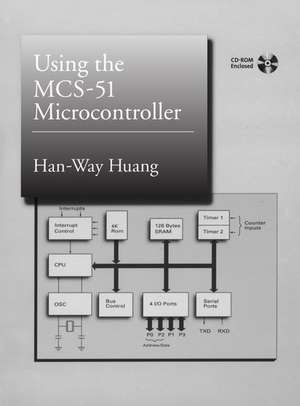
Using the MCS-51 Microcontroller
Autor Han-Way Huangen Limba Engleză Hardback – 13 ian 2000
Preț: 1206.64 lei
Preț vechi: 1731.41 lei
-30%
Puncte Express: 1810
Carte tipărită la comandă
Livrare economică 27 noiembrie-02 decembrie
Livrare prin curier în România Termenul estimat este afișat lângă disponibilitate.
Transport gratuit pentru acest produs Plată online sau ramburs, în funcție de opțiunile comenzii.
Retur gratuit în 14 zile Comandă securizată și suport în română.
Specificații
ISBN-13: 9780195125139
ISBN-10: 0195125134
Pagini: 562
Ilustrații: numerous line figures and tables
Dimensiuni: 245 x 198 x 36 mm
Greutate: 1.18 kg
Editura: Oxford University Press
Colecția OUP USA
Locul publicării:New York, United States
ISBN-10: 0195125134
Pagini: 562
Ilustrații: numerous line figures and tables
Dimensiuni: 245 x 198 x 36 mm
Greutate: 1.18 kg
Editura: Oxford University Press
Colecția OUP USA
Locul publicării:New York, United States
V-ar putea interesa
-
 -28%Preț: 428.82 lei597.47 lei
 -
 -38%Preț: 1518.42 lei2451.30 lei
 -
 -20%Preț: 1726.21 lei2157.76 lei
 -
 Computer Architecture: From Microprocessors to SupercomputersBehrooz Parhami-24%Preț: 1220.41 lei1609.96 lei
 -
 Principles of Computer HardwareAlan Clements-29%Preț: 602.71 lei846.14 lei
 -
 The ZX Spectrum UlaChristopher David Smith-20%Preț: 239.54 lei299.42 lei
 -
 Digital Logic DesignGuy Even-20%Preț: 426.99 lei533.74 lei
 -
 Comp Arch Security CWang-9%Preț: 806.13 lei885.86 lei
 -
 Vision Architectures CJeong-20%Preț: 870.22 lei1087.78 lei
 -
 Enterprise Content and Search Management for Building Digital PlatformsShailesh Kumar Shivakumar-20%Preț: 528.34 lei660.43 lei
 -
 -20%Preț: 315.34 lei394.17 lei
 -
 CoCo: The Colorful History of Tandy’s Underdog ComputerBoisy G Pitre-20%Preț: 383.02 lei478.78 lei
 -
 Reconfigurable Multipipeline Computing StructuresIgor A Kalyaev-35%Preț: 1171.03 lei1811.74 lei
 -
 -20%Preț: 927.73 lei1159.66 lei
 -
 System ArchitectureWolfgang J. Paul-20%Preț: 362.83 lei453.53 lei
 -
 Decision Theory with Imperfect InformationRafik A. Aliev-20%Preț: 992.33 lei1240.41 lei
Recenzii
"This is a great textbook for a microcontroller course at either undergraduate or masters level ... very well written, with a large set of practical examples, explained with clear figures. The educational style is concise, progressive and interesting." International Journal of Electrical Engineering Education, April 2001
Cuprins
- 1: Introduction to the Intel MCS-51
- 1.1: Objectives
- 1.2: What is a Computer?
- 1.3: The Computer's Software
- 1.4: The MCS-51 Memory Organization
- 1.5: The MCS-51 Registers
- 1.6: Memory Addressing
- 1.7: The MCS-51 Addressing Modes
- 1.8: The MCS-51 Memory Spaces
- 1.9: A Sample of MCS-51 Instructions
- 1.10: The MCS-51 Machine Code
- 1.11: Summary
- 1.12Exercises
- 2: MCS-51 Assembly Programming
- 2.1: Objectives
- 2.2: Assembly Language Program Structure
- 2.3: A Sampler of Assembler Directives
- 2.4: Flowcharts
- 2.5: Writing Programs to Do Arithmetic
- 2.6: Program loops
- 2.7: Logical Operations
- 2.8: Rate Instructions
- 2.9: Boolean Variable Manipulation Instructions
- 2.10: Program Execution time
- 2.11: MCS-51 Development Tools
- 2.12: Summary
- 2.13: Exercises
- 2.14: Lab Exercises and Assignments
- 3: Advanced Assembly Programming
- 3.1: Objectives
- 3.2: Introduction
- 3.3: Stack
- 3.4: Indexable Data Structures
- 3.5: Strings
- 3.6: Subroutines
- 3.7: Issues in Subroutine Calls
- 3.8: The Stack Frame
- 3.9: Examples of Subroutine Calls
- 3.10: Dual Data Pointers of the DS87C520 Microcontroller
- 3.11: Summary
- 3.12: Exercises
- 3.13: Lab Exercises and Assignments
- 4: Bus Cycles and Memory Expansion
- 4.1: Objectives
- 4.2: Introduction
- 4.3: Basics of Bus
- 4.4: Waveforms of Bus Signals
- 4.5: Bus Transactions
- 4.6: Bus Transaction timing Diagram
- 4.7: A Summary of the MCS-51/52 Signal Pins
- 4.8: The MCS-51/52 Bus Cycle Timing Diagram
- 4.9: Memory Terminology and SRAM
- 4.10: Memory System Design for MCS-51/52
- 4.11: Summary
- 4.12: Exercises
- 5: Interrupts, Resets, and Exception Procesing
- 5.1: Objectives
- 5.2: Basics of Interrupts
- 5.3: Resets
- 5.4: MCS-51 Interrupts
- 5.5: The MCS-51 Reset
- 5.6: Power-Saving Modes of Operation
- 5.7: MCS-51 Interrupt Programming
- 5.8: Summary
- 5.9: Exercises
- 5.10: Lab Exercises and Assignments
- 6: Parallel I/O Ports
- 6.1: Objectives
- 6.2: Basic I/O Concepts
- 6.3: I/O Addressing
- 6.4: I/O Transfer Synchronization
- 6.5: MCS-51/52 Parallel I/O Overview
- 6.6: Simple Input Device
- 6.7: Interfacing Parallel Ports with the Keyboard
- 6.8: Simple Output Devices
- 6.9: The I8255 Programmable Peripheral Interface
- 6.10: Summary
- 6.11: Exercises
- 6.12: Lab Exercises and Assignments
- 7: Timer Function
- 7.1: Objectives
- 7.2: Introduction
- 7.3: Timer 0 and Timer 1
- 7.4: Timer 2
- 7.5: Programmable Counter Array
- 7.6: Motor Control
- 7.7: DS87C520 Timers
- 7.8: Summary
- 7.9: Exercises
- 7.10: Lab Exercises and Assignments
- 8: Analog to Digital Converter
- 8.1: Objectives
- 8.2: Introduction
- 8.3: Successive Approximation Method
- 8.4: Voltage Level Scaling and Shifting
- 8.5: The Intel 8XC51GB A/D Converter
- 8.6: The Procedure for Using the A/D Converter
- 8.7: Measuring the Barometric Pressure
- 8.8: Measuring the Temperature
- 8.9: Measuring the Humidity
- 8.10: Using an External A/D Converter ADC0820
- 8.11: Summary
- 8.12: Exercises
- 8.13: Lab Exercises and Assignments
- 9: Serial Communication
- 9.1: Objectives
- 9.2: Introduction
- 9.3: The EIA-232-E (or RS232) Standard
- 9.4: The MCS-51 Serial Interface
- 9.5: Applications of Mode 0
- 9.6: Applications of Mode 1
- 9.7: Applications of Mode 2 and 3
- 9.8: The DS87C520 Serial Ports
- 9.9: Summary
- 9.10: Exercises
- 9.11: Lab Exercises and Assignments
- 10: Serial Expansion Port
- 10.1: Objectives
- 10.2: Introduction
- 10.3: SEP-related Registers
- 10.4: The SEP Operation
- 10.5: SEP-Compatible Peripheral Chips
- 10.6: Simulating the SEP
- 10.7: Interfacing the 74HC589 to the SEP
- 10.8: Interfacing the 74HC595 and the SEP
- 10.9: Interfacing to the Seven-Segment Display Driver MC14489
- 10.10: The Xicor Serial EPROM
- 10.11: Interfacing to A/D Converter with Serial Interface
- 10.12: D/A Converters with Serial Interface
- 10.13: Summary
- 10.14: Exercises
- 10.15: Lab Exercises and Assignments
- Appendix A: Instruction Execution Time
- Appendix B: Special Funciton Registers (SFR)
- Appendix C: Interrupt Vector Addresses
- Appendix D: Standard Resistors
- Appendix E: MCS-51 Software and Hardware Vendors
- Appendix F: MCS-51 Variants
- Appendix G: MCS-51 Instruction Set
- Appendix H: Dallas DS87C520 Datasheet
- References
- Glossary
- Index