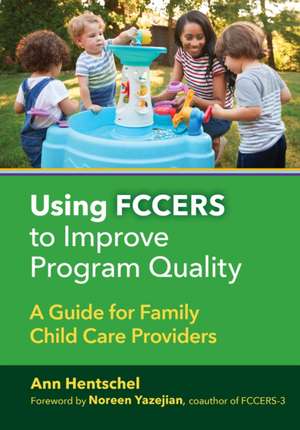
Using Fccers to Improve Program Quality
Autor Ann Hentschelen Limba Engleză Paperback – 25 noi 2026
This book shows family child care providers how to use FCCERS as a tool for self-reflection to support quality improvement, which was an original purpose of the ERS. It includes reflection questions that providers can use to think about their program operations in ways aligned with best practices as well as their own values. Readers will also learn the role of coaches and communities of practice in supporting quality, using the FCCERS as a framework.
National early childhood expert Ann Hentschel draws on her 40-year career to help home-based educators move beyond scores and focus on what children experience every day—the relationships, routines, and learning experiences that directly shape children's development (birth through age 12). After reading this book, providers will be empowered to create nurturing, developmentally appropriate environments where both children and educators thrive. They will also discover how to build reflective teaching habits and engage in peer communities of practice to reduce isolation and address common challenges such as transitions, mixed-age care, and children’s behavior.
When individuals at every level of the system embrace these tools for ongoing reflection and improvement, they cultivate a lasting driver of quality that inspires meaningful, sustainable change.
Key Features:
- Designed for Family Child Care Settings: Grounded in the unique strengths of home-based programs, including mixed-age groups, continuity of care, and shared living spaces.
- Actionable, Everyday Strategies: Packed with "Try This" strategy boxes, reflective questions, and an Action Plan Template for immediate use. Six appendices are also available as free, downloadable PDFs.
- From Assessment to Improvement: Translates FCCERS Items and Indicators into meaningful, developmentally appropriate practices that enhance children’s daily experiences.
- Supports Reflective Practice and Coaching: Ideal for individual reflection, coaching conversations, and community of practice networks.
- Focuses on What Matters Most: Centers process quality (interactions, relationships, and engagement) as the foundation of children’s learning and well-being.
Preț: 283.35 lei
Nou
Puncte Express: 425
Carte indisponibilă temporar
Doresc să fiu notificat când acest titlu va fi disponibil:
Se trimite...
Specificații
Cuprins
Contents
Foreword xi
Noreen Yazejian, coauthor of FCCERS-3
Acknowledgments xiii
Introduction: Changing the Conversation About Quality 1
The Stakes Are Real 1
What I Have Learned 2
What This Book Offers 3
Who This Book Is For 3
Why I Am Writing This Book 4
What’s Ahead 4
How to Use This Book 6
Part I
1. Quality Is the Heartbeat of Early Care and Learning 9
When Quality Feels Personal 9
What Makes Home-Based Child Care Distinctive 10
Reclaiming the Purpose of FCCERS 12
Looking Beyond the Rating 14
Understanding FCCERS: A Framework for Quality 15
More Than a Score: The Story Behind the Scales 19
Listening to the Heartbeat of Quality 22
2. Learning to Pause: Reflection as Professional Practice 24
Developing the Capacity to Stay Curious Over Time 25
The Environment as a Coeducator 26
Moving From Reaction to Intention 27
Observation as a Diagnostic Tool 29
The Four-Step Reflective Cycle 30
Why Reflective Practice Works With FCCERS 39
3. Building Communities of Practice: From Isolation to Collaboration 42
Why Communities of Practice Matter 42
Turning the Scale Into a Conversation 43
Clarifying the Purpose: Beyond Compliance 45
The Core Elements of a Strong Community of Practice 46
The Facilitator as a Guide, Not an Expert 48
Listening Practices for CoP Members 49
The Cycle of a Community of Practice 52
Thriving Communities of Practice 57
4. The Coaching Conversation: You Don’t Have to Do This Alone 59
What Coaching Is and What It Can Be 61
Understanding the Coaching Relationship: Two Kinds of Expertise 61
Making the Most of the Debrief Conversation 68
When You Need More Than Coaching Offers 71
Part II
5. Looking Closely: A Reflective Guide to the FCCERS Subscales 77
Subscale 1: Space and Furnishings (Items 1–4) 78
Subscale 2: Personal Care Routines (Items 5–8) 79
Subscale 3: Language and Books (Items 9–14) 81
Subscale 4: Activities (Items 15–24) 84
Subscale 5: Interaction (Items 25–30) 93
Subscale 6: Program Structure (Items 31–33) 101
Carrying It Forward 105
6. From Reflection to Action: Your New Road Map 117
Making Meaning of Your FCCERS Report 118
The Action Plan as a Stress Management Tool 120
When Behavior Is the Message: A Framework for Understanding What Children Are Communicating 121
A Leadership Mindset 129
Advocacy: Using the Action Plan as Your Professional Voice 131
When Change Feels Difficult 132
7. Sustaining the Journey 135
Everything This Book Has Been About 135
A Final Reflection: The Heartbeat Continues 141
References 143
Appendixes 147
Appendix A: Where Am I Now? A Provider Self-Rating Snapshot 149
Appendix B: Creating Ground Rules for Conversation 153
Appendix C: Moments That Mattered 155
Appendix D: FCCERS Community of Practice Protocol 157
Appendix E: Family Child Care Environment Rating Scale Action Plan 159
Appendix F: Developmental Expectations for Guiding Children’s Behavior 161
Index 169
About the Author 173