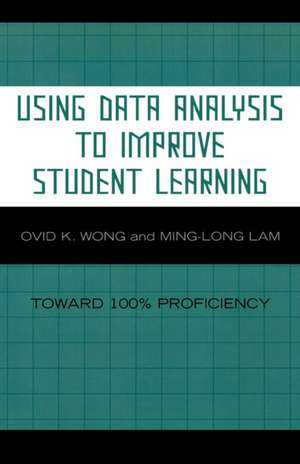
Using Data Analysis to Improve Student Learning: Toward 100% Proficiency
Autor Ovid K. Wong, Ming-Long Lamen Limba Engleză Paperback – 30 noi 2006
Standards of behavior such as attendance, discipline, homework, and academic learning are the answering points for the first question with connections to school policy and curriculum. The question of "how do we know?" is answered by assessment with relevant data support. Decisions to adjust student behaviors or to modify a school program are based on thorough data analysis and interpretation. What is the evidence that a student is not learning? A teacher is not effective? A school program is not serving the needs of students? The evidence can be addressed by information from a student record book; a teacher performance summary; a program survey or other data based reports. This book uses a unique blend of quantitative and qualitative strategies to tackle challenges in both student and school improvement and should be of interest to all educators.
Preț: 308.92 lei
Preț vechi: 387.68 lei
-20%
Puncte Express: 463
Carte tipărită la comandă
Livrare economică 24 noiembrie-08 decembrie
Livrare prin curier în România Termenul estimat este afișat lângă disponibilitate.
Transport gratuit de la 400.00 lei Plată online sau ramburs, în funcție de opțiunile comenzii.
Retur gratuit în 14 zile Comandă securizată și suport în română.
Specificații
ISBN-13: 9781578864805
ISBN-10: 1578864801
Pagini: 128
Dimensiuni: 136 x 214 x 10 mm
Greutate: 0.2 kg
Editura: Bloomsbury Publishing
Colecția R&L Education
Locul publicării:New York, United States
ISBN-10: 1578864801
Pagini: 128
Dimensiuni: 136 x 214 x 10 mm
Greutate: 0.2 kg
Editura: Bloomsbury Publishing
Colecția R&L Education
Locul publicării:New York, United States
Cuprins
Chapter 1 Paving the Road to Using More Data for Student Improvement
Chapter 2 Student Data, Improvement & Accountability: Setting the Stage for Success
Chapter 3 School Professional Practice and Program Data, Improvement, and Accountability: Professional Practice: Walk-through Supervision and Collaborative Coaching
Chapter 4 School District Community Improvement Accountability
Chapter 5 Putting It Altogether in the Continuous School Improvement Plan
Chapter 2 Student Data, Improvement & Accountability: Setting the Stage for Success
Chapter 3 School Professional Practice and Program Data, Improvement, and Accountability: Professional Practice: Walk-through Supervision and Collaborative Coaching
Chapter 4 School District Community Improvement Accountability
Chapter 5 Putting It Altogether in the Continuous School Improvement Plan
Recenzii
This text will provide the reader with a sound basis for using today's accountability requirements as a framework for school improvement.
School administrators are recruited from the ranks of teachers, and many have little understanding of the use of data as it applies to decision-making. Using Data Analysis to Improve Student Learning: Toward 100% Proficiency is a great resource to enhance a school administrator's understanding of the use of data to drive school improvement in ways that are succinct, relevant, and doable. This book is a step-by-step recipe book for making decisions that helps address every student's learning outcomes. The book aims to help readers find a systematic way to effectively make decisions; improve judgment; and reflect on individual practices by using necessary student data. It is a good, confidence-building, resource for new administrators and for seasoned administrators who want some validation of their methods.
The book is a must-read for teachers and administrators who are grappling with the challenges of improving student achievement as mandated by the No Child Left Behind Act. The book provides direction for data-driven reform that is both comprehensive and comprehendible: it empowers teachers and administrators with the tools they need to make informed decisions that will lead to improved student achievement.
[This book] provides teachers, parents, and administrators regular feedback on each student's mastery of new information. A student who is not succeeding in understanding a subject can get immediate tutoring before proceeding to the next topic. If the United States is serious about leaving no child behind, we need to begin implementing the ideas in this guide.
Bringing education to a child's classroom is a big responsibility; delivering it the right way is even bigger; and using data analysis to guide the education process is the only way to do it effectively.
In these times of increasing accountability, Drs. Wong and Lam have written an indispensable guide using data analysis to guide critical decision making in schools. This is a useful and informative tool.
This book contains essential information: it explains the 'how' portion of dealing with data and using it to help students achieve and teachers be effective. It is a chance to understand the usefulness of data rather than to be intimidated by it.
School administrators are recruited from the ranks of teachers, and many have little understanding of the use of data as it applies to decision-making. Using Data Analysis to Improve Student Learning: Toward 100% Proficiency is a great resource to enhance a school administrator's understanding of the use of data to drive school improvement in ways that are succinct, relevant, and doable. This book is a step-by-step recipe book for making decisions that helps address every student's learning outcomes. The book aims to help readers find a systematic way to effectively make decisions; improve judgment; and reflect on individual practices by using necessary student data. It is a good, confidence-building, resource for new administrators and for seasoned administrators who want some validation of their methods.
The book is a must-read for teachers and administrators who are grappling with the challenges of improving student achievement as mandated by the No Child Left Behind Act. The book provides direction for data-driven reform that is both comprehensive and comprehendible: it empowers teachers and administrators with the tools they need to make informed decisions that will lead to improved student achievement.
[This book] provides teachers, parents, and administrators regular feedback on each student's mastery of new information. A student who is not succeeding in understanding a subject can get immediate tutoring before proceeding to the next topic. If the United States is serious about leaving no child behind, we need to begin implementing the ideas in this guide.
Bringing education to a child's classroom is a big responsibility; delivering it the right way is even bigger; and using data analysis to guide the education process is the only way to do it effectively.
In these times of increasing accountability, Drs. Wong and Lam have written an indispensable guide using data analysis to guide critical decision making in schools. This is a useful and informative tool.
This book contains essential information: it explains the 'how' portion of dealing with data and using it to help students achieve and teachers be effective. It is a chance to understand the usefulness of data rather than to be intimidated by it.