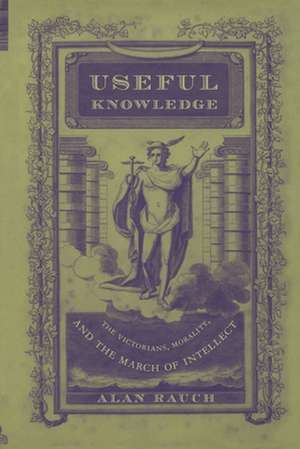
Useful Knowledge
Autor Alan Rauchen Limba Engleză Paperback – 17 iul 2001
Preț: 262.29 lei
Puncte Express: 393
Carte tipărită la comandă
Livrare economică 07-21 decembrie
Livrare prin curier în România Termenul estimat este afișat lângă disponibilitate.
Transport gratuit de la 400.00 lei Plată online sau ramburs, în funcție de opțiunile comenzii.
Retur gratuit în 14 zile Comandă securizată și suport în română.
Specificații
ISBN-13: 9780822326687
ISBN-10: 082232668X
Pagini: 304
Ilustrații: 20 illustrations
Dimensiuni: 153 x 229 x 24 mm
Greutate: 0.49 kg
Editura: Duke University Press
ISBN-10: 082232668X
Pagini: 304
Ilustrații: 20 illustrations
Dimensiuni: 153 x 229 x 24 mm
Greutate: 0.49 kg
Editura: Duke University Press
V-ar putea interesa
-
 The Poets DaughtersKatie WaldegravePreț: 122.82 lei
 -
 -30%Preț: 748.54 lei1071.35 lei
 -
 -31%Preț: 787.31 lei1145.34 lei
 -
 Robert Browning: 21st-Century Oxford AuthorsRichard Cronin-35%Preț: 1172.03 lei1803.42 lei
 -
 -30%Preț: 900.19 lei1286.19 lei
 -
 Clare's Lyric: John Clare and Three Modern PoetsStephanie Kuduk Weiner-31%Preț: 801.76 lei1167.66 lei
 -
 La Folie BaudelaireRoberto CalassoPreț: 92.71 lei
 -
 Irish Dramatic MovementM. FitzgeraldPreț: 458.59 lei
 -
 RomanticismFrederick Burwick-23%Preț: 611.65 lei794.35 lei
 -
 The Orient of StyleBeryl SchlossmanPreț: 251.40 lei
 -
 DolphinAlan Rauch-9%Preț: 98.52 lei108.36 lei
Recenzii
"A welcome addition to humanistic analyses of science-in-culture. Rauch deftly blends science, history, and literature-novels, speculative fiction, encyclopedias-to explore cultural attitudes to the challenges of new knowledge during the Information Age of the early nineteenth century."- Ann B. Shteir, York University "Useful Knowledge can stand as a model of informed and scrupulous historicism. The breadth of Rauch's acquaintance with subliterary and paraliterary texts is truly impressive as he clearly lays out what was at stake for nineteenth-century intellectuals and usefully relates their preoccupations with those that concern us now, as we experience another information revolution."- Harriet Ritvo, author of The Platypus and the Mermaid, and Other Figments of the Classifying Imagination> Useful Knowledge by >Alan Rauch won the Georgia Writers Association for the best >non-fiction book of 2001
"A welcome addition to humanistic analyses of science-in-culture. Rauch deftly blends science, history, and literature-novels, speculative fiction, encyclopedias-to explore cultural attitudes to the challenges of new knowledge during the Information Age of the early nineteenth century."- Ann B. Shteir, York University "Useful Knowledge can stand as a model of informed and scrupulous historicism. The breadth of Rauch's acquaintance with subliterary and paraliterary texts is truly impressive as he clearly lays out what was at stake for nineteenth-century intellectuals and usefully relates their preoccupations with those that concern us now, as we experience another information revolution."- Harriet Ritvo, author of The Platypus and the Mermaid, and Other Figments of the Classifying Imagination > Useful Knowledge by >Alan Rauch won the Georgia Writers Association for the best >non-fiction book of 2001
"A welcome addition to humanistic analyses of science-in-culture. Rauch deftly blends science, history, and literature-novels, speculative fiction, encyclopedias-to explore cultural attitudes to the challenges of new knowledge during the Information Age of the early nineteenth century."- Ann B. Shteir, York University "Useful Knowledge can stand as a model of informed and scrupulous historicism. The breadth of Rauch's acquaintance with subliterary and paraliterary texts is truly impressive as he clearly lays out what was at stake for nineteenth-century intellectuals and usefully relates their preoccupations with those that concern us now, as we experience another information revolution."- Harriet Ritvo, author of The Platypus and the Mermaid, and Other Figments of the Classifying Imagination > Useful Knowledge by >Alan Rauch won the Georgia Writers Association for the best >non-fiction book of 2001
Textul de pe ultima copertă
""Useful Knowledge" can stand as a model of informed and scrupulous historicism. The breadth of Rauch's acquaintance with subliterary and paraliterary texts is truly impressive as he clearly lays out what was at stake for nineteenth-century intellectuals and usefully relates their preoccupations with those that concern us now, as we experience another information revolution."--Harriet Ritvo, author of "The Platypus and the Mermaid, and Other Figments of the Classifying Imagination "
Cuprins
Acknowledgements
Introduction: Knowledge and the Novel
1. Food for Thought: The Dissemination of Knowledge in the Early Nineteenth Century
2. Science in the Popular Novel: Jane Webb Loudon’s The Mummy!
3. The Monstrous Body of Knowledge: Mary Shelley’s Frankenstein
4. Lessons Learned in Class: Charlotte Brontë’s The Professor
5. The Tailor Transformed: Charles Kingsley’s Alton Locke
6. Destiny as an Unmapped River: George Eliot’s The Mill on the Floss
Notes
Bibliography
Index
Introduction: Knowledge and the Novel
1. Food for Thought: The Dissemination of Knowledge in the Early Nineteenth Century
2. Science in the Popular Novel: Jane Webb Loudon’s The Mummy!
3. The Monstrous Body of Knowledge: Mary Shelley’s Frankenstein
4. Lessons Learned in Class: Charlotte Brontë’s The Professor
5. The Tailor Transformed: Charles Kingsley’s Alton Locke
6. Destiny as an Unmapped River: George Eliot’s The Mill on the Floss
Notes
Bibliography
Index