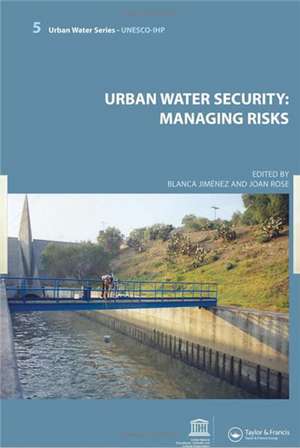
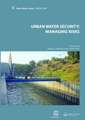
Urban Water Security: Managing Risks: UNESCO-IHP: Urban Water Series
Editat de Blanca Jimenez Cisneros, Joan B Roseen Limba Engleză Paperback – 24 mar 2009
Urban Water Security: Managing Risks – the result of a project by UNESCO’s International Hydrological Programme on the topic – addresses issues associated with urban water risks. The first section of the volume describes risks associated with urban water systems and services. The volume then discusses the concept of risk management for urban water systems and explores different approaches to managing and controlling urban water risks. A concluding section presents case studies on managing urban water risks.
Urban Water Series - UNESCO-IHP, ISSN 1749-0790
Following from the Sixth Phase of UNESCO’s International Hydrological Programme (2002–2007), the Urban Water Series – UNESCO-IHP addresses fundamental issues related to the role of water in cities and the effects of urbanization on the hydrological cycle and water resources. Focusing on the development of integrated approaches to sustainable urban water management, the Series should inform the work of urban water management practitioners, policy-makers and educators throughout the world.

Preț: 507.87 lei
Preț vechi: 644.33 lei
-21%
Puncte Express: 762
Carte indisponibilă temporar
Doresc să fiu notificat când acest titlu va fi disponibil:
Se trimite...
Specificații
ISBN-13: 9780415485678
ISBN-10: 0415485673
Pagini: 324
Dimensiuni: 174 x 246 x 18 mm
Greutate: 0.64 kg
Ediția:1
Editura: CRC Press
Colecția CRC Press
Seria Urban Water Series
ISBN-10: 0415485673
Pagini: 324
Dimensiuni: 174 x 246 x 18 mm
Greutate: 0.64 kg
Ediția:1
Editura: CRC Press
Colecția CRC Press
Seria Urban Water Series
Public țintă
Postgraduate and ProfessionalCuprins
1. Introduction
2. Drinking water – Potential health effects caused by wastewater disposal
3. Microbial Health Risks and Water Quality; 4. Chemical Health Risks
5. Risk Management on the urban water cycle. Climate change risks
6. Water source and drinking water risk management
7. Wastewater risks in the urban water cycle
8. Risks Associated with Biosolids Reuse in Agriculture
9. Closing the Urban Water Cycle” Integrated Approach towards Water Reuse in Windhoek, Namibia
10. Reducing risk from wastewater use in urban farming – a case study of Accra, Ghana
11. Drinking water – potential health effects caused by infiltration of pollutants from solid waste landfills
12. Exploding sewers: the industrial use and abuse of municipal sewers, and reducing the risk—the experience of Louisville, Kentucky US
13. Lessons learned: a response and recovery framework for post-disaster scenarios
14. Managing urban water risks: Managing drought and climate change risks in Australia
2. Drinking water – Potential health effects caused by wastewater disposal
3. Microbial Health Risks and Water Quality; 4. Chemical Health Risks
5. Risk Management on the urban water cycle. Climate change risks
6. Water source and drinking water risk management
7. Wastewater risks in the urban water cycle
8. Risks Associated with Biosolids Reuse in Agriculture
9. Closing the Urban Water Cycle” Integrated Approach towards Water Reuse in Windhoek, Namibia
10. Reducing risk from wastewater use in urban farming – a case study of Accra, Ghana
11. Drinking water – potential health effects caused by infiltration of pollutants from solid waste landfills
12. Exploding sewers: the industrial use and abuse of municipal sewers, and reducing the risk—the experience of Louisville, Kentucky US
13. Lessons learned: a response and recovery framework for post-disaster scenarios
14. Managing urban water risks: Managing drought and climate change risks in Australia
Descriere
Addresses urban water risks by examining how urbanization impacts the urban water cycle and the associated health risks from microbiological and chemical contamination, water-borne diseases, poor sanitation, inadequately treated wastewater, and climate change, emphasizing the need for adequate management strategies and alternative scenarios.