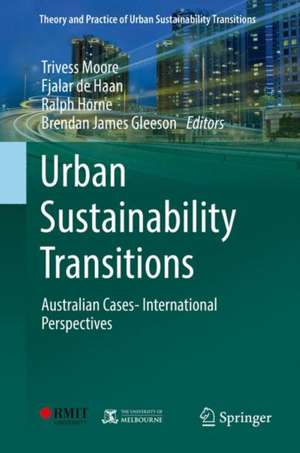
Urban Sustainability Transitions: Theory and Practice of Urban Sustainability Transitions
Editat de Trivess Moore, Fjalar de Haan, Ralph Horne, Brendan James Gleesonen Limba Engleză Hardback – 10 noi 2017
Notăm cu interes apariția volumului Urban Sustainability Transitions, o lucrare care vine să completeze o lacună semnificativă în literatura academică actuală: lipsa unei analize aprofundate asupra dimensiunilor spațiale și de guvernanță în studiile de tranziție către sustenabilitate. Într-un secol marcat de urbanizare accelerată, unde intervențiile guvernamentale clasice de tip „top-down” și soluțiile bazate exclusiv pe piață se dovedesc adesea insuficiente, acest volum propune o explorare critică a modului în care orașele se pot transforma structural. Găsim în această carte o abordare metodologică inedită, care folosește Australia ca un laborator de testare pentru dinamici globale. Datorită structurii politice federale și autonomiei mari a metropolelor sale, Australia oferă perspective valoroase asupra modului în care guvernanța urbană poate influența schimbarea regimurilor socio-tehnice. Ediția de față extinde cadrul propus de Governance of Urban Sustainability Transitions de Derk Loorbach cu date noi din contextul australian și internațional, punând accent pe provocările practice ale planificării spațiale strategice și pe rolul organizațiilor regionale în contextul schimbărilor climatice. Structura volumului este riguros organizată în zece capitole, debutând cu fundamentele teoretice ale dimensiunilor sociale și scalare, urmate de secțiuni dedicate soluțiilor de guvernanță și studiilor de caz aplicate, precum „Water Sensitive Cities”. Această progresie de la teorie la practică reflectă preocupările constante ale editorilor, precum Trivess Moore și Ralph Horne, vizibile și în lucrările lor anterioare, A Transition to Sustainable Housing sau Energy Performance in the Australian Built Environment. Dacă lucrările lor precedente s-au concentrat pe eficiența energetică și eșecurile pieței de locuințe, volumul de față ridică miza către o viziune sistemică asupra întregului ecosistem urban.
Preț: 708.49 lei
Preț vechi: 864.01 lei
-18%
Carte disponibilă
Livrare economică 21 mai-04 iunie
Specificații
ISBN-10: 981104791X
Pagini: 276
Ilustrații: XVI, 260 p. 38 illus., 16 illus. in color.
Dimensiuni: 160 x 241 x 20 mm
Greutate: 0.63 kg
Ediția:1st edition 2018
Editura: Springer
Colecția Theory and Practice of Urban Sustainability Transitions
Seria Theory and Practice of Urban Sustainability Transitions
Locul publicării:Singapore, Singapore
V-ar putea interesa
-
 Preț: 425.13 lei
 -
 Preț: 376.66 lei
 -
 Preț: 398.86 lei
 -
 The EU's New Borderland: Cross-border relations and regional developmentAndrzej JakubowskiPreț: 412.37 lei
 -
 Preț: 389.39 lei
 -
 Encyclopedia of Sustainability Science and TechnologyRobert A. Meyers-18%Preț: 2941.70 lei3587.44 lei
 -
 Preț: 442.32 lei
 -
 Practicing SustainabilityGuru MadhavanPreț: 277.00 lei
 -
 System of Open SpacesRaquel Tardin-15%Preț: 621.56 lei731.25 lei
 -
 -15%Preț: 623.17 lei733.13 lei
 -
 Preț: 369.96 lei
 -
 Sustainability Perspectives: Science, Policy and PracticePeter A. Khaiter-19%Preț: 623.93 lei770.28 lei
 -
 -18%Preț: 944.49 lei1151.81 lei
 -
 Technologies for Sustainable DevelopmentJean-Claude Bolay-18%Preț: 916.09 lei1117.19 lei
 -
 Brooklyn's Bushwick - Urban Renewal in New York, USARaymond Charles Rauscher-15%Preț: 618.91 lei728.14 lei
 -
 Managing Geo-Based ChallengesSerwan M. J. Baban-15%Preț: 621.51 lei731.19 lei
 -
 Japanese Commons in the Coastal SeasTetsuo Yanagi-15%Preț: 616.07 lei724.79 lei
 -
 Social-Ecological Systems in TransitionShoko Sakai-15%Preț: 617.72 lei726.72 lei
 -
 Urban LandscapesMassimo SargoliniPreț: 370.78 lei
 -
 Energy Performance in the Australian Built EnvironmentPriyadarsini Rajagopalan-18%Preț: 753.63 lei919.07 lei
 -
 Preț: 399.24 lei
 -
 Bioeconomy for Sustainable DevelopmentChetan Keswani-24%Preț: 981.02 lei1290.82 lei
 -
 A City in Blue and GreenPeter G. RowePreț: 391.55 lei
 -
 -15%Preț: 639.26 lei752.07 lei
 -
 -19%Preț: 602.04 lei743.26 lei
 -
 Actioning the Global Goals for Local ImpactIsabel B. Franco-20%Preț: 625.44 lei781.80 lei
De ce să citești această carte
Această carte este esențială pentru cercetătorii și practicienii din urbanism și politici publice care doresc să înțeleagă mecanismele complexe ale schimbării urbane. Cititorul câștigă acces la un set de instrumente teoretice și studii de caz care demonstrează cum pot fi depășite rezistențele de regim. Este o resursă valoroasă pentru cei care caută modele de guvernanță adaptabile pentru orașele viitorului, dincolo de teoriile europocentrice clasice.
Despre autor
Echipa editorială este formată din cercetători de prestigiu în domeniul urbanismului și sustenabilității. Trivess Moore și Ralph Horne sunt recunoscuți pentru cercetările lor asupra tranziției către locuințe sustenabile și performanței energetice în Australia. Brendan James Gleeson este o figură centrală în planificarea urbană australiană, contribuind extensiv la literatura despre vulnerabilitățile urbane și reziliența socială. Expertiza lor combinată, reflectată în numeroase studii publicate de edituri precum Springer, asigură o perspectivă interdisciplinară ce îmbină geografia socială, economia politică și științele mediului.
Descriere scurtă
The chapters in this volume contribute to the growing body of literature on city-scale transformative change, which seeks to address a lack of consideration for spatial and urban governance dimensions in sustainability transitions studies, and expand on the basis established in the preceding book. Drawing on a range of perspectives and written by leading Australian and international urban researchers, the chapters explore contemporary cases from Australia and locate them within the international context.
Australia is on the one hand representative of many OECD countries, while on the other possessing a number of unique attributes that may serve to highlight issues and potentials internationally. Australia is a highly urbanized country and because of the federal political structure and the large distances, the five largest state-capital cities have a relatively high degree of autonomy in governance – even dominating the rest of their respective states and rural hinterlands to a certain extent. This context suggests that Australian cases can provide interesting “test-tube” perspectives on processes relevant to urban sustainability transitions worldwide. This volume presents an extensive overview of theories, concepts, approaches and practical examples informed by sustainability transitions thinking, offering a unique resource for all urban practitioners and scholars who want to understand and transition to sustainable urban futures.
Cuprins
Chapter 11 – Transition towns and the Transition Network – Australian experiences.- Part III Introduction to spatial dimensions of urban transitions section.- Chapter 12 – Urban fragmentation and sustainability transitions.- Chapter 13 – Multi-level perspective and urban planning.- Chapter 14 – Urban mobilities and transitions.- Chapter 15 – Sustainability transitions in the urban age.- Chapter 16 – Conclusion.
Notă biografică
Trivess Moore is a Research Fellow in the Sustainable Buildings Innovation Laboratory (SBiLab) in the School of Property, Construction and Project Management at RMIT University. Prior to this Trivess was in the Beyond Behaviour Change group in the Centre for Urban Research at RMIT University. Trivess’ research interests include socio-technical transitions to a low carbon urban future, with a focus on housing, households, practices, energy efficiency, renewable energy technologies, good design, affordability and liveability. He has worked on several larger Australian Research Council funded projects such as Lifetime Affordable Housing in Australia and is currently working on projects which are based upon monitoring and evaluating sustainable housing and compact cities more broadly.
Fjalar de Haan is a transitionist. He develops theory and other tools for understanding sustainability transitions. Modelling is one of his favourite tools and he would say that modelling helps to accelerate the interactions between theory and empirical work towards better understanding. Fjalar has an MSc in theoretical physics (Institute Lorentz, Leiden University, under supervision of Prof Wim van Saarloos) and a PhD in transitions studies (DRIFT, Erasmus University Rotterdam, under supervision of Prof Jan Rotmans), with a thesis entitled ‘Towards Transition Theory’. He developed the Multi-Pattern Approach which enables systematic case analysis by breaking down complex transition pathways into sequences of patterns and led the development of the Societal Needs Framework, describing and explaining how service-provision systems are intimately related with the societal needs they meet. Fjalar has been exploring the fringe of transitions theory and modelling in a variety of contexts including health care, urban water management and energy, as part of international, interdisciplinary teams, project-based with industry and in curiosity-driven solo projects. Currently,Fjalar is Lecturer – Sustainability Transitions at the Melbourne School of Design and an associate of the Melbourne Sustainable Society Institute, both at The University of Melbourne.
Ralph Horne is interested in social and policy change to support sustainable urban development, and has a specific research interest in low carbon urban transitions, housing and households. The spatial, material and contingent social and policy structures at play are the main focus of his work on both the making and shaping of urban environments. He is also Deputy Pro-Vice Chancellor, Research and Innovation for the College of Design and Social Context at RMIT University, and Director of the Cities Programme, the urban arm of the United Nations Global Compact. Through these positions and his own research he combines research leadership and participation in research projects concerning the environmental, social and policy context of production and consumption in the urban environment.
Brendan Gleeson is the Director of the Melbourne Sustainable Society Institute, at the University of Melbourne. He joined the University in January 2012 as Professor of Urban Policy Studies and then took on directorship of MSSI in early 2013. Melbourne provides MSSI with a lens through which to consider, challenge, and redefine levels of liveability and urban resilience. Brendan’s research interests include urban planning and governance, urban social policy, disability studies, and environmental theory and policy. Brendan is currently invested in understanding what urban levers can be rapidly deployed by the State and Federal Government, to alleviate the homelessness crisis.