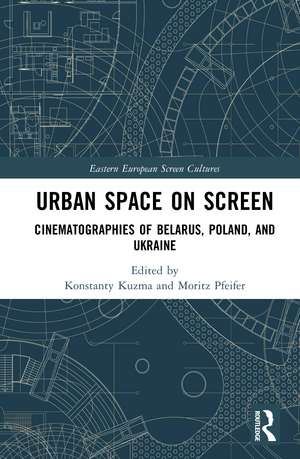
Urban Space on Screen: Cinematographies of Belarus, Poland, and Ukraine: Eastern European Screen Cultures
Editat de Konstanty Kuzma, Moritz Pfeiferen Limba Engleză Hardback – 29 iun 2026
the evolution of urban life.
From Soviet-era planned cities to post-Socialist urban renewal, and from industrial decline to the impact of war on public space, the essays in this volume uncover the role of cinema in constructing—and contesting—visions of urban life. How have films documented social change and revolution, engaged with histories of migration and displacement, and dreamed up alternative urban futures?




Preț: 1103.07 lei
Preț vechi: 1466.23 lei
-25%
Puncte Express: 1655
Carte indisponibilă temporar
Doresc să fiu notificat când acest titlu va fi disponibil:
Se trimite...
Specificații
ISBN-13: 9789463727471
ISBN-10: 9463727477
Pagini: 252
Ilustrații: 38
Dimensiuni: 156 x 234 mm
Greutate: 0.63 kg
Ediția:1
Editura: Taylor & Francis
Colecția Routledge
Seria Eastern European Screen Cultures
Locul publicării:Oxford, United Kingdom
ISBN-10: 9463727477
Pagini: 252
Ilustrații: 38
Dimensiuni: 156 x 234 mm
Greutate: 0.63 kg
Ediția:1
Editura: Taylor & Francis
Colecția Routledge
Seria Eastern European Screen Cultures
Locul publicării:Oxford, United Kingdom
Public țintă
AcademicNotă biografică
Konstanty Kuzma is the co-founder and co-editor of the East European Film Bulletin. He studied Philosophy in Berlin, Berkeley, and Munich. He completed his doctoral studies at the Ludwig Maximilian University of Munich with a scholarship from the Heinrich Böll Foundation and is a research fellow (“wiss. Mitarbeiter”) at the Institute of Philosophy of the University of Stuttgart.
Moritz Pfeifer is the co-founder and co-editor of the East European Film Bulletin. He studied Philosophy, Sociology and Economics in Berlin and Paris. He holds a PhD from the University of Nanterre in Paris and is currently a post-doctoral researcher at the Institute of Economic Policy of the University of Leipzig.
Moritz Pfeifer is the co-founder and co-editor of the East European Film Bulletin. He studied Philosophy, Sociology and Economics in Berlin and Paris. He holds a PhD from the University of Nanterre in Paris and is currently a post-doctoral researcher at the Institute of Economic Policy of the University of Leipzig.
Cuprins
List of Figures List of Contributors Acknowledgements Introduction KONSTANTY KUZMA AND MORITZ PFEIFER PART I Redefining the Identity of the City 1 A Hollowed City: Łódź in Cinema EWA MAZIERSKA 2 Cinema and Urban Culture in 1930s Lviv: The Circle of the Awangarda Magazine MAŁGORZATA RADKIEWICZ 3 Flooded Streets and Hollow Monuments: Aesthetics of Political Legitimacy in Revolutionary Cinemas KONSTANTY KUZMA 4 Beneath the Surface of Minsk: Struggle Over Identity in Contemporary Belarusian Cinema ANTONIS LAGARIAS PART II
The Legacy of War 5 Cinema Palaces and Military Barracks: Assimilating the Post-German Space—Cinema in Divided Towns on the Polish–German Border after 1945 MAGDALENA ABRAHAM-DIEFENBACH 6 Wrocław as the Protagonist of See You on Sunday (1959) ANDRZEJ DĘBSKI 7 The Donbas as a Metaphor: The Representation of Post-Industrial and Wartime Landscapes after 2014
KATERYNA IAKOVLENKO PART III Utopian Spaces 8 Between the Town and the Countryside: Utopian Images and Expanses within Soviet Belarusian Films OLGA ROMANOVA 9 The Grain, the Tractor, and the City: VUFKU and the Urban–Rural Conflict (1928–1931) MORITZ PFEIFER 10 Filming Utopia: Atomic Towns in Soviet Ukrainian Documentaries before Chornobyl STANISLAV MENZELEVSKYI Index
The Legacy of War 5 Cinema Palaces and Military Barracks: Assimilating the Post-German Space—Cinema in Divided Towns on the Polish–German Border after 1945 MAGDALENA ABRAHAM-DIEFENBACH 6 Wrocław as the Protagonist of See You on Sunday (1959) ANDRZEJ DĘBSKI 7 The Donbas as a Metaphor: The Representation of Post-Industrial and Wartime Landscapes after 2014
KATERYNA IAKOVLENKO PART III Utopian Spaces 8 Between the Town and the Countryside: Utopian Images and Expanses within Soviet Belarusian Films OLGA ROMANOVA 9 The Grain, the Tractor, and the City: VUFKU and the Urban–Rural Conflict (1928–1931) MORITZ PFEIFER 10 Filming Utopia: Atomic Towns in Soviet Ukrainian Documentaries before Chornobyl STANISLAV MENZELEVSKYI Index
Descriere
The birth of cinema parallels industrial urbanization. This edited collection examines how the film cultures of Belarus, Poland, and Ukraine have engaged with the built environment. Across political upheavals and shifting borders, filmmakers have documented, interpreted, and imagined the evolution of urban life.