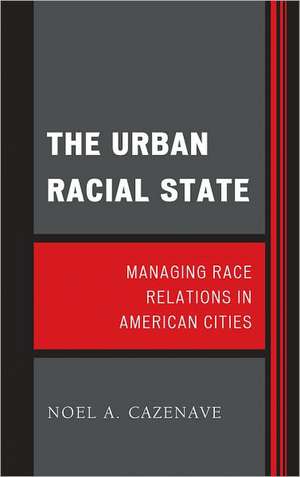
The Urban Racial State: Managing Race Relations in American Cities: Perspectives on a Multiracial America
Autor Noel A. Cazenaveen Limba Engleză Hardback – 16 apr 2011
In The Urban Racial State, Cazenave incorporates extensive archival and oral history case study data to support the placement of racism analysis as the focal point of the formulation of urban theory and the study of urban politics. Cazenave's approach offers a set of analytical tools that is sophisticated enough to address topics like the persistence of the urban racial state under the rule of African Americans and other politicians of color.
Din seria Perspectives on a Multiracial America
- 24%
 Preț: 265.06 lei
 - 25%
 Preț: 270.13 lei
 - 25%
 Preț: 257.52 lei
 - 26%
 Preț: 208.30 lei
 -
 Preț: 370.55 lei
 - 22%
 Preț: 293.48 lei
 - 28%
 Preț: 245.75 lei
 - 18%
 Preț: 338.58 lei
 - 28%
 Preț: 244.91 lei
 - 25%
 Preț: 352.03 lei
 - 30%
 Preț: 208.87 lei
 - 33%
 Preț: 497.89 lei
 - 28%
 Preț: 245.00 lei
 - 19%
 Preț: 244.24 lei
 - 29%
 Preț: 209.69 lei
 - 34%
 Preț: 492.52 lei
 - 31%
 Preț: 602.41 lei
 -
 Preț: 124.09 lei
 - 27%
 Preț: 344.26 lei
 - 26%
 Preț: 212.15 lei
 - 28%
 Preț: 482.68 lei
 - 22%
 Preț: 352.40 lei
 - 22%
 Preț: 295.70 lei
 - 20%
 Preț: 123.40 lei
Preț: 567.43 lei
Preț vechi: 883.03 lei
-36%
Puncte Express: 851
Preț estimativ în valută:
100.33€ • 118.29$ • 86.60£
100.33€ • 118.29$ • 86.60£
Carte tipărită la comandă
Livrare economică 19 martie-02 aprilie
Specificații
ISBN-13: 9781442207752
ISBN-10: 1442207752
Pagini: 224
Dimensiuni: 154 x 232 x 20 mm
Greutate: 0.5 kg
Editura: Bloomsbury Publishing
Colecția Rowman & Littlefield
Seria Perspectives on a Multiracial America
Locul publicării:New York, United States
ISBN-10: 1442207752
Pagini: 224
Dimensiuni: 154 x 232 x 20 mm
Greutate: 0.5 kg
Editura: Bloomsbury Publishing
Colecția Rowman & Littlefield
Seria Perspectives on a Multiracial America
Locul publicării:New York, United States
Cuprins
List of Illustrations
Preface and Acknowledgments
Introduction: The Urban Racial State: An Overview
Chapter 1: Understanding the Urban Racial State
Chapter 2: Programming Race Relations through Community Action
Chapter 3: The Civil Rights Movement, the War on Poverty, and Conflict over the Use of Community Action to Support African American Insurgency
Chapter 4.:Maximum Feasible Participation Meets Black Power and the White Backlash: The Struggle over Community Action in Syracuse
Chapter 5.:Black Rebellion, White Repression, and the Transformation of Community Progress, Inc. and Urban Politics in New Haven
Chapter 6: Recent Examples of the Urban Racial State
Conclusion: Summaries of Findings, Lessons Learned for Understanding Today's Urban Racial State, and What We Still Need to Know
Notes
Index
About the Author
Preface and Acknowledgments
Introduction: The Urban Racial State: An Overview
Chapter 1: Understanding the Urban Racial State
Chapter 2: Programming Race Relations through Community Action
Chapter 3: The Civil Rights Movement, the War on Poverty, and Conflict over the Use of Community Action to Support African American Insurgency
Chapter 4.:Maximum Feasible Participation Meets Black Power and the White Backlash: The Struggle over Community Action in Syracuse
Chapter 5.:Black Rebellion, White Repression, and the Transformation of Community Progress, Inc. and Urban Politics in New Haven
Chapter 6: Recent Examples of the Urban Racial State
Conclusion: Summaries of Findings, Lessons Learned for Understanding Today's Urban Racial State, and What We Still Need to Know
Notes
Index
About the Author
Recenzii
In this pathbreaking study, Noel Cazenave introduces a revelatory concept-the urban racial state-which brings to light the pivotal role that the state plays in the production and reproduction of racial inequalities. Instead of devising policies to address such fundamental problems as ghettoization, poverty, and labor market discrimination, mayors and heads of governmental agencies see their function as one of managing race relations, which they do by appeasing protest groups with minor reforms or co-opting their leaders. The end result is pacification rather than social justice and, tragically, maintenance of the racial status quo.
Noel Cazenave's book, The Urban Racial State represents the cutting edge of theoretical developments and empirical comparative studies research on managing race relations in U.S. cities. His book is a must read for all students of urban areas, whether they are focusing on urban sociology, urban government or urban race relations. In his book, Cazenave reviews the theoretical literature on urban government and state management of race relations. Out of this review, he develops a powerful theory of the urban racial state. He applies this theory to mayoral management of race relations in the cities of New Haven, Connecticut and Syracuse, New York in the late 1950s and throughout the 1960s with a focus on the impacts of the civil rights movement, the War on Poverty, maximum feasible participation through community action agencies and programs and the riots. He also applies his theory to contemporary cities focusing on the Giuliani administration in New York and the Nagin administration in New Orleans. His case studies illustrate how urban racial states have shifted from a racially oblivious mode, to a racially ameliorative position, to a racially repressive state and sometimes back to earlier modes. His theory demonstrates how the urban racial state manages race relations through a repressive state apparatus (police, courts and prisons) and an ideological apparatus (social programs, public schools and public relations). His study provides a clear picture of the structures and processes that operate to sustain racial oppression and maintain the racial status quo. As the case of Nagin of New Orleans demonstrates, these structures and processes do not disappear with the election of a black mayor.
This is a refreshing and much needed analysis about how race and continuing racial hierarchy continue to mold U.S. cities. Unfortunately, and without merit, the racial and class dimensions of how U.S. cities are evolving is missing from some recent literature on U.S. urban affairs. Cazenave's timely work and his concept of the "urban racial state" reminds us that race, class, and power dynamics should not be overlooked in analyzing the development and evolution of U.S. cities within a global context. But, further, he provides a framework that facilitates comparative insight into this subject matter in different cities and political settings.
The potential of racial explosions has always been a potent reality in America. American cities, both large and small, have served as historical incubators of explosive racial dynamics. Despite the prominence of urban racial explosions, relatively little is known about their systemic causes, trajectories and outcomes. Noel Cazenave's new book, The Urban Racial State: Managing Race Relations in American Cities, takes major steps toward providing answers as to why these racial conflicts exist in both large and small cities and the factors responsible for triggering racial explosions. This book is especially valuable in revealing the interactions between dominant power structures and insurgent social movements that determine the nature and consequences of explosive race relations. The Urban Racial State: Managing Race Relations in American Cities is a valuable study for anyone interested in understanding race relations in contemporary American cities. Scholars, policy makers and social change agents will treasure this book because its theoretical and empirical analyzes provide insights regarding real racial dynamics occurring on the ground in modern cities.
Sociologist Cazenave (Univ. of Connecticut) presents an analytical approach to studying urban racial politics. He posits that in US cities, an urban racial state (consisting of the municipal government and other key local institutions) attempts to manage race relations, with the ultimate goal of maintaining the racial status quo within a metropolitan area to the benefit of the dominant racial group, white Americans. The author provides case studies based on archival research in New Haven and Syracuse during the civil rights era of the 1950s-60s in support of his proposed theoretical approach to understanding race relations in US cities. This provocative volume provides an important contribution to the field of critical race theory. While much of the focus is upon theory construction, Cazenave also provides extensive histories of community action programs initiated in African American neighborhoods of northeastern US cities in the 1960s, which may interest broader audiences. Of strongest interest to students and scholars of US urban history, African American studies, and ethnic studies. Summing Up: Recommended. Upper-division undergraduates and above.
Noel Cazenave's book, The Urban Racial State represents the cutting edge of theoretical developments and empirical comparative studies research on managing race relations in U.S. cities. His book is a must read for all students of urban areas, whether they are focusing on urban sociology, urban government or urban race relations. In his book, Cazenave reviews the theoretical literature on urban government and state management of race relations. Out of this review, he develops a powerful theory of the urban racial state. He applies this theory to mayoral management of race relations in the cities of New Haven, Connecticut and Syracuse, New York in the late 1950s and throughout the 1960s with a focus on the impacts of the civil rights movement, the War on Poverty, maximum feasible participation through community action agencies and programs and the riots. He also applies his theory to contemporary cities focusing on the Giuliani administration in New York and the Nagin administration in New Orleans. His case studies illustrate how urban racial states have shifted from a racially oblivious mode, to a racially ameliorative position, to a racially repressive state and sometimes back to earlier modes. His theory demonstrates how the urban racial state manages race relations through a repressive state apparatus (police, courts and prisons) and an ideological apparatus (social programs, public schools and public relations). His study provides a clear picture of the structures and processes that operate to sustain racial oppression and maintain the racial status quo. As the case of Nagin of New Orleans demonstrates, these structures and processes do not disappear with the election of a black mayor.
This is a refreshing and much needed analysis about how race and continuing racial hierarchy continue to mold U.S. cities. Unfortunately, and without merit, the racial and class dimensions of how U.S. cities are evolving is missing from some recent literature on U.S. urban affairs. Cazenave's timely work and his concept of the "urban racial state" reminds us that race, class, and power dynamics should not be overlooked in analyzing the development and evolution of U.S. cities within a global context. But, further, he provides a framework that facilitates comparative insight into this subject matter in different cities and political settings.
The potential of racial explosions has always been a potent reality in America. American cities, both large and small, have served as historical incubators of explosive racial dynamics. Despite the prominence of urban racial explosions, relatively little is known about their systemic causes, trajectories and outcomes. Noel Cazenave's new book, The Urban Racial State: Managing Race Relations in American Cities, takes major steps toward providing answers as to why these racial conflicts exist in both large and small cities and the factors responsible for triggering racial explosions. This book is especially valuable in revealing the interactions between dominant power structures and insurgent social movements that determine the nature and consequences of explosive race relations. The Urban Racial State: Managing Race Relations in American Cities is a valuable study for anyone interested in understanding race relations in contemporary American cities. Scholars, policy makers and social change agents will treasure this book because its theoretical and empirical analyzes provide insights regarding real racial dynamics occurring on the ground in modern cities.
Sociologist Cazenave (Univ. of Connecticut) presents an analytical approach to studying urban racial politics. He posits that in US cities, an urban racial state (consisting of the municipal government and other key local institutions) attempts to manage race relations, with the ultimate goal of maintaining the racial status quo within a metropolitan area to the benefit of the dominant racial group, white Americans. The author provides case studies based on archival research in New Haven and Syracuse during the civil rights era of the 1950s-60s in support of his proposed theoretical approach to understanding race relations in US cities. This provocative volume provides an important contribution to the field of critical race theory. While much of the focus is upon theory construction, Cazenave also provides extensive histories of community action programs initiated in African American neighborhoods of northeastern US cities in the 1960s, which may interest broader audiences. Of strongest interest to students and scholars of US urban history, African American studies, and ethnic studies. Summing Up: Recommended. Upper-division undergraduates and above.