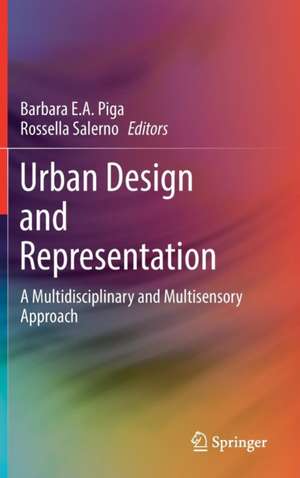
Urban Design and Representation
Editat de Barbara E. A. Piga, Rossella Salernoen Limba Engleză Hardback – 13 mar 2017
The chapters are linked by their relevance to simple but crucial questions: How can representational solutions enhance an urban design approach in which people’s well-being is considered the primary goal? How can one best represent and design the ambiance of places? What kinds of technologies and tools are available to support multisensory urban design? How can current and future environments be optimally represented and simulated, taking into account the way in which we experience places? Shedding new light on these key questions, the book offers both a reference guide for those engaged in applied research, and a toolkit for professionals and students.
Preț: 867.70 lei
Preț vechi: 1058.17 lei
-18%
Puncte Express: 1302
Carte tipărită la comandă
Livrare economică 16-30 iulie
Livrare prin curier în România Termenul estimat este afișat lângă disponibilitate.
Transport gratuit pentru acest produs Plată online sau ramburs, în funcție de opțiunile comenzii.
Retur gratuit în 14 zile Comandă securizată și suport în română.
Specificații
ISBN-13: 9783319518039
ISBN-10: 3319518038
Pagini: 232
Ilustrații: VIII, 223 p. 89 illus., 71 illus. in color.
Dimensiuni: 160 x 241 x 19 mm
Greutate: 0.52 kg
Ediția:1st edition 2017
Editura: Springer
Locul publicării:Cham, Switzerland
ISBN-10: 3319518038
Pagini: 232
Ilustrații: VIII, 223 p. 89 illus., 71 illus. in color.
Dimensiuni: 160 x 241 x 19 mm
Greutate: 0.52 kg
Ediția:1st edition 2017
Editura: Springer
Locul publicării:Cham, Switzerland
V-ar putea interesa
-
 -11%Preț: 430.79 lei484.04 lei
 -
 The Economics of Clusters: Lessons from the French ExperienceGilles Duranton-34%Preț: 591.61 lei892.25 lei
 -
 Rocky Mountain Divide: Selling and Saving the WestJohn B. WrightPreț: 223.74 lei
 -
 Preț: 190.24 lei
 -
 -18%Preț: 917.56 lei1118.98 lei
 -
 The Security ArchipelagoPaul AmarPreț: 245.11 lei
 -
 The Politics of PossibilityLouise AmoorePreț: 221.74 lei
 -
 A Companion to Global Environmental HistoryJ R McNeillPreț: 376.71 lei
 -
 GeopiracyJoel WainwrightPreț: 376.68 lei
 -
 Learning from ClustersRon A Boschma-18%Preț: 932.66 lei1137.38 lei
 -
 -24%Preț: 1124.75 lei1479.93 lei
 -
 Global ShiftPeter Dicken-23%Preț: 452.72 lei587.96 lei
 -
 Innovative Technologies in Urban MappingAntonella Contin-20%Preț: 317.70 lei397.14 lei
 -
 -15%Preț: 617.72 lei726.72 lei
 -
 -18%Preț: 753.63 lei919.07 lei
 -
 -15%Preț: 611.74 lei719.70 lei
 -
 Handbook of Regional ScienceManfred M. Fischer-18%Preț: 5553.11 lei6772.08 lei
 -
 Famine: As a Geographical PhenomenonB. Currey-18%Preț: 909.82 lei1109.53 lei
 -
 Sustainable Retail DevelopmentJerry Yudelson-18%Preț: 916.14 lei1117.25 lei
Cuprins
1.Mapping urban environment by geometry(es) and perception(s).- 2.Experiential Simulation for Urban Design: from design thinking to final presentation.- 3.Visibility analysis for open spaces in urban areas. Coupling environmental quality and human comfort assessment.- 4.Experience the void in-between buildings. Towards ready to use visual-based software solutions aiming at representing the weight of hidden parts of the vista.- 5.Evolution of planning with visual conditions.- 6.The physical model for design project: a professional experience.- 7.Architectural Modeling in a Fab Lab.- 8.Mapping Venezia.- 9.Hear through the map. Reflections on the representation of the sonic environment by means of digital technologies.- 10.Simulation as an analytical and design tool.- 11.Outdoor Augmented Reality for Urban Design and Simulation.- 12.Luminous Planning Table: TUI as support for Education and Public Participation.- 13.Mobile devices and urban ambiances. How connected wearable tools change the ways we perceive and design public spaces.
Textul de pe ultima copertă
This book explores how environmental urban design can benefit from established and emerging representation and simulation techniques that meet the need for a multisensory approach. Bringing together contributions by researchers and practicing professionals that approach the topics discussed from both theoretical and practical perspectives and draw on case-study applications, it addresses important themes including digital modeling, physical modeling, mapping, and simulation.
The chapters are linked by their relevance to simple but crucial questions: How can representational solutions enhance an urban design approach in which people’s well-being is considered the primary goal? How can one best represent and design the ambiance of places? What kinds of technologies and tools are available to support multisensory urban design? How can current and future environments be optimally represented and simulated, taking into account the way in which we experience places? Shedding new light on these key questions, the book offers both a reference guide for those engaged in applied research, and a toolkit for professionals and students.
The chapters are linked by their relevance to simple but crucial questions: How can representational solutions enhance an urban design approach in which people’s well-being is considered the primary goal? How can one best represent and design the ambiance of places? What kinds of technologies and tools are available to support multisensory urban design? How can current and future environments be optimally represented and simulated, taking into account the way in which we experience places? Shedding new light on these key questions, the book offers both a reference guide for those engaged in applied research, and a toolkit for professionals and students.
Caracteristici
Provides a multidisciplinary approach to environmental urban design
Covers both the theory and the practice of innovative techniques and technologies
Serves as a reference for those engaged in applied research and as a toolkit for professionals and students
Includes supplementary material: sn.pub/extras
Covers both the theory and the practice of innovative techniques and technologies
Serves as a reference for those engaged in applied research and as a toolkit for professionals and students
Includes supplementary material: sn.pub/extras