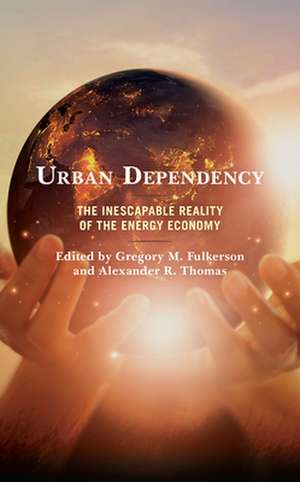
Urban Dependency: The Inescapable Reality of the Energy Economy: Studies in Urban–Rural Dynamics
Autor Gregory M. Fulkerson, Alexander R. Thomasen Limba Engleză Hardback – 15 noi 2020






Preț: 582.10 lei
Preț vechi: 863.28 lei
-33%
Puncte Express: 873
Carte tipărită la comandă
Livrare economică 02-16 decembrie
Livrare prin curier în România Termenul estimat este afișat lângă disponibilitate.
Transport gratuit pentru acest produs Plată online sau ramburs, în funcție de opțiunile comenzii.
Retur gratuit în 14 zile Comandă securizată și suport în română.
Specificații
ISBN-13: 9781793623096
ISBN-10: 1793623090
Pagini: 226
Ilustrații: 44 b/w photos; 11 tables;
Dimensiuni: 150 x 232 x 18 mm
Greutate: 0.46 kg
Editura: Bloomsbury Publishing
Colecția Lexington Books
Seria Studies in Urban–Rural Dynamics
Locul publicării:New York, United States
ISBN-10: 1793623090
Pagini: 226
Ilustrații: 44 b/w photos; 11 tables;
Dimensiuni: 150 x 232 x 18 mm
Greutate: 0.46 kg
Editura: Bloomsbury Publishing
Colecția Lexington Books
Seria Studies in Urban–Rural Dynamics
Locul publicării:New York, United States
Descriere
Urban Dependency investigates the risks of urban populations that cannot survive without the massive consumption of basic rural products like food, textiles, fossil fuels, and other energy-rich goods that are harvested by a shrinking rural base. Thomas and Fulkerson argue that though essential, rural workers and communities are poorly compensated for their labor that is both dangerous and highly exploitative. While the rural population is already shrinking, the authors predict that harsh political-economic conditions will only fuel further rural-urban migration, worsening the problem of urban dependency. The authors apply their theory of the energy economy to explore a balance between the supply and demand of energy resources that promotes rural justice.
Cuprins
Chapter 1 An Environmental Demographic Perspective
Chapter 2 Matter and Energy: Theorizing Balance
Chapter 3 The Energy Economy: Accounting for Sustainable Balance
Chapter 4 Caloric Well Analysis of Settlements
Chapter 5 World Urbanization and Urban Dependency
Chapter 6 Urban Food Dependency
Chapter 7 Urban Energy Dependency
Chapter 8 Urbanormativity and Urban Dependency
Conclusion: Sustainability and the Future of Urban-Rural Systems
Appendix 1 Definition of Population Related Municipalities
Appendix 2 Comparison of FAO Food Energy Balance Ratios
Chapter 2 Matter and Energy: Theorizing Balance
Chapter 3 The Energy Economy: Accounting for Sustainable Balance
Chapter 4 Caloric Well Analysis of Settlements
Chapter 5 World Urbanization and Urban Dependency
Chapter 6 Urban Food Dependency
Chapter 7 Urban Energy Dependency
Chapter 8 Urbanormativity and Urban Dependency
Conclusion: Sustainability and the Future of Urban-Rural Systems
Appendix 1 Definition of Population Related Municipalities
Appendix 2 Comparison of FAO Food Energy Balance Ratios
Recenzii
Urban Dependency is a must read for scholars in the area of environmental, urban and rural sociology, and the sociology of development. The book provides an excellent compendium of thought and future directions for theorizing and modeling population-environment interactions. Fulkerson and Thomas' energetic analysis of the world system is unparalleled. They deftly wed areas of emphasis in novel ways, complemented with methodological tools appropriate for such large-scale, cross-cutting analyses. Their construction of a world-level system dynamic model is a major contribution to knowledge surrounding global sustainability. As the rural-urban divide incites greater inequality worldwide, an analytic approach such as this is of increasing importance.
Avoiding complex socio-ecological dynamics between rural and urban areas, many environmental scholars have framed city-life as a solution to the global environmental crisis. With novel theoretical and empirical insight, Fulkerson and Thomas address these dynamics head-on and present a challenge to the conceptual hegemony of cities in the environmental literature. Moving from localized cases to global analyses, their work shows how an uneven settlement system circulates with an uneven ecological exchange between rural and urban. Fulkerson and Thomas stress that the question of human settlement must not be taken for granted in discussions of sustainability, as it often is.
Fulkerson and Thomas provide a superb presentation of urban dependency and an illuminating discussion of how the current urban-rural system is an unsustainable one that privileges urban populations over rural people. Urban Dependency tackles the large theme of sustainability by focusing on the often overlooked urban-rural dimension. It's a clearly written and timely account that combines a clear summary of societal energy demands with their introduction of a new energy accounting method, Caloric Well Analysis. We urgently need a societal discussion about the urban-rural relationship, and this book makes a thought-provoking contribution to that discussion.
Avoiding complex socio-ecological dynamics between rural and urban areas, many environmental scholars have framed city-life as a solution to the global environmental crisis. With novel theoretical and empirical insight, Fulkerson and Thomas address these dynamics head-on and present a challenge to the conceptual hegemony of cities in the environmental literature. Moving from localized cases to global analyses, their work shows how an uneven settlement system circulates with an uneven ecological exchange between rural and urban. Fulkerson and Thomas stress that the question of human settlement must not be taken for granted in discussions of sustainability, as it often is.
Fulkerson and Thomas provide a superb presentation of urban dependency and an illuminating discussion of how the current urban-rural system is an unsustainable one that privileges urban populations over rural people. Urban Dependency tackles the large theme of sustainability by focusing on the often overlooked urban-rural dimension. It's a clearly written and timely account that combines a clear summary of societal energy demands with their introduction of a new energy accounting method, Caloric Well Analysis. We urgently need a societal discussion about the urban-rural relationship, and this book makes a thought-provoking contribution to that discussion.