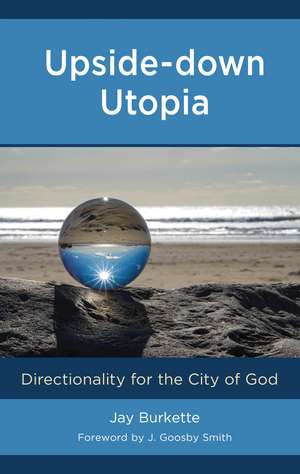
Upside-down Utopia: Directionality for the City of God
Autor Jay Burkette Cuvânt înainte de J. Goosby Smithen Limba Engleză Hardback – 15 mar 2025
Preț: 542.38 lei
Preț vechi: 818.65 lei
-34%
Puncte Express: 814
Preț estimativ în valută:
95.99€ • 112.18$ • 83.34£
95.99€ • 112.18$ • 83.34£
Carte tipărită la comandă
Livrare economică 20 februarie-06 martie
Preluare comenzi: 021 569.72.76
Specificații
ISBN-13: 9781666949049
ISBN-10: 1666949043
Pagini: 274
Dimensiuni: 152 x 229 x 19 mm
Greutate: 0.54 kg
Editura: Bloomsbury Publishing
Colecția Lexington Books
Locul publicării:New York, United States
ISBN-10: 1666949043
Pagini: 274
Dimensiuni: 152 x 229 x 19 mm
Greutate: 0.54 kg
Editura: Bloomsbury Publishing
Colecția Lexington Books
Locul publicării:New York, United States
Cuprins
Acknowledgments
Foreword
Introduction
Part I: Utopian Performativity vs. Merely-Political Comb
Chapter One: Utopia Revisited: Performative Process vs. Fixed Destination
Chapter Two: A Tale of Two Hopes, Part One
Chapter Three: A Tale of Two Hopes, Part Two
Part II: Epistemological Structures for Ordering Utopia's Method
Chapter Four: Faith as Utopia's Framework
Chapter Five: The Master's Tools: What Cannot be Utopia's Method
Chapter Six: The Ethical Minefield, a Relational Challenge
Part III: Ontological Frameworks and Practical Correctives Informing Utopia's Method
Chapter Seven: Alternate Futures: Privileged Utopian Correctives
Chapter Eight: Rediscovering an Ancient-Modern Utopian Language
Chapter Nine: A More Excellent Way: Invaded by Love
Conclusion: Mutual Vulnerability: A Disaster-Focused Theory
Appendix: Protopian Theory
Bibliography
About the Author
Foreword
Introduction
Part I: Utopian Performativity vs. Merely-Political Comb
Chapter One: Utopia Revisited: Performative Process vs. Fixed Destination
Chapter Two: A Tale of Two Hopes, Part One
Chapter Three: A Tale of Two Hopes, Part Two
Part II: Epistemological Structures for Ordering Utopia's Method
Chapter Four: Faith as Utopia's Framework
Chapter Five: The Master's Tools: What Cannot be Utopia's Method
Chapter Six: The Ethical Minefield, a Relational Challenge
Part III: Ontological Frameworks and Practical Correctives Informing Utopia's Method
Chapter Seven: Alternate Futures: Privileged Utopian Correctives
Chapter Eight: Rediscovering an Ancient-Modern Utopian Language
Chapter Nine: A More Excellent Way: Invaded by Love
Conclusion: Mutual Vulnerability: A Disaster-Focused Theory
Appendix: Protopian Theory
Bibliography
About the Author
Recenzii
Burkette's intriguing new book, Upside-Down Utopia, brings cultural, social, philosophical, and theological studies into conversation around the pursuit of a better world. His work relies on interpretations of St. Augustine, Hannah Arendt, Ruth Levitas, and Ernst Bloch, among others. The volume's key insights include the performative and processual aspects of envisioning and working toward a utopia. Recommended. Advanced undergraduates through faculty; professionals.
In this unusual book, Jay Burkette provokes readers with new ways of thinking and practicing utopia. Analyzing texts from the ancients to the moderns to the postmoderns, from German Jewish thought to African American thought, and with surprising turns including to Eminem and Camelot, Burkette builds a constructive account of utopia that synthesizes critical theory and theology. While it is unlikely that readers will agree with all of Burkette's arguments, thinking through those disagreements will surely be edifying.
I have long considered Jay Burkette an insightful thinker and wonderful conversationalist. In this provocative and indispensable work, Burkette takes bold steps-navigating the jagged terrain of weaponized vocabularies and polarized social relations-in pursuit of the utopian novum. This opportunity to engage with his formidable intellect, in long-form writing, should be cherished by anyone committed to unmaking codified social hierarchies, realizing divine human dignity, and unceasingly striving towards a better world.
In Upside-Down Utopia, Jay Burkette offers a practical guide on how to make progress toward a utopian ideal. Utopia, Burkette suggests, is a verb. Utopia is not a final state that society reaches; instead, it is a process. Burkette uses his expertise in social science and philosophy, and the religious view of the City of God, to show us how we can make a utopian ideal a reality. This book is essential reading for anyone interested in the connection between sociology, moral theory, and religion.
In this unusual book, Jay Burkette provokes readers with new ways of thinking and practicing utopia. Analyzing texts from the ancients to the moderns to the postmoderns, from German Jewish thought to African American thought, and with surprising turns including to Eminem and Camelot, Burkette builds a constructive account of utopia that synthesizes critical theory and theology. While it is unlikely that readers will agree with all of Burkette's arguments, thinking through those disagreements will surely be edifying.
I have long considered Jay Burkette an insightful thinker and wonderful conversationalist. In this provocative and indispensable work, Burkette takes bold steps-navigating the jagged terrain of weaponized vocabularies and polarized social relations-in pursuit of the utopian novum. This opportunity to engage with his formidable intellect, in long-form writing, should be cherished by anyone committed to unmaking codified social hierarchies, realizing divine human dignity, and unceasingly striving towards a better world.
In Upside-Down Utopia, Jay Burkette offers a practical guide on how to make progress toward a utopian ideal. Utopia, Burkette suggests, is a verb. Utopia is not a final state that society reaches; instead, it is a process. Burkette uses his expertise in social science and philosophy, and the religious view of the City of God, to show us how we can make a utopian ideal a reality. This book is essential reading for anyone interested in the connection between sociology, moral theory, and religion.