Cantitate/Preț
Produs

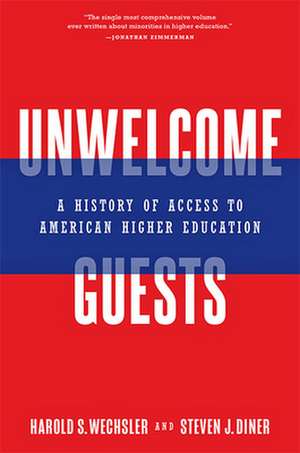
Unwelcome Guests

Autor Harold S Wechsler, Steven J Diner
en Limba Engleză Hardback – feb 2022

Notăm cu interes apariția acestei monografii sub egida Johns Hopkins University Press, o lucrare care propune o perspectivă istorică riguroasă asupra politicilor de admitere în învățământul superior american. Unwelcome Guests investighează modul în care universitățile cu predominanță albă au construit bariere sistematice împotriva grupurilor marginalizate rasial, etnic și religios. Remarcăm structura narativă care nu se limitează la analiza administrativă a criteriilor de selecție, ci oferă o voce studenților care au navigat prin medii caracterizate de indiferență sau ostilitate deschisă din partea profesorilor și a colegilor. Autorii Harold S Wechsler și Steven J Diner documentează evoluția acestor practici de la perioada de după Primul Război Mondial până la controversele juridice recente, precum procesul din 2014 privind admiterea studenților de origine asiatică la Harvard. Textul completează perspectiva oferită de The Half-Opened Door, adăugând o analiză extinsă asupra experienței studenților de culoare, în timp ce lucrarea lui Marcia Synnott se concentra precumpănitor pe elitele protestante și integrarea imigranților catolici și evrei în universitățile din Ivy League. De asemenea, spre deosebire de The Qualified Student, care analizează metodele de selecție ca instrumente de reformă, volumul de față subliniază caracterul deliberat excludent al acestor mecanisme. Reținem atenția specială acordată traiectoriilor post-absolvire, oferind astfel o imagine completă a impactului pe care discriminarea instituționalizată l-a avut asupra mobilității sociale în Statele Unite.

Citește tot Restrânge

Preț: 41231 lei

Puncte Express: 618

Carte disponibilă

Livrare economică 11-25 mai
Livrare express 25 aprilie-01 mai pentru 3196 lei


Specificații

ISBN-13: 9781421441313
ISBN-10: 1421441314
Pagini: 225
Dimensiuni: 133 x 260 x 21 mm
Greutate: 0.35 kg
Editura: Johns Hopkins University Press

De ce să citești această carte

Recomandăm această carte cercetătorilor în sociologia educației și istoria politicilor publice. Cititorul va obține o înțelegere profundă a rădăcinilor istorice ale discriminării academice, dincolo de titlurile de știri despre acțiunea afirmativă. Este o resursă esențială pentru a înțelege cum s-a format peisajul universitar contemporan și de ce diversitatea rămâne un subiect atât de disputat în mediul academic american.


Despre autor

Harold S. Wechsler a fost un distins profesor de educație și istorie, cunoscut pentru cercetările sale asupra politicilor de acces în universități, fiind autorul lucrării de referință „The Qualified Student”. Steven J. Diner este profesor de istorie și fost cancelar al Universității Rutgers-Newark, specializat în istoria urbană și a educației superioare din Statele Unite. Împreună, cei doi autori combină expertiza în arhivele universitare cu o înțelegere acută a contextului social american, oferind o analiză documentată a barierelor rasiale și religioase din mediul academic.


Notă biografică

Harold S. Wechsler (1946-2017) was a professor of education in the Steinhardt School of Culture, Education, and Human Development at New York University, where he served as the director of the program in education and Jewish studies until his death. He was the author of many books, including The Qualified Student: A History of Selective College Admission in America. Steven J. Diner is a University Professor at Rutgers University-Newark, where he served as chancellor from 2002 to 2011. He is the author of A City and Its Universities: Public Policy in Chicago, 1892-1919, and Universities and Their Cities: Urban Higher Education in America.

Descriere scurtă

"This book examines how American colleges and universities since the mid-nineteenth century have used students' race, religion, and ethnicity in deciding whom to admit and how to shape enrolled students' campus social life"--

Descriere

A comprehensive history of the barriers faced by students from marginalized racial, ethnic, and religious groups to gain access to predominantly white colleges and universities—and how these students responded to these barriers.Affirmative action in college admission is one of the most contested initiatives in contemporary federal policy, from its beginnings in the 1960s through the 2014 lawsuit alleging that Harvard discriminates against Asian American applicants. Supporters point out that using race and ethnicity as a criterion for admission helps remediate some of the effects of racist practices on minorities, including restrictions on college admissions. Opponents insist that the practice violates civil rights laws that prohibit racial discrimination and that it reenacts the historic racial bias of colleges. In Unwelcome Guests, Harold S. Wechsler and Steven J. Diner argue that discrimination in college admissions has a long and troubling history in the United States. Institutions of higher learning have vigorously sought to shape their mission and the experiences of their undergraduate students by paying careful attention to race and religion in admissions decisions. Post–World War I institutions devised exclusionary mechanisms that disadvantaged African Americans and other minority students for much of the century. Wechsler and Diner explore how American colleges and universities sought to restrict enrollment of students they considered undesirable. How, they ask, did these practices change over time? And how did underrepresented students cope with this discrimination—and with the indifference, bare tolerance, or outright hostility of some of their professors and peers? Tracing the efforts of people from underrepresented racial, ethnic, and religious groups to attend mainstream colleges, Wechsler and Diner also look at how these students fared after graduation, paying particular attention to Black women and men. Unwelcome Guests illuminates a critically important aspect of the history of American colleges and universities but also addresses policy debates about affirmative action and racial/ethnic diversity in colleges today. This profound history of the limits on college access over decades of discrimination will help readers recognize and understand the central role of race in the history of American higher education.