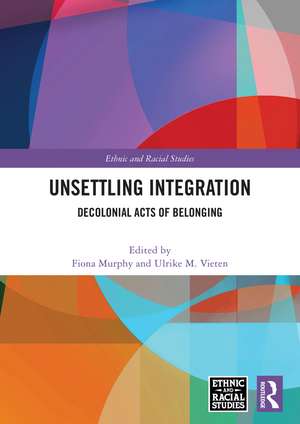
Unsettling Integration: Decolonial Acts of Belonging: Ethnic and Racial Studies
Editat de Fiona Murphy, Ulrike M. Vietenen Limba Engleză Hardback – 6 iul 2026
The volume is aimed at scholars, policymakers, activists, and students engaged in migration studies, political science, sociology, and decolonial theory. It will also resonate with practitioners working in refugee support, human rights advocacy, and international development.
The chapters in this book were originally published as a special issue of Ethnic and Racial Studies.
Din seria Ethnic and Racial Studies
-
 Preț: 266.74 lei
 -
 Preț: 309.71 lei
 -
 Preț: 469.39 lei
 -
 Preț: 437.36 lei
 -
 Preț: 435.62 lei
 -
 Preț: 473.49 lei
 - 15%
 Preț: 423.28 lei
 - 15%
 Preț: 455.18 lei
 -
 Preț: 419.64 lei
 - 18%
 Preț: 1150.77 lei
 -
 Preț: 411.72 lei
 -
 Preț: 301.45 lei
 -
 Preț: 314.87 lei
 - 15%
 Preț: 419.92 lei
 - 18%
 Preț: 1116.57 lei
 -
 Preț: 360.15 lei
 -
 Preț: 459.36 lei
 -
 Preț: 435.65 lei
 -
 Preț: 455.71 lei
 -
 Preț: 462.00 lei
 -
 Preț: 312.40 lei
 - 18%
 Preț: 1118.66 lei
 -
 Preț: 477.10 lei
 - 18%
 Preț: 1112.48 lei
 -
 Preț: 491.70 lei
 - 18%
 Preț: 1119.56 lei
 -
 Preț: 297.78 lei
 - 18%
 Preț: 1114.12 lei
 - 18%
 Preț: 778.48 lei
 - 18%
 Preț: 1144.63 lei
 - 18%
 Preț: 1113.77 lei
 -
 Preț: 462.43 lei
Preț: 1100.18 lei
Preț vechi: 1464.45 lei
-25%
Puncte Express: 1650
Carte indisponibilă temporar
Doresc să fiu notificat când acest titlu va fi disponibil:
Se trimite...
Specificații
ISBN-13: 9781041270713
ISBN-10: 1041270712
Pagini: 172
Dimensiuni: 174 x 246 mm
Greutate: 0.48 kg
Ediția:1
Editura: Taylor & Francis
Colecția Routledge
Seria Ethnic and Racial Studies
Locul publicării:Oxford, United Kingdom
ISBN-10: 1041270712
Pagini: 172
Dimensiuni: 174 x 246 mm
Greutate: 0.48 kg
Ediția:1
Editura: Taylor & Francis
Colecția Routledge
Seria Ethnic and Racial Studies
Locul publicării:Oxford, United Kingdom
Public țintă
Postgraduate, Undergraduate Advanced, and Undergraduate CoreNotă biografică
Fiona Murphy is an Anthropologist and Assistant Professor at Dublin City University, Ireland. Her research focuses on displacement, migration, and environmental change, with a particular emphasis on refugee experiences in Ireland and Turkey. She has also worked with Australia’s ‘Stolen Generation.’ Dr. Murphy’s interdisciplinary work bridges anthropology, creative writing, and advocacy, exploring themes of identity, justice, and belonging.
Ulrike M. Vieten is a transnational sociologist and Associate Professor at Queen’s University Belfast, Northern Ireland, United Kingdom, specializing in the historical construction and transformation of racialized group boundaries in and beyond Europe. She has published eight books; the latest, Loss and Liquid Citizenship in Europe: The Postmigration Condition in an Age of Populism (with Routledge), in 2025. Dr. Vieten has held various research grants focusing on displacement, minority EU citizens, refugees, and loss, e.g., working internationally with colleagues in Turkey, Ireland, Great Britain, the Netherlands, Australia, and India.
Ulrike M. Vieten is a transnational sociologist and Associate Professor at Queen’s University Belfast, Northern Ireland, United Kingdom, specializing in the historical construction and transformation of racialized group boundaries in and beyond Europe. She has published eight books; the latest, Loss and Liquid Citizenship in Europe: The Postmigration Condition in an Age of Populism (with Routledge), in 2025. Dr. Vieten has held various research grants focusing on displacement, minority EU citizens, refugees, and loss, e.g., working internationally with colleagues in Turkey, Ireland, Great Britain, the Netherlands, Australia, and India.
Cuprins
Foreword by Agnes Maillot Introduction – Decolonising refugee integration paradigms: visions for a new politics of inclusion and participation in Europe and beyond 1. Decolonizing the integration discourse through embedded narratives 2. Valuing women’s spaces and communities: refugee integration in hostile environments 3. Spaces of teaching and (un)learning: forced migration and volunteer-led English teaching 4. Exclusionary inclusion in the German higher education system. Students designated as refugees and the coloniality of epistemic power 5. Stories of hospitality: practising hospitality and intercultural dialogue in a University of Sanctuary context 6. Crafting in waiting: social entrepreneurship and refugee labour at the frontier 7. Decolonizing refugee integration: challenges and pathways for addressing protracted refugee situation in Kakuma refugee camp Afterword – Decoding “decolonising” in decolonising living and writing integration: commentary of the special issue on decolonising refugee paradigms
Descriere
This book critically examines the idea of refugee integration, challenging its colonial underpinnings and structural asymmetries while exploring alternative possibilities for inclusion. Through case studies in five countries, it delves into how education, labor, and social participation can foster just and inclusive political arrangements.