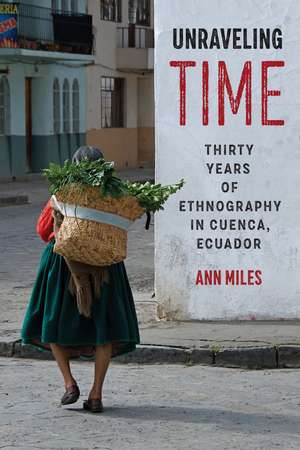
Unraveling Time: Thirty Years of Ethnography in Cuenca, Ecuador
Autor Ann Milesen Limba Engleză Paperback – 20 dec 2022
Recomandăm Unraveling Time ca pe o resursă metodologică esențială pentru cercetătorii care doresc să înțeleagă cum se manifestă transformările globale la nivelul micro-istoriei urbane. Aplicabilitatea practică a acestui volum rezidă în abordarea sa longitudinală; Ann Miles demonstrează că procesele sociale complexe, precum migrația sau dezvoltarea economică, pot fi înțelese pe deplin doar prin observarea acumulărilor de experiențe pe parcursul a trei decenii. Ne-a atras atenția modul în care autoarea reușește să transforme orașul Cuenca dintr-un simplu cadru geografic într-un laborator viu al schimbării.
Structura volumului este una inovatoare, alternând capitolele de analiză teoretică — care discută despre cosmopolitism, rolul femeilor singure și identitatea culturală — cu secțiuni de tip „Dateline”. Acestea din urmă oferă o perspectivă intimă asupra transformărilor, urmărind traiectoriile unor rezidenți precum Alejandra sau Blanca din 1988 până în 2020. Putem afirma că această „etnografie a acumulării” oferă o profunzime pe care studiile pe termen scurt nu o pot atinge, surprinzând momentul în care telefoanele mobile înlocuiesc interacțiunile de la colțul străzii sau când remitențele din străinătate încep să remodeleze arhitectura locală.
Această lucrare completează perspectiva oferită de Urban Residence de Klaufus, adăugând o dimensiune temporală mult mai vastă și o focalizare pe viețile individuale, acolo unde Klaufus se concentra pe rețelele globale și transformările peisajului urban. În contextul operei sale, Unraveling Time reprezintă o rafinare a temelor din From Cuenca to Queens, trecând de la povestea specifică a unui migrant la o analiză sistemică a modului în care migrația și gentrificarea au alterat țesutul social al unui întreg oraș. De asemenea, spre deosebire de studiile sale anterioare despre sănătate, precum Living with Lupus, acest volum se concentrează pe identitatea socio-culturală în fața modernizării accelerate.
Preț: 227.35 lei
Carte disponibilă
Livrare economică 16-30 noiembrie
Livrare express 30 octombrie-05 noiembrie pentru 26.96 lei
Specificații
ISBN-10: 1477326197
Pagini: 232
Dimensiuni: 152 x 229 x 25 mm
Greutate: 0.34 kg
Editura: University of Texas Press
Colecția University of Texas Press
De ce să citești această carte
Această carte este indispensabilă studenților și profesioniștilor din antropologie și sociologie care studiază America Latină. Cititorul câștigă o înțelegere profundă a modului în care migrația transnațională și urbanizarea afectează structura familiei și identitatea locală. Este o lecție de metodologie etnografică ce demonstrează valoarea răbdării în cercetarea socială, oferind un model clar despre cum se pot sintetiza decenii de date într-o narațiune coerentă și relevantă.
Despre autor
Ann Miles este antropolog și profesor în cadrul Departamentului de Sociologie al Western Michigan University. Cu o experiență de cercetare de peste două decenii în Cuenca, Ecuador, ea s-a specializat în studiul migrației transnaționale și al impactului social al bolilor cronice în mediile urbane. Lucrările sale anterioare reflectă un interes constant pentru intersecția dintre viața privată și forțele macroeconomice, fiind recunoscută pentru capacitatea de a aduce în prim-plan poveștile individuale ale migranților și ale familiilor acestora. Expertiza sa în regiunea andină o poziționează ca una dintre cele mai avizate voci în antropologia contemporană a Americii Latine.
Descriere scurtă
Unraveling Time traces the enduring consequences of political and social movements, transnational migration, and economic development in Cuenca. Miles reckons with details that often escape less committed observers, suggesting that we learn a good deal more when we look back on whole lives. Practicing what she calls an ethnography of accrual, Miles takes a long view, where decades of seemingly disparate experiences coalesce into cultural transformation. Her approach not only reveals what change has meant in a major Latin American city but also serves as a reflection on ethnography itself.
Notă biografică
Cuprins
- Acknowledgments
- Chapter 1. The Ethnography of Accrual: 1988–2020
- Dateline 1990: Remembering and Forgetting
- Chapter 2. Making a Cosmopolitan City
- Dateline 1988–1989: The Virgin of Cajas
- Chapter 3. Single Women in the City
- Dateline 1988–2020: Alejandra
- Chapter 4. Ni de Aqui, Ni de Allá
- Dateline 1988–2020: Blanca
- Chapter 5. The Gringo Invasion
- Dateline 2015–2019: Soon the Tourists Will Have the Place to Themselves
- Chapter 6. Thinking about Endings
- Notes
- References
- Index