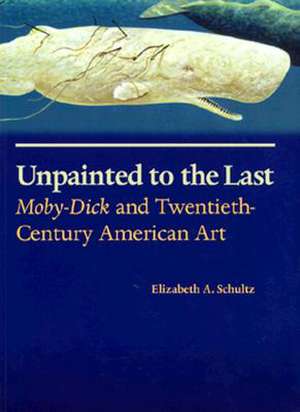
Unpainted to the Last: Moby-Dick and Twentieth-Century American Art
Autor Elizabeth A. Schultzen Limba Engleză Paperback – 30 sep 1995
Această monografie de istorie a artei și critică literară propune o incursiune fascinantă în „imaginația americană”, luând ca punct de plecare cel mai ilustrat roman din literatura Statelor Unite. Ne-a atras atenția modul în care Elizabeth A. Schultz reușește să demonstreze că capodopera lui Melville nu este doar un text de referință, ci o sursă inepuizabilă de stimuli vizuali care au modelat arta secolului XX. Descoperim aici o analiză riguroasă a modului în care balena albă a fost transpusă în medii diverse, de la benzile desenate ale lui Bill Sienkiewicz până la sculpturile monumentale ale lui Richard Serra sau pânzele expresioniste ale lui Jackson Pollock.
Abordarea este una interdisciplinară, refuzând să se limiteze la simpla descriere a ilustrațiilor de carte. Schultz investighează cum artiști precum Frank Stella sau Rockwell Kent au capturat dimensiunea vizionară a textului, transformând simbolul literar într-un instrument de explorare a realităților politice și sociale contemporane. Unpainted to the Last acoperă o arie tematică similară cu Floodgates of the Wonderworld de Robert Deltredici, dar cu o abordare mult mai extinsă din punct de vedere istoric și teoretic. În timp ce volumul lui Deltredici se concentrează pe o viziune postmodernă specifică, studiul lui Schultz oferă o panoramă vastă, de la realismul secolului trecut la abstracționismul radical, oferind cititorului o nouă metodă de a „citi” Moby Dick; Or the Whale prin prisma artelor plastice. Ritmul textului este academic, însă extrem de bogat în detalii factuale, reușind să integreze natural terminologia criticii de artă cu cea a analizei literare.
Preț: 335.32 lei
Carte disponibilă
Livrare economică 15-29 mai
Specificații
ISBN-10: 0700607420
Pagini: 400
Dimensiuni: 203 x 279 x 30 mm
Greutate: 1.62 kg
Ediția:New.
Editura: University Press of Kansas
V-ar putea interesa
-
 The Wild Ass's SkinHonoré de Balzac-5%Preț: 70.04 lei73.52 lei
 -
 -12%Preț: 283.88 lei321.51 lei
 -
 Pushkin's Lyric IntelligenceAndrew Kahn-22%Preț: 430.20 lei551.51 lei
 -
 William Blake: The PoemsNicholas MarshPreț: 170.54 lei
 -
 Mrs Warren's ProfessionBrad Kent-24%Preț: 69.91 lei92.55 lei
 -
 Jane Austen's Narrative Techniques: A Stylistic and Pragmatic AnalysisMassimiliano Morini-18%Preț: 1195.65 lei1458.11 lei
 -
 What Matters in Jane Austen?John Mullan-27%Preț: 65.15 lei89.47 lei
 -
 Frankenstein: York Notes AS & A2 - for 2026, 2027 examsGlennis ByronPreț: 60.38 lei
 -
 In Other Worlds: SF and the Human ImaginationMargaret Atwood-28%Preț: 63.20 lei88.30 lei
 -
 Bleak HouseChristine Geraghty-12%Preț: 164.20 lei187.26 lei
 -
 Eyes Wide Shut: Re-Envisioning Christina Rossetti’s Poetry and ProseMelanie A. Hanson-12%Preț: 157.83 lei179.42 lei
De ce să citești această carte
Recomandăm această carte cercetătorilor și studenților la litere sau istoria artei, dar și pasionaților de opera lui Melville. Cititorul câștigă o perspectivă inedită asupra modului în care literatura influențează direct artele vizuale, transformând un roman clasic într-un obiect de studiu multidisciplinar. Este un instrument esențial pentru a înțelege cum simbolul balenei albe a devenit un reper cultural în America modernă.
Descriere scurtă
Deftly interweaving words with images, Elizabeth Schultz radically reframes our most famous literary symbol and provides a profoundly new way of "reading" one of the key texts in American literature. Ranging from the realists to the abstract expressionists, from the famous to the obscure, Schultz reveals how these artists have tried both to capture the essence of Moby-Dick's many meanings and to use it as a springboard for their own provocative imaginations.
The most continuously, frequently, and diversely illustrated of all American novels, Moby-Dick has attracted some remarkable book illustrators in Rockwell Kent, Boardman Robinson, Garrick Palmer, Barry Moser, and Bill Sienkiewicz, among others represented here. It has also inspired extraordinary creations by such prominent artists as Jackson Pollock, Frank Stella, Sam Francis, Benton Spruance, Leonard Baskin, Theodoros Stamos, Richard Ellis, Ralph Goings, Seymour Lipton, Walter Martin, Tony Rosenthal, Richard Serra, and Theodore Roszak.
The artists reflect in equal measure the novel's realistic (plot, character, natural history) and philosophical modes, its visual and visionary dimensions. Some, like the obsessed and haunted Gilbert Wilson, claim "Moby-Dick" as their "Bible." Still others view the novel as a touchstone for feminist, multicultural, and environmentalist themes, or mock its status as a cultural icon.
Schultz demonstrates how these and many other diverse talents enlarge our appreciation of "Moby-Dick" and how literature and art can amplify each other's meanings and achievements. Yet ultimately she, like Melville, concludes that the great white whale remains unpainted and unread in any absolute or final sense.