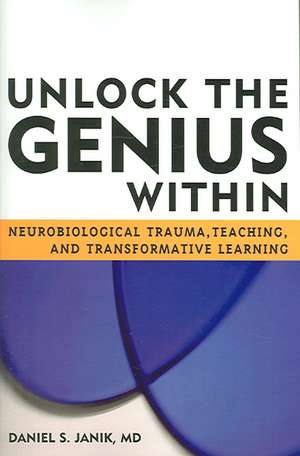
Unlock the Genius Within: Neurobiological Trauma, Teaching, and Transformative Learning
Autor Janik, MD, PhD, Daniel S.en Limba Engleză Paperback – 8 sep 2005
Features:
·Descriptions of classical and contemporary research alongside allusions to popular movies and television programs
·Suggested further readings
·Neurobiological learning web resources
Throughout this book, the author incorporates humor, wisdom, and anecdotes to draw readers into traditionally incomprehensible concepts and information that demonstrates transformational learning. It will be of interest to teachers (postsecondary, secondary, and ESL), administrators, counselors, parents, students, and medical researchers.
Preț: 363.08 lei
Preț vechi: 461.84 lei
-21%
Puncte Express: 545
Carte tipărită la comandă
Livrare economică 20 noiembrie-04 decembrie
Livrare prin curier în România Termenul estimat este afișat lângă disponibilitate.
Transport gratuit de la 400.00 lei Plată online sau ramburs, în funcție de opțiunile comenzii.
Retur gratuit în 14 zile Comandă securizată și suport în română.
Specificații
ISBN-13: 9781578862917
ISBN-10: 1578862914
Pagini: 230
Dimensiuni: 148 x 226 x 16 mm
Greutate: 0.34 kg
Ediția:New.
Editura: Bloomsbury Publishing
Colecția R&L Education
Locul publicării:New York, United States
ISBN-10: 1578862914
Pagini: 230
Dimensiuni: 148 x 226 x 16 mm
Greutate: 0.34 kg
Ediția:New.
Editura: Bloomsbury Publishing
Colecția R&L Education
Locul publicării:New York, United States
Recenzii
[A] topic of extreme importance, yet there is no proper coverage of the subject in the open literature. . . . The parts of the book related to neurobiological learning are especially strong. The questions asked in that part are the crucial ones, and they open many new avenues for research. . . . I personally will use this book in my graduate teaching.
Readable, very informative. . . . The concepts put forth are applicable to today's students and their unique needs. . . . This book is a tool that will take them beyond trying to actually succeeding. As I read, I was conscious of an overwhelming feeling of 'I wish I had known that.' I can see this book revolutionizing education as we know it.
Informative, educative, stimulating, and fun to read. . . . Recent scientific findings are introduced and explained in a language that I think is fairly accessible . . . especially fascinating and helpful to someone like myself, a language teacher who teaches language and at the same time studies it academically.
A welcome addition to current work on . . . effective learning. After his academic book, A Neurobiological Theory and Method of Language Acquisition, [Janik] now presents us with a text stripped of the medical, biological, linguistic, and educational jargon, highlighting the most compelling and important contemporary contributions to neurobiological learning . . . [and] its derivative, transformational learning.
To an informed language specialist, this book gives a lot to digest, a lot to enjoy, a lot to wonder about. Combining his expertise in medicine and in education, [Dan Janik] has pushed language education theory and practice a quantum leap ahead. . . . To an SLA researcher and an FL educationalist, this fine and exquisite book tells a different story: something that has not yet been touched upon in the research literature. Simply, this book is thought-provoking, eye-opening, and immensely immersive. I will personally recommend it to all my language colleagues and to our future student teachers.
Written in a style accessible to the general reader, this volume is a good primer for those wishing to learn how effective learning via practical mentoring can be so much more rewarding to students, than standard 'talk and chalk' teaching practice. ...there is much to be gained from this book with regards shifting one's affective teaching style, methodology and effective pedagogical practice towards mentoring in determining student learning outcome...
Sections concerned with the history of learning theories (from the ancient Greeks, through Darwin to behaviorism and the new cognitive revolution), the evolution of the nervous system, and brain imaging techniques are very valuable, and are made easily accessible to the lay reader in simple language.
...I must recommend [the book's] inclusion on the reading list of any teachers and instructors wishing to explore the power of good mentoring, and its potential for enhancing the intellects of those willing to afford the luxury of such intimacy, time, and energy that is required for such potentially rewarding voyages of discovery.
This book takes a new look at how humans acquire language and knowledge.... A good book for your...reading.
Janik wondered about the extent to which traditional classroom teaching that stresses imposed efficiency and mastery invokes the emotional side effects of trauma. The result is his intriguing book, Unlock the Genius Within: Neurobiological Trauma, Teaching, and Transformative Learning. In it, he describes the principal and side effects of traumatic learning as they occur in the classroom, the neurobiological mechanisms underlying them, and the resulting collective inhibition of curiosity.
The culmination of over 20 years of work, Dr. Janik discusses the traumatic roots of traditional teaching, how traditional teaching, while effective, results in loss of interest and creativity, and proceeds to describe the neurobiological foundations of a new form of nontraumatic learning-transformative learning-that is equally effective but free of the liabilities of traditional teaching.
Janik describes his neurobiological theory of learning using a minimum of technical jargon. Drawing upon his experience working with patients recovering from trauma, he identifies some basic principles of effective learning and suggests how they may be applied in a wide range of educational settings.
The author weaves an integrated philosophical and physical net to contain his neurobiological theory of learning. The comments on education and the suppositions on the physicality of learning are intriguing and fascinating.
Readable, very informative. . . . The concepts put forth are applicable to today's students and their unique needs. . . . This book is a tool that will take them beyond trying to actually succeeding. As I read, I was conscious of an overwhelming feeling of 'I wish I had known that.' I can see this book revolutionizing education as we know it.
Informative, educative, stimulating, and fun to read. . . . Recent scientific findings are introduced and explained in a language that I think is fairly accessible . . . especially fascinating and helpful to someone like myself, a language teacher who teaches language and at the same time studies it academically.
A welcome addition to current work on . . . effective learning. After his academic book, A Neurobiological Theory and Method of Language Acquisition, [Janik] now presents us with a text stripped of the medical, biological, linguistic, and educational jargon, highlighting the most compelling and important contemporary contributions to neurobiological learning . . . [and] its derivative, transformational learning.
To an informed language specialist, this book gives a lot to digest, a lot to enjoy, a lot to wonder about. Combining his expertise in medicine and in education, [Dan Janik] has pushed language education theory and practice a quantum leap ahead. . . . To an SLA researcher and an FL educationalist, this fine and exquisite book tells a different story: something that has not yet been touched upon in the research literature. Simply, this book is thought-provoking, eye-opening, and immensely immersive. I will personally recommend it to all my language colleagues and to our future student teachers.
Written in a style accessible to the general reader, this volume is a good primer for those wishing to learn how effective learning via practical mentoring can be so much more rewarding to students, than standard 'talk and chalk' teaching practice. ...there is much to be gained from this book with regards shifting one's affective teaching style, methodology and effective pedagogical practice towards mentoring in determining student learning outcome...
Sections concerned with the history of learning theories (from the ancient Greeks, through Darwin to behaviorism and the new cognitive revolution), the evolution of the nervous system, and brain imaging techniques are very valuable, and are made easily accessible to the lay reader in simple language.
...I must recommend [the book's] inclusion on the reading list of any teachers and instructors wishing to explore the power of good mentoring, and its potential for enhancing the intellects of those willing to afford the luxury of such intimacy, time, and energy that is required for such potentially rewarding voyages of discovery.
This book takes a new look at how humans acquire language and knowledge.... A good book for your...reading.
Janik wondered about the extent to which traditional classroom teaching that stresses imposed efficiency and mastery invokes the emotional side effects of trauma. The result is his intriguing book, Unlock the Genius Within: Neurobiological Trauma, Teaching, and Transformative Learning. In it, he describes the principal and side effects of traumatic learning as they occur in the classroom, the neurobiological mechanisms underlying them, and the resulting collective inhibition of curiosity.
The culmination of over 20 years of work, Dr. Janik discusses the traumatic roots of traditional teaching, how traditional teaching, while effective, results in loss of interest and creativity, and proceeds to describe the neurobiological foundations of a new form of nontraumatic learning-transformative learning-that is equally effective but free of the liabilities of traditional teaching.
Janik describes his neurobiological theory of learning using a minimum of technical jargon. Drawing upon his experience working with patients recovering from trauma, he identifies some basic principles of effective learning and suggests how they may be applied in a wide range of educational settings.
The author weaves an integrated philosophical and physical net to contain his neurobiological theory of learning. The comments on education and the suppositions on the physicality of learning are intriguing and fascinating.