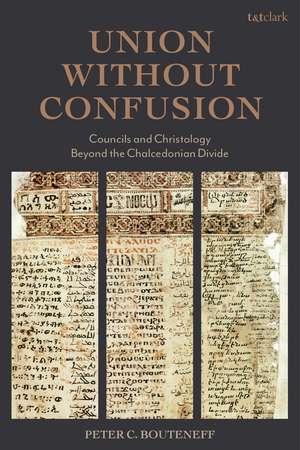
Union Without Confusion: Councils and Christology Beyond the Chalcedonian Divide
Autor Professor Peter C. Bouteneffen Limba Engleză Hardback – 19 feb 2026
This study examines the theological formulations of the seven great councils alongside other key writings- presented here in Greek with English translations. It invites a reconsideration of figures long revered or rejected by the different churches, and traces how Greek philosophical terminology was gradually reshaped to express Christian belief-a process that took different forms across the diverse regions in late antiquity.
More than a reappraisal of the past, this study challenges readers to reflect on the nature of patristic authority, and its enduring implications for theology and the restoration of communion among the churches.
Preț: 550.36 lei
Preț vechi: 815.86 lei
-33%
Puncte Express: 826
Carte disponibilă
Livrare economică 10-24 noiembrie
Livrare prin curier în România Termenul estimat este afișat lângă disponibilitate.
Transport gratuit pentru acest produs Plată online sau ramburs, în funcție de opțiunile comenzii.
Retur gratuit în 14 zile Comandă securizată și suport în română.
Specificații
ISBN-13: 9780567724847
ISBN-10: 0567724840
Pagini: 200
Dimensiuni: 164 x 236 x 18 mm
Greutate: 0.45 kg
Editura: Bloomsbury Publishing
Colecția T&T Clark
Locul publicării:London, United Kingdom
ISBN-10: 0567724840
Pagini: 200
Dimensiuni: 164 x 236 x 18 mm
Greutate: 0.45 kg
Editura: Bloomsbury Publishing
Colecția T&T Clark
Locul publicării:London, United Kingdom
Cuprins
Preface
I. Introduction: An Ancient Schism in a New Light
II. Communion and Discord: History and Theology Through the Church's Great Councils
The Fourth Century: Nicea, Constantinople, and their Interim
From Ephesus to Constantinople III: A Conciliar Tetrad
III. Conclusions: Revisiting The Past In Our Own Day
Appendix
Abbreviations
Bibliography
Index
I. Introduction: An Ancient Schism in a New Light
II. Communion and Discord: History and Theology Through the Church's Great Councils
The Fourth Century: Nicea, Constantinople, and their Interim
From Ephesus to Constantinople III: A Conciliar Tetrad
III. Conclusions: Revisiting The Past In Our Own Day
Appendix
Abbreviations
Bibliography
Index
Recenzii
Agreed Statements from the bilateral dialogue, both Non-Official and Official, suggest that the Eastern Orthodox and the Oriental Orthodox are in fact very close in their understanding of the mystery of the Incarnation. Hesitations which have been expressed from both sides, however, have hindered further progress. Since many of these hesitations turn out to be based on polemical misunderstandings of the past which have become fossilized over the course of time, Peter Bouteneff's eirenic and more objective revisiting of the key documents of the controversies is most welcome, and it is greatly to be hoped that his book will help to remove misconceptions on both sides which have been inherited from the past.
This is a learned and sensitive study by a distinguished Eastern Orthodox scholar. It has arisen from a conviction that the problems arising from the fifth-century Chalcedonian schism that still divides the Eastern Orthodox and Oriental Orthodox communions are resolvable through reconceiving the way in which conciliar and patristic authority functions. Marked by clarity of thought and written in accessible language despite the complexity of the subject, Bouteneff's book is essential reading for anyone concerned with healing the division between these two closely related but long-estranged Christian families.
Bouteneff's study offers a historically nuanced and theologically rigorous analysis of the fifth century Christological controversies with an eye to the contemporary dialogue between the Eastern and Oriental Orthodox Churches. By consistently defending term/meaning distinction, Bouteneff shows that the schism of the two churches was primarily a result of terminological misunderstandings rather than profound doctrinal differences. The book is an important contribution to the healing of theological memories, so much needed in our time.
This is a learned and sensitive study by a distinguished Eastern Orthodox scholar. It has arisen from a conviction that the problems arising from the fifth-century Chalcedonian schism that still divides the Eastern Orthodox and Oriental Orthodox communions are resolvable through reconceiving the way in which conciliar and patristic authority functions. Marked by clarity of thought and written in accessible language despite the complexity of the subject, Bouteneff's book is essential reading for anyone concerned with healing the division between these two closely related but long-estranged Christian families.
Bouteneff's study offers a historically nuanced and theologically rigorous analysis of the fifth century Christological controversies with an eye to the contemporary dialogue between the Eastern and Oriental Orthodox Churches. By consistently defending term/meaning distinction, Bouteneff shows that the schism of the two churches was primarily a result of terminological misunderstandings rather than profound doctrinal differences. The book is an important contribution to the healing of theological memories, so much needed in our time.