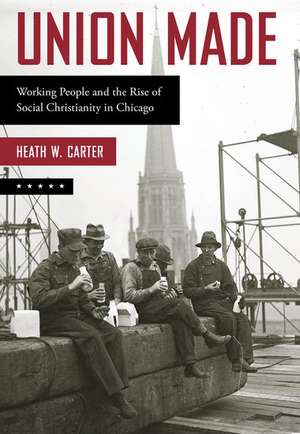
Union Made: Working People and the Rise of Social Christianity in Chicago
Autor Heath W. Carteren Limba Engleză Paperback – 4 ian 2018
Preț: 293.82 lei
Preț vechi: 368.11 lei
-20%
Puncte Express: 441
Carte tipărită la comandă
Livrare economică 03-09 decembrie
Livrare prin curier în România Termenul estimat este afișat lângă disponibilitate.
Transport gratuit de la 400.00 lei Plată online sau ramburs, în funcție de opțiunile comenzii.
Retur gratuit în 14 zile Comandă securizată și suport în română.
Specificații
ISBN-13: 9780190847371
ISBN-10: 0190847379
Pagini: 296
Ilustrații: 18 illus.
Dimensiuni: 155 x 231 x 20 mm
Greutate: 0.42 kg
Editura: Oxford University Press
Colecția OUP USA
Locul publicării:New York, United States
ISBN-10: 0190847379
Pagini: 296
Ilustrații: 18 illus.
Dimensiuni: 155 x 231 x 20 mm
Greutate: 0.42 kg
Editura: Oxford University Press
Colecția OUP USA
Locul publicării:New York, United States
Recenzii
Animated with moral energy, Union Made is engagingly written and passionately argued.
The author's respect for those 'prophets' is patent throughout the book, and he demonstrates why they deserve such respect.
[A] highly readable narrative The book's strengths lie in clear, narrative prose that belies the enormous primary and secondary research the book required Recommended.
Carter's strong, clear argument is based on his extensive and creative research, as well as a highly readable narrative His narrative skillfully interweaves biographical information on key actors and situates the story in concrete places [F]orcefully crafted and ambitiously conceived [T]he author deserves much praise for crafting a long overdue and engaging study that interrelates working people's mobilization at the job and in union halls with their stands in the pews, and for relating those activities with some of the great challenges faced by Gilded Age America.
[M]eticulously researched and stimulating [Carter] argues convincingly that working people were 'at the very center of fierce fights to reconcile democracy and capitalism in the industrializing world' His use of many interesting vignettes makes his account very lively.
A common critique in this subfield is the privileged focus it often places on mainline Protestants and on the voices of religious and labor leaders. Carter, in contrast, furthers our understanding of the complexities of the working-class religious experiences by including the detailed ideas of Catholics, women, black workers, and other non-native-born rank and file workers. By taking into account such diversity, Carter's narrative makes a tremendous contribution to the on-going scholarship in this area.
Ambitious Carter persuasively illustrates the existence of a working-class Christian discourse that predates the work of Social Gospel proponents such as Walter Rauschenbusch [H]is book will prompt thinking about the place of working-class religion in nineteenth-century culture.
[L]ucid and extensively documented Union Made is a wonderful resource for those interested in the progressive movement and the social gospel. Readers will find the extensive research to be clear and well-written. Yet this book's greatest achievement is not merely its expansive exposé of social Christianity in Chicago, but how closely it mirrors current movements for economic justice.
[A] careful exploration Carter has a knack for placing his big argument
In contemporary America, where the gulf between the rich and poor threatens to yawn that wide again, Christianity and conservative politics have become so intertwined that many American believers are convinced that their faith mandates small government....Carter, however, shows us a different route.
A fascinating historical journey.
A huge accomplishment a gift to everyone interested in American history, and a huge gift to those with a keen interest in the role that Christianity played in American-North American, even-social and economic history.
Gracefully written and richly illustrated, Union Made is an eminently accessible text. It is also of pressing relevance in our present age of staggering prosperity and shameful poverty.
Required reading for all who are studying the Social Gospel.
In Union Made: Working People and the Rise of Social Christianity in Chicago, Carter recovers what has been lost to the rhetoric of the Christian right, namely that Christianity (even its evangelical iterations) aligns very well with the goals of organizers fighting for justice and dignity in their work.
At the height of the industrial age, working-class Chicago buzzed with talk and action about a progressive Christianity based on the Golden Rule. Heath Carter's Union Made is a brilliantly researched, vividly written, and unfailingly wise work of history that transforms our conception of the Social Gospel.
No mere opiate or tool of oppression, working-class faith emerges from the pages of this extraordinary book as the generative force that made the nineteenth-century social gospel viable. Social Christianity made resistance against industrial capitalism and its barons a possible and necessary thing. Combining the finest qualities of classic social, urban, and labor histories with the curiosities of our scholarly (and political) moment, Union Made is a sharp, much-needed reminder that American Christianity has not always been free-market in persuasion or comfortable on the corporate side. Beautifully crafted, it is also a stirring must-read.
Heath Carter's Union Made is a powerful and important book. It persuasively documents the working class origins of Social Christianity among Protestant and Catholics alike. It also makes clear that the decline of this Social Gospel tradition has left us increasingly vulnerable to the conscienceless capitalism of our own time. Reading it reminds us of what we have lost.
Union Made provides an amazing history of the battle between elite religious leaders and workers and their pastors to define the meaning of Christianity in society. Set in Chicago... Carter's deep research allows the words from pastors and labor leaders from across the city to come alive. If you care about the intersection of faith and labor, the development of the social gospel, or labor history in Chicago, this is a must read.
In recovering these working-class voices, Carter makes a significant scholarly contribution to the field of American religious history while also deepening our understanding of the labor movement during the Gilded Age and Progressive Era. More than just recasting the origins of Social Christianity, he reminds us of the profound moral debates that surrounded the rise of industrial capitalism and reveals how workers campaigned for justice as forcefully and ardently within the religious sphere as they did in the political and economic arenas.
Carter makes a signal contribution to the history of the social gospel by excavating its working-class roots.
Carter's claims are interesting and provocative. Union Made provides crucial insights into how many skilled workers rejected socialism or secularism in favor of a reformist Christianity that conceived of a new and more equitable cooperation between laborers and the church. As historians search for the grassroots origins of the religious right and its support of laissez-faire corporate power, it is interesting to note the existence of an earlier counternarrative that pushed urban Protestants toward liberalism and the New Deal state.
The author's respect for those 'prophets' is patent throughout the book, and he demonstrates why they deserve such respect.
[A] highly readable narrative The book's strengths lie in clear, narrative prose that belies the enormous primary and secondary research the book required Recommended.
Carter's strong, clear argument is based on his extensive and creative research, as well as a highly readable narrative His narrative skillfully interweaves biographical information on key actors and situates the story in concrete places [F]orcefully crafted and ambitiously conceived [T]he author deserves much praise for crafting a long overdue and engaging study that interrelates working people's mobilization at the job and in union halls with their stands in the pews, and for relating those activities with some of the great challenges faced by Gilded Age America.
[M]eticulously researched and stimulating [Carter] argues convincingly that working people were 'at the very center of fierce fights to reconcile democracy and capitalism in the industrializing world' His use of many interesting vignettes makes his account very lively.
A common critique in this subfield is the privileged focus it often places on mainline Protestants and on the voices of religious and labor leaders. Carter, in contrast, furthers our understanding of the complexities of the working-class religious experiences by including the detailed ideas of Catholics, women, black workers, and other non-native-born rank and file workers. By taking into account such diversity, Carter's narrative makes a tremendous contribution to the on-going scholarship in this area.
Ambitious Carter persuasively illustrates the existence of a working-class Christian discourse that predates the work of Social Gospel proponents such as Walter Rauschenbusch [H]is book will prompt thinking about the place of working-class religion in nineteenth-century culture.
[L]ucid and extensively documented Union Made is a wonderful resource for those interested in the progressive movement and the social gospel. Readers will find the extensive research to be clear and well-written. Yet this book's greatest achievement is not merely its expansive exposé of social Christianity in Chicago, but how closely it mirrors current movements for economic justice.
[A] careful exploration Carter has a knack for placing his big argument
In contemporary America, where the gulf between the rich and poor threatens to yawn that wide again, Christianity and conservative politics have become so intertwined that many American believers are convinced that their faith mandates small government....Carter, however, shows us a different route.
A fascinating historical journey.
A huge accomplishment a gift to everyone interested in American history, and a huge gift to those with a keen interest in the role that Christianity played in American-North American, even-social and economic history.
Gracefully written and richly illustrated, Union Made is an eminently accessible text. It is also of pressing relevance in our present age of staggering prosperity and shameful poverty.
Required reading for all who are studying the Social Gospel.
In Union Made: Working People and the Rise of Social Christianity in Chicago, Carter recovers what has been lost to the rhetoric of the Christian right, namely that Christianity (even its evangelical iterations) aligns very well with the goals of organizers fighting for justice and dignity in their work.
At the height of the industrial age, working-class Chicago buzzed with talk and action about a progressive Christianity based on the Golden Rule. Heath Carter's Union Made is a brilliantly researched, vividly written, and unfailingly wise work of history that transforms our conception of the Social Gospel.
No mere opiate or tool of oppression, working-class faith emerges from the pages of this extraordinary book as the generative force that made the nineteenth-century social gospel viable. Social Christianity made resistance against industrial capitalism and its barons a possible and necessary thing. Combining the finest qualities of classic social, urban, and labor histories with the curiosities of our scholarly (and political) moment, Union Made is a sharp, much-needed reminder that American Christianity has not always been free-market in persuasion or comfortable on the corporate side. Beautifully crafted, it is also a stirring must-read.
Heath Carter's Union Made is a powerful and important book. It persuasively documents the working class origins of Social Christianity among Protestant and Catholics alike. It also makes clear that the decline of this Social Gospel tradition has left us increasingly vulnerable to the conscienceless capitalism of our own time. Reading it reminds us of what we have lost.
Union Made provides an amazing history of the battle between elite religious leaders and workers and their pastors to define the meaning of Christianity in society. Set in Chicago... Carter's deep research allows the words from pastors and labor leaders from across the city to come alive. If you care about the intersection of faith and labor, the development of the social gospel, or labor history in Chicago, this is a must read.
In recovering these working-class voices, Carter makes a significant scholarly contribution to the field of American religious history while also deepening our understanding of the labor movement during the Gilded Age and Progressive Era. More than just recasting the origins of Social Christianity, he reminds us of the profound moral debates that surrounded the rise of industrial capitalism and reveals how workers campaigned for justice as forcefully and ardently within the religious sphere as they did in the political and economic arenas.
Carter makes a signal contribution to the history of the social gospel by excavating its working-class roots.
Carter's claims are interesting and provocative. Union Made provides crucial insights into how many skilled workers rejected socialism or secularism in favor of a reformist Christianity that conceived of a new and more equitable cooperation between laborers and the church. As historians search for the grassroots origins of the religious right and its support of laissez-faire corporate power, it is interesting to note the existence of an earlier counternarrative that pushed urban Protestants toward liberalism and the New Deal state.
Notă biografică
Heath W. Carter is an assistant professor at Valparaiso University, where he teaches a variety of courses on the history of the modern United States. He is a co-editor of two forthcoming volumes on religion in American history.