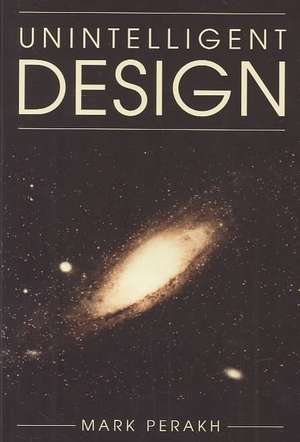
Unintelligent Design
Autor Mark Perakhen Limba Engleză Hardback – dec 2003
Beginning with the design theorists, Perakh provides a detailed critique of the publications of William Dembski, Michael Behe, and Phillip Johnson. In each case he clearly demonstrates lack of substantiation, internal contradictions, and multiple fallacies that mar their works.
In Part Two he critiques the "mental acrobatics" of various Christian and Jewish writers whose works attempt to prove such unlikely propositions as: the inerrancy of the Bible, the harmony of the Torah and science, the duration of the six days of creation, and deriving a theory of nonrandom evolution from the Talmud.
Part Three describes how genuine science is conducted, what the laws of science actually mean to practicing scientists, and what distinguishes real science from pseudoscience.
In conclusion, Perakh discusses the rise and fall of the so-called Bible code as an example of how well-marketed pseudoscience can successfully cloak itself in the mantle of science.
For everyone interested in separating scientific facts from the hype of trendy theories about science, this book is must reading.
Preț: 243.41 lei
Puncte Express: 365
Carte disponibilă
Livrare economică 11-25 noiembrie
Livrare prin curier în România Termenul estimat este afișat lângă disponibilitate.
Transport gratuit de la 400.00 lei Plată online sau ramburs, în funcție de opțiunile comenzii.
Retur gratuit în 14 zile Comandă securizată și suport în română.
Specificații
ISBN-13: 9781591020844
ISBN-10: 1591020840
Pagini: 459
Dimensiuni: 164 x 238 x 40 mm
Greutate: 0.81 kg
Ediția:New.
Editura: Globe Pequot Publishing
ISBN-10: 1591020840
Pagini: 459
Dimensiuni: 164 x 238 x 40 mm
Greutate: 0.81 kg
Ediția:New.
Editura: Globe Pequot Publishing
Notă biografică
Mark Perakh is a prize-winning professor emeritus of physics at California State University at Fullerton and the author of four books and nearly 300 scientific articles.
Descriere
Physicist Perakh critically reviews recent trends towards harmonizing religion and science, and shows that all such approaches are little more than tailoring evidence to fit the desired theory.