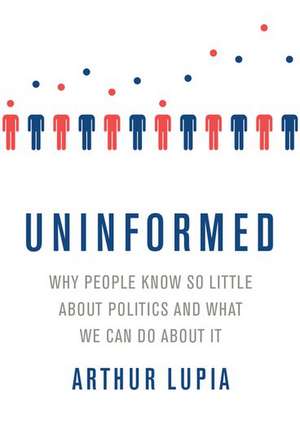
Uninformed: Why People Seem to Know So Little about Politics and What We Can Do about It
Autor Arthur Lupiaen Limba Engleză Paperback – 15 iun 2017
Preț: 189.48 lei
Preț vechi: 223.40 lei
-15%
Puncte Express: 284
Carte disponibilă
Livrare economică 06-11 noiembrie
Livrare prin curier în România Termenul estimat este afișat lângă disponibilitate.
Transport gratuit de la 400.00 lei Plată online sau ramburs, în funcție de opțiunile comenzii.
Retur gratuit în 14 zile Comandă securizată și suport în română.
Specificații
ISBN-13: 9780190659936
ISBN-10: 0190659939
Pagini: 360
Dimensiuni: 155 x 231 x 23 mm
Greutate: 0.5 kg
Editura: Oxford University Press
Colecția OUP USA
Locul publicării:New York, United States
ISBN-10: 0190659939
Pagini: 360
Dimensiuni: 155 x 231 x 23 mm
Greutate: 0.5 kg
Editura: Oxford University Press
Colecția OUP USA
Locul publicării:New York, United States
V-ar putea interesa
-
 Preț: 276.75 lei
 -
 -24%Preț: 157.13 lei206.84 lei
 -
 -33%Preț: 1249.03 lei1860.06 lei
 -
 Political Choice in BritainHarold D. Clarke-28%Preț: 395.97 lei551.67 lei
 -
 Presidential Campaigning and Social Media: An Analysis of the 2012 CampaignJohn Allen Hendricks-23%Preț: 607.38 lei788.81 lei
 -
 The Simple Art of Voting: The Cognitive Shortcuts of Italian VotersDelia Baldassarri-23%Preț: 370.50 lei482.44 lei
 -
 -13%Preț: 279.30 lei320.96 lei
 -
 Cambridge Handbook of Experimental Political ScienceJames N. DruckmanPreț: 450.53 lei
 -
 The Democratic DilemmaArthur LupiaPreț: 248.36 lei
 -
 Elements of ReasonArthur LupiaPreț: 281.43 lei
 -
 Winning Elections in the 21st CenturyDick SimpsonPreț: 229.23 lei
 -
 Scotland's Referendum and the MediaNeil Blain-25%Preț: 599.48 lei798.41 lei
 -
 Scotland's Referendum and the MediaNeil Blain-16%Preț: 208.54 lei248.96 lei
 -
 National Elections in Turkey: People, Politics, and the Party SystemF. Michael WuthrichPreț: 384.97 lei
 -
 The Political Geography of Campaign FinanceAndrew DowdlePreț: 388.17 lei
 -
 Political Campaigns in the United StatesRichard K. Scher-15%Preț: 447.39 lei526.34 lei
 -
 -15%Preț: 418.47 lei492.32 lei
 -
 -18%Preț: 1349.03 lei1645.15 lei
 -
 Elections and Democratization in the PhilippinesJennifer FrancoPreț: 477.59 lei
 -
 The Political Battle over Congressional RedistrictingWilliam J. Miller Jr.-34%Preț: 383.68 lei581.18 lei
 -
 -25%Preț: 102.96 lei137.91 lei
 -
 The Merkel RepublicEric LangenbacherPreț: 262.57 lei
 -
 Can Labour Win?: The Hard Road to PowerPatrick Diamond-22%Preț: 126.72 lei162.30 lei
Recenzii
Lupia has spent his professional lifetime mastering the art,the science, in his hands, of education in the broadest sense. He has much to offer and does so supremely. Uninformed is not only an excellent guide to educating people about politics, but also an instruction manual in pedagogy more broadly.
Lupia presents solutions to improve the interaction and communication strategies of those who would seek to improve citizens' political knowledge...
Why don't more voters come forward to support-or reject-new laws and regulations that would directly affect them? In his new book, ^lUninformed: Why People Seem to Know So Little About Politics and What We Can Do About It, political scientist Arthur Lupia argues that it's a matter of education. And America's key influencers, he writes, should address this-by making things personal. Rather than focusing on how an environmental regulation might slightly change the temperature on a polar ice cap, for example, Lupia contends that journalists, teachers and advocates should explain how it will save a local elementary school from ending up underwater. Once voters are hooked on a big-picture concept, it's easier to get them engaged with the details of a law, rule or regulation-and take informed action to help it pass, fail or evolve.
In Uninformed, Lupia provides sightlines for educators to ... add new voices of reason, inflections of passion, and perhaps, murmurs of compromise to our political discourse."
Lupia presents solutions to improve the interaction and communication strategies of those who would seek to improve citizens' political knowledge...
Why don't more voters come forward to support-or reject-new laws and regulations that would directly affect them? In his new book, ^lUninformed: Why People Seem to Know So Little About Politics and What We Can Do About It, political scientist Arthur Lupia argues that it's a matter of education. And America's key influencers, he writes, should address this-by making things personal. Rather than focusing on how an environmental regulation might slightly change the temperature on a polar ice cap, for example, Lupia contends that journalists, teachers and advocates should explain how it will save a local elementary school from ending up underwater. Once voters are hooked on a big-picture concept, it's easier to get them engaged with the details of a law, rule or regulation-and take informed action to help it pass, fail or evolve.
In Uninformed, Lupia provides sightlines for educators to ... add new voices of reason, inflections of passion, and perhaps, murmurs of compromise to our political discourse."
Notă biografică
Arthur Lupia is the Hal R. Varian Collegiate Professor of Political Science at the University of Michigan. He serves on advisory boards for several science communication endeavors, including the Division of Behavioral and Social Sciences and Education at the National Academy of Science and Climate Central. He is also Chair of the American Political Science Association Task Force on Improving Public Engagement.
Cuprins
- TABLE OF CONTENTS
- Dedication
- Acknowledgements
- 1. From Infinite Ignorance to Knowledge that Matters
- 2. Who Are the Educators and How Can We Help Them?
- PART I: THE VALUE OF INFORMATION
- 3. Three Definitions
- 4. The Silver Bullet
- 5. The Logic of Competence
- 6. Lost in the Woods
- 7. Attracting Attention
- 8. Building Source Credibility
- 9. The Politics of Competence
- 10. Value Diversity and How to Manage It
- 11. Complexity and Framing
- 12. Political Roles: Who Needs to Know?
- 13. Costs and Benefits
- PART II. HOW TO IMPROVE "POLITICAL KNOWLEDGE"
- 14. What We Know
- 15. Reading the Questions, Understanding the Answers
- 16. Political Knowledge Scales: Something Doesn't Add Up
- 17. Assessing Information Assessments
- 18. All in Good Measure
- 19. The Silver Lining
- References