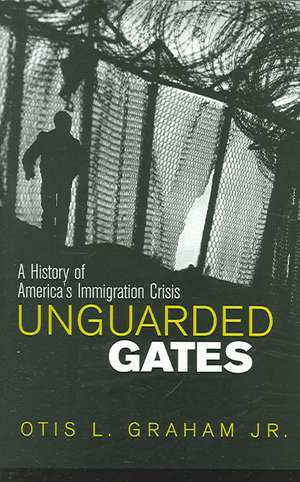
Unguarded Gates: A History of America's Immigration Crisis
Autor Otis L. Graham Jr.en Limba Engleză Paperback – 26 ian 2006
In this cogently-argued work, immigration scholar Otis L. Graham, Jr. examines the history of immigration pressures and American policy debates and choices. He begins with the first "Great Wave" of the 1880s and traces the effects of the system of national origins, enforced from the 1920s through 1965. The reforms of the 1960s ushered in an era of large-scale legal and illegal immigration, resulting in a vast social experiment in demographic transformation. In assessing the past, present, and future of immigration, Graham shows that the failure to control the influx of foreigners is leading America toward further security risks, unsustainable population growth, imported worker competition with American labor, and, ultimately, social fragmentation.
Preț: 221.84 lei
Preț vechi: 293.74 lei
-24%
Puncte Express: 333
Carte tipărită la comandă
Livrare economică 04-18 decembrie
Livrare prin curier în România Termenul estimat este afișat lângă disponibilitate.
Transport gratuit de la 400.00 lei Plată online sau ramburs, în funcție de opțiunile comenzii.
Retur gratuit în 14 zile Comandă securizată și suport în română.
Specificații
ISBN-13: 9780742522299
ISBN-10: 0742522296
Pagini: 242
Dimensiuni: 154 x 231 x 21 mm
Greutate: 0.39 kg
Editura: Bloomsbury Publishing
Colecția Rowman & Littlefield
Locul publicării:New York, United States
ISBN-10: 0742522296
Pagini: 242
Dimensiuni: 154 x 231 x 21 mm
Greutate: 0.39 kg
Editura: Bloomsbury Publishing
Colecția Rowman & Littlefield
Locul publicării:New York, United States
V-ar putea interesa
-
 Debating American Immigration, 1882-PresentRoger Daniels-23%Preț: 277.28 lei361.50 lei
 -
 Survival Communications in OregonJohn ParnellPreț: 153.48 lei
 -
 Survival Communications in ArizonaJohn ParnellPreț: 150.52 lei
 -
 Survival Communications in IllinoisJohn ParnellPreț: 220.83 lei
 -
 Survival Communications in IndianaJohn ParnellPreț: 153.66 lei
 -
 Survival Communications in CaliforniaJohn ParnellPreț: 132.80 lei
 -
 Survival Communications in ConnecticutJohn ParnellPreț: 194.42 lei
 -
 Survival Communications in MassachusettsJohn ParnellPreț: 219.62 lei
 -
 Survival Communications in MichiganJohn ParnellPreț: 185.89 lei
 -
 Survival Communications in New HampshireJohn ParnellPreț: 149.28 lei
 -
 Survival Communications in PennsylvaniaJohn ParnellPreț: 186.50 lei
 -
 Survival Communications in VirginiaJohn ParnellPreț: 195.25 lei
 -
 Survival Communication in CaliforniaJohn ParnellPreț: 145.75 lei
 -
 Field Manual for Effective LeadershipSteve S AslanPreț: 75.74 lei
 -
 Preț: 97.98 lei
 -
 Preț: 126.02 lei
Cuprins
Introduction
Part I: Immigration Issues from the Founders to the Creation of a System of Limitation
Chapter 1: Nation of the Native Born Unready for the Great Wave
Chapter 2: Immigration Reform: The Beginnings of National Policy
Chapter 3: Great Wave and the Search for National Policy
Chapter 4: Labeling of Reformers
Chapter 5: In Search of National Immigration Policy
Chapter 6: Reform Comes: New System for Choosing and Limiting America's Immigrants
Part II: Benefits and Erosion of the National Origins System
Chapter 7: Immigration Restriction: Results and Reflections
Chapter 8: Reform of the Reform? Gate-Widening Counterattack Quietly Begins
Chapter 9: Forties and Fifties: Regulated Immigration: Popular, and under Global Pressure
Part III: Second Great Wave and the Return of Mass Immigration
Chapter 10: Immigration Reform Again: Road to the 1965 Immigration Act
Chapter 11: Mass Immigration Builds Momentum: Refugees Unlimited
Chapter 12: Illegal Immigration: "Peaceful Invasion" and Policy Ineptitude
Chapter 13: Case for Restriction: Economics
Chapter 14: Case for Restriction: Concerns over National Cohesion
Chapter 15: Case for Restriction: Immigration's Population-Environment Connection
Part IV: Strange Politics of Porous Borders: Present and Future
Chapter 16: Politics of Immigration-The 1990s
Chapter 17: September 11-A Turning Point?
Chapter 18: Our Mass Immigration Era: How Can This Be?
Chapter 19: Dogmas of the Past
Part I: Immigration Issues from the Founders to the Creation of a System of Limitation
Chapter 1: Nation of the Native Born Unready for the Great Wave
Chapter 2: Immigration Reform: The Beginnings of National Policy
Chapter 3: Great Wave and the Search for National Policy
Chapter 4: Labeling of Reformers
Chapter 5: In Search of National Immigration Policy
Chapter 6: Reform Comes: New System for Choosing and Limiting America's Immigrants
Part II: Benefits and Erosion of the National Origins System
Chapter 7: Immigration Restriction: Results and Reflections
Chapter 8: Reform of the Reform? Gate-Widening Counterattack Quietly Begins
Chapter 9: Forties and Fifties: Regulated Immigration: Popular, and under Global Pressure
Part III: Second Great Wave and the Return of Mass Immigration
Chapter 10: Immigration Reform Again: Road to the 1965 Immigration Act
Chapter 11: Mass Immigration Builds Momentum: Refugees Unlimited
Chapter 12: Illegal Immigration: "Peaceful Invasion" and Policy Ineptitude
Chapter 13: Case for Restriction: Economics
Chapter 14: Case for Restriction: Concerns over National Cohesion
Chapter 15: Case for Restriction: Immigration's Population-Environment Connection
Part IV: Strange Politics of Porous Borders: Present and Future
Chapter 16: Politics of Immigration-The 1990s
Chapter 17: September 11-A Turning Point?
Chapter 18: Our Mass Immigration Era: How Can This Be?
Chapter 19: Dogmas of the Past
Recenzii
Otis Graham brings new eyes and new scholarship to the agonizing question of immigration, a subject that usually engenders too much emotion and too little objective analysis. Unguarded Gates: A History of America's Immigration Crisis is a clear-eyed look at both the pluses and minuses of our new immigration patterns. Readable and compelling.
Otis Graham's Unguarded Gates is a vivid reminder that our contemporary debates over immigration have a long history. Graham shows powerfully how immigration has proven a continual challenge to the ability of America to realize its highest ideals and, as such, is must reading for understanding one of the pivotal issue of our times.
A much-needed guide to an unknown history: America's constant effort to control immigration in the national interest, culminating in the legislation that ended out-of-control immigration in the 1920s. Graham performs a great service in calmly stripping away the self-serving myths that grew up around this cut-off, caused its abandonment in the 1960s, and still poison debate today, as immigration once again reaches crisis proportions.
Otis Graham has been reflecting on the consequences of large-scale immigration in the U.S. for many years. Unguarded Gates distills many of those insights in a coherent and informative fashion. Regardless of one's perspective on the immigration debate, Graham's analysis shows that the making of an informed policy requires that we all become aware of how immigration is changing the country.
Graham performs a valuable service in refuting modern-day charges that racist motivations and eugenicist theories underlay the Progressives' move to restrict immigration. Unguarded Gates is especially enlightening in its analysis of the vast cultural rift between the elites, who benefit economically from cheap immigrant labor, and average Americans, who bear the costs and consequences of the present mass immigration.
Ethnic activists-along, unfortunately, with most liberals and historians of immigration-refuse to grant that efforts to restrict immigration can be inspired by anything but nativism, racism, and fear of 'the Other.' This book shows how ungrounded-and unfair-that assumption is. Graham's evidence and argumentation should go far toward making reasonable discussion of the issue possible.
This is a clear and rational little book-no small accomplishment when the subject is immigration.Unguarded Gates: A History of America's Immigration Crisis is less a policy tome or a polemic than a fine exercise in simply telling it like it was.
Unguarded Gates provides an intriguing historical survey of America's immigration crisis. . . . This should be a part of any college-level collection on immigrant social issues.
Otis Graham's Unguarded Gates is a vivid reminder that our contemporary debates over immigration have a long history. Graham shows powerfully how immigration has proven a continual challenge to the ability of America to realize its highest ideals and, as such, is must reading for understanding one of the pivotal issue of our times.
A much-needed guide to an unknown history: America's constant effort to control immigration in the national interest, culminating in the legislation that ended out-of-control immigration in the 1920s. Graham performs a great service in calmly stripping away the self-serving myths that grew up around this cut-off, caused its abandonment in the 1960s, and still poison debate today, as immigration once again reaches crisis proportions.
Otis Graham has been reflecting on the consequences of large-scale immigration in the U.S. for many years. Unguarded Gates distills many of those insights in a coherent and informative fashion. Regardless of one's perspective on the immigration debate, Graham's analysis shows that the making of an informed policy requires that we all become aware of how immigration is changing the country.
Graham performs a valuable service in refuting modern-day charges that racist motivations and eugenicist theories underlay the Progressives' move to restrict immigration. Unguarded Gates is especially enlightening in its analysis of the vast cultural rift between the elites, who benefit economically from cheap immigrant labor, and average Americans, who bear the costs and consequences of the present mass immigration.
Ethnic activists-along, unfortunately, with most liberals and historians of immigration-refuse to grant that efforts to restrict immigration can be inspired by anything but nativism, racism, and fear of 'the Other.' This book shows how ungrounded-and unfair-that assumption is. Graham's evidence and argumentation should go far toward making reasonable discussion of the issue possible.
This is a clear and rational little book-no small accomplishment when the subject is immigration.Unguarded Gates: A History of America's Immigration Crisis is less a policy tome or a polemic than a fine exercise in simply telling it like it was.
Unguarded Gates provides an intriguing historical survey of America's immigration crisis. . . . This should be a part of any college-level collection on immigrant social issues.