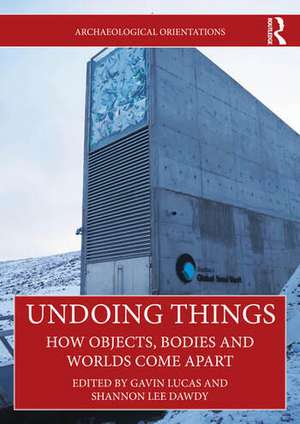
Undoing Things: How Objects, Bodies and Worlds Come Apart: Archaeological Orientations
Editat de Gavin Lucas, Shannon Lee Dawdyen Limba Engleză Paperback – 30 apr 2025
Deși arheologia s-a concentrat tradițional pe dimensiunile productive ale materialității — construirea obiectelor, a clădirilor și a identităților — procesele prin care lucrurile se destramă au rămas adesea un subiect fragmentat în literatura academică. Undoing Things vine să umple această lacună, propunând o perspectivă integrată asupra ruinei, degradării și demostrării. Remarcăm curajul editorilor Gavin Lucas și Shannon Lee Dawdy de a chestiona dacă există o componentă creativă în spatele distrugerii și cum se manifestă puterea în actul de a „desface” o lume sau un obiect.
Structura volumului este riguros organizată în trei secțiuni fundamentale: „Undoing Objects”, „Undoing Bodies” și „Undoing Places”. Această progresie permite cititorului să navigheze de la micro-istoria cărților și a artefactelor muzeale, trecând prin arheologia resturilor umane și animale (cu studii fascinante despre Maya clasică sau abatoarele din New Orleans), până la macro-geografiile peisajelor toxice și ale violenței structurale. Cititorii familiarizați cu Curated Decay de Caitlin DeSilvey vor aprecia modul în care acest volum extinde discuția despre entropie și conservare, transformând degradarea dintr-o pierdere într-un proces activ de reconfigurare.
Această lucrare se înscrie natural în opera lui Gavin Lucas, continuând direcțiile exploratorii din Shadow Archaeologies și Understanding the Archaeological Record. Dacă lucrările sale anterioare chestionau natura dovezilor arheologice, Undoing Things aplică aceste interogații teoretice asupra crizelor contemporane, precum pandemia de Covid-19 sau dezastrele climatice. Putem afirma că volumul recontextualizează arheologia nu doar ca o știință a trecutului, ci ca un instrument critic pentru a înțelege rupturile prezentului.
Preț: 363.55 lei
Preț vechi: 394.22 lei
-8%
Carte indisponibilă temporar
Specificații
ISBN-10: 1032061820
Pagini: 384
Ilustrații: 212
Dimensiuni: 174 x 246 x 23 mm
Greutate: 0.98 kg
Ediția:1
Editura: Taylor & Francis
Colecția Routledge
Seria Archaeological Orientations
Locul publicării:Oxford, United Kingdom
Public țintă
GeneralDe ce să citești această carte
Recomandăm această carte cercetătorilor și studenților în arheologie, antropologie și studii culturale care doresc să depășească viziunea tradițională asupra conservării. Veți câștiga o înțelegere profundă a modului în care distrugerea și degradarea pot fi acte de rezistență sau regenerare. Este o lectură esențială pentru a înțelege cum se reconstruiesc societățile după colaps, într-o eră a incertitudinii climatice și politice.
Despre autor
Gavin Lucas este profesor asociat la Departamentul de Arheologie al Universității din Islanda, fiind o voce proeminentă în teoria arheologică contemporană. Printre lucrările sale de referință se numără Critical Approaches to Fieldwork și The Archaeology of Time. Interesul său constant pentru epistemologia arheologiei și pentru modul în care timpul și cultura materială interacționează este reflectat în numeroase volume editate, precum cele din seria Archaeological Orientations. Expertiza sa în arheologia perioadelor moderne și contemporane oferă acestui volum o rigoare metodologică dublată de o deschidere teoretică inovatoare.
Cuprins
Descriere scurtă
Although archaeologists have long attended to the productive dimensions of materiality and material culture as a coherent phenomenon—making objects, building things, constructing identities—the discourse around undoing is more fragmented. Topics such as ruination, death, decay, demolition, and collapse are usually examined separately. Undoing Things asks what connections or continuities can be discerned in a diverse range of practices, both intentional and taphonomic, both destructive and healing. Is there a creative component to undoing? How visible are different processes of undoing? How is time implicated? Is undoing reversible? Who has the power to undo and when is undoing empowering? What does it take to undo knowledge? These and other questions are examined through archaeological studies ranging from classical Maya and colonial Caribbean examples to present-day Liberia, historical and ethnographic approaches to present-day Argentina, and the contemporary art world.
In the first quarter of the 21st century, human worlds have experienced a series of ruptures from climate-related disasters, political violence, and the Covid-19 pandemic. Undoing Things helps move us beyond a cloud of chaos with a deeper understanding of how and why things fall apart and is vital reading for archaeologists and those in related disciplines.
Notă biografică
Shannon Lee Dawdy is a Professor of Anthropology at the University of Chicago. Dawdy’s fieldwork combines archival, ethnographic, and archaeological methods. Her work has focused on the history of colonialism and capitalism, human-material relations, temporality, and the archaeology of contemporary life. Her books include Building the Devil’s Empire: French Colonial New Orleans (2008), Patina: A Profane Archaeology (2016), and American Afterlives: Reinventing Death in the Twenty-First Century (2021).