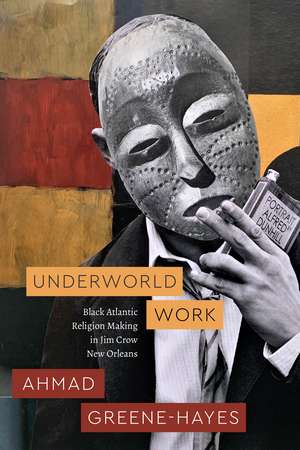
Underworld Work: Black Atlantic Religion Making in Jim Crow New Orleans: Class 200: New Studies in Religion
Autor Ahmad Greene-Hayesen Limba Engleză Paperback – 6 mai 2025
When Zora Neale Hurston traveled to New Orleans, she encountered a religious underworld, a beautiful anarchy of spiritual life. In Underworld Work, Ahmad Greene-Hayes follows Hurston on a journey through the rich tapestry of Black religious expression from emancipation through Jim Crow. He looks within and beyond the church to recover the diverse leadership of migrants, healers, dissidents, and queer people who transformed their marginalized homes, bars, and street corners into sacred space.
Greene-Hayes shows how, while enclosed within an anti-black world, these outcasts embraced Africana esotericisms—ancestral veneration, faith healing, spiritualized sex work, and more—to conjure a connection to freer worlds past and yet to come. In recovering these spiritual innovations, Underworld Work celebrates the resilience and creativity of Africana religions.
Din seria Class 200: New Studies in Religion
-
 Preț: 62.80 lei
 -
 Preț: 258.13 lei
 -
 Preț: 259.43 lei
 -
 Preț: 241.90 lei
 -
 Preț: 252.45 lei
 -
 Preț: 261.27 lei
 -
 Preț: 230.71 lei
 -
 Preț: 265.55 lei
 -
 Preț: 188.57 lei
 -
 Preț: 211.44 lei
 -
 Preț: 210.41 lei
 -
 Preț: 215.91 lei
 - 27%
 Preț: 702.17 lei
 - 27%
 Preț: 668.60 lei
 -
 Preț: 267.52 lei
 -
 Preț: 209.39 lei
 -
 Preț: 192.25 lei
 -
 Preț: 209.91 lei
 -
 Preț: 274.46 lei
 -
 Preț: 228.46 lei
 -
 Preț: 207.46 lei
 - 22%
 Preț: 256.15 lei
 - 26%
 Preț: 494.26 lei
 - 13%
 Preț: 195.82 lei
Preț: 209.98 lei
Puncte Express: 315
Carte disponibilă
Livrare economică 14-28 noiembrie
Livrare express 03-07 noiembrie pentru 25.85 lei
Livrare prin curier în România Termenul estimat este afișat lângă disponibilitate.
Transport gratuit de la 400.00 lei Plată online sau ramburs, în funcție de opțiunile comenzii.
Retur gratuit în 14 zile Comandă securizată și suport în română.
Specificații
ISBN-13: 9780226838861
ISBN-10: 0226838862
Pagini: 288
Ilustrații: 28 halftones
Dimensiuni: 152 x 229 x 20 mm
Greutate: 0.36 kg
Ediția:First Edition
Editura: University of Chicago Press
Colecția University of Chicago Press
Seria Class 200: New Studies in Religion
ISBN-10: 0226838862
Pagini: 288
Ilustrații: 28 halftones
Dimensiuni: 152 x 229 x 20 mm
Greutate: 0.36 kg
Ediția:First Edition
Editura: University of Chicago Press
Colecția University of Chicago Press
Seria Class 200: New Studies in Religion
Notă biografică
Ahmad Greene-Hayes is assistant professor of African American religious studies at Harvard Divinity School at Harvard University.
Cuprins
List of Abbreviations
Introduction
VISITATION 1 Zora on “Voodoo”
1 “Midnight Orgies”: Voudou and the Problem of Possessed Black Flesh from Haiti to Louisiana
VISITATION 2 Zora on Lynching
2 “Smoke Out the Negro Devils”: Black Cosmopolitan Eclecticism in the New Century and the Terror of Lynching
VISITATION 3 Zora Eats the Salt
3 “Making a Place for Negro Untouchables”: Black Sexual Victorianism and Its Counterconducts
VISITATION 4 Zora Talks “Hoodoo in America” and Elsewhere
4 “Dangerous and Suspicious”: Hoodoo, Faith Healing, and Sex Work in the Black Slum
VISITATION 5 Zora’s Unpublished Satire on Marcus Garvey: “The Emperor Effaces Himself”
5 “The Right Idea of God”: Sinners and Saints in the New Orleans Division of the Universal Negro Improvement Association
VISITATION 6 Zora Worships with the Sanctified
6 “We Ain’t Spiritualists, We’s the Sanctified Church”: Black Pentecostals and the Politics of Distinction
Coda
Acknowledgments
Notes
Index
Introduction
VISITATION 1 Zora on “Voodoo”
1 “Midnight Orgies”: Voudou and the Problem of Possessed Black Flesh from Haiti to Louisiana
VISITATION 2 Zora on Lynching
2 “Smoke Out the Negro Devils”: Black Cosmopolitan Eclecticism in the New Century and the Terror of Lynching
VISITATION 3 Zora Eats the Salt
3 “Making a Place for Negro Untouchables”: Black Sexual Victorianism and Its Counterconducts
VISITATION 4 Zora Talks “Hoodoo in America” and Elsewhere
4 “Dangerous and Suspicious”: Hoodoo, Faith Healing, and Sex Work in the Black Slum
VISITATION 5 Zora’s Unpublished Satire on Marcus Garvey: “The Emperor Effaces Himself”
5 “The Right Idea of God”: Sinners and Saints in the New Orleans Division of the Universal Negro Improvement Association
VISITATION 6 Zora Worships with the Sanctified
6 “We Ain’t Spiritualists, We’s the Sanctified Church”: Black Pentecostals and the Politics of Distinction
Coda
Acknowledgments
Notes
Index
Recenzii
“Underworld Work represents the state-of-the-art in scholarship on African American religious history. . . . The currents that Greene-Hayes rides in the study of Black religion complement currents in the field of Black studies as it has developed in recent years . . . Greene-Hayes’s book helpfully invites us to begin . . . reflecting more deeply on the future of the field.”
"In Greene-Hayes’s hands, queerness becomes a way of knowing, relating, and surviving—central, not marginal, to Black religious life—offering a provocative rethinking of African American religious history by showing that queerness is a generative way of knowing, relating, and surviving in Black America. His Hurstonian ethic strengthens this vision: he takes Black folk on their own terms, centering lived theologies and embodied ritual knowledge."
“[An] astonishingly generative book . . . Not a page goes by without a fascinating nugget dug out of sometimes obscure archival sources, local newspaper records, the Louisiana Federal Writers Project, or the always pungent observations of Zora Neale Hurston and sometimes other writers; or without a challenging theoretical clarification or strongly phrased argument; or without an arresting photograph; or without a miniature biography of someone . . . All of which is to say, this book richly captures a portions of the lives, the religion making, of largely poor Black New Orleans residents who were surveilled, cataloged, folklorized, harassed, criminalized, rebuked, and scorned, both by the white Christian state (including its social scientific academic apparatus) and by the Black Protestant leadership class. . . . This is an intellectually challenging text to read; it is also an unforgettable one."
"Under the umbrella of underworld work, the author celebrates a wide range of practices loosely tied to each other primarily by their presence in New Orleans, their Black adherents, and the suspicion under which they fell in the eyes of the dominant white society. To literarily link these diverse and sometimes antagonistic faiths together, he introduces each chapter with what he calls a visitation, a selection from the writings of Zora Neale Hurston."
“Greene-Hayes credits a diverse array of what he terms Black Atlantic ‘religion makers’ with the agency and creativity denied them by contemporary journalists and interviewers from the Works Progress Administration (WPA) who classified them as fanatics, cultists, and criminals.”
“This study’s inventive reconstruction of New Orleans’ “underworld” will force American religious historians to reconsider what is deemed to be a religious versus a secular space, and what constitutes a religious tradition or community. Considering this, the book is a notable contribution to secular studies, as Greene-Hayes’ probe into New Orleanian religious life confronts the elemental assumption at the heart of secularization narratives: that religion became privatized and no longer remained in modern public life. Rather than accepting this perspective, Greene-Hayes successfully illustrates how Black Atlantic religions in New Orleans were not concerned with the limits of sociality laid out by American secularism, but instead were focused on spiritual innovation that allowed practitioners of African descent the means to carve out their own ideas about what can be considered an acceptable expression of religion, sexuality, or race in the face of social exclusion.”
"In Greene-Hayes’s hands, queerness becomes a way of knowing, relating, and surviving—central, not marginal, to Black religious life—offering a provocative rethinking of African American religious history by showing that queerness is a generative way of knowing, relating, and surviving in Black America. His Hurstonian ethic strengthens this vision: he takes Black folk on their own terms, centering lived theologies and embodied ritual knowledge."
“[An] astonishingly generative book . . . Not a page goes by without a fascinating nugget dug out of sometimes obscure archival sources, local newspaper records, the Louisiana Federal Writers Project, or the always pungent observations of Zora Neale Hurston and sometimes other writers; or without a challenging theoretical clarification or strongly phrased argument; or without an arresting photograph; or without a miniature biography of someone . . . All of which is to say, this book richly captures a portions of the lives, the religion making, of largely poor Black New Orleans residents who were surveilled, cataloged, folklorized, harassed, criminalized, rebuked, and scorned, both by the white Christian state (including its social scientific academic apparatus) and by the Black Protestant leadership class. . . . This is an intellectually challenging text to read; it is also an unforgettable one."
"Under the umbrella of underworld work, the author celebrates a wide range of practices loosely tied to each other primarily by their presence in New Orleans, their Black adherents, and the suspicion under which they fell in the eyes of the dominant white society. To literarily link these diverse and sometimes antagonistic faiths together, he introduces each chapter with what he calls a visitation, a selection from the writings of Zora Neale Hurston."
“Greene-Hayes credits a diverse array of what he terms Black Atlantic ‘religion makers’ with the agency and creativity denied them by contemporary journalists and interviewers from the Works Progress Administration (WPA) who classified them as fanatics, cultists, and criminals.”
"Greene-Hayes skillfully teases out archival evidence and uses it to paint a picture of a vibrant, dynamic, intentionally counterhegemonic Black space."
“Underworld Work recovers the beautiful complexity of Black religion in twentieth-century New Orleans, elevating the archives as sacred sites where the ancestors speak. Guided by Zora Neale Hurston—through faith healing, Hoodoo recipes, and ecstatic performances in Baptist, Spiritualist, and Sanctified churches—Greene-Hayes ushers us into spaces of historical disorientation where Africana spiritual traditions persist despite relentless policing and criminalization by salvage ethnographers and Christian race makers.”
“Greene-Hayes beautifully captures the religious strivings of Zora Neale Hurston and many of the varied manifestations of Black religion that were maligned as criminal and dangerous by conservative social forces terrified by the freedom and power of occult practices untethered from Protestantism, heteropatriarchy, and other life-denying orientations. Perceptive, remarkable, and innovative, Underworld Work is a must-read for anyone interested in the life-affirming practices Black people conjure in the face of state violence and the terrifying enclosures of this world.”
“This study’s inventive reconstruction of New Orleans’ “underworld” will force American religious historians to reconsider what is deemed to be a religious versus a secular space, and what constitutes a religious tradition or community. Considering this, the book is a notable contribution to secular studies, as Greene-Hayes’ probe into New Orleanian religious life confronts the elemental assumption at the heart of secularization narratives: that religion became privatized and no longer remained in modern public life. Rather than accepting this perspective, Greene-Hayes successfully illustrates how Black Atlantic religions in New Orleans were not concerned with the limits of sociality laid out by American secularism, but instead were focused on spiritual innovation that allowed practitioners of African descent the means to carve out their own ideas about what can be considered an acceptable expression of religion, sexuality, or race in the face of social exclusion.”