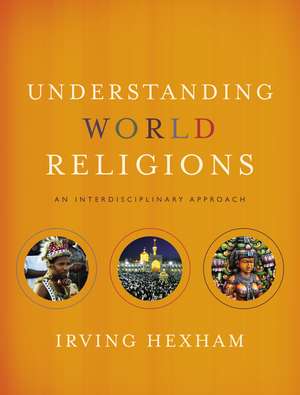
Understanding World Religions: An Interdisciplinary Approach
Autor Irving Hexhamen Limba Engleză Hardback – 14 aug 2018
Prezentat sub formă de manual academic robust, Understanding World Religions de Irving Hexham propune o analiză interdisciplinară esențială pentru înțelegerea peisajului spiritual global contemporan. Observăm că autorul evită capcana stereotipurilor religioase și a generalizărilor facile care susțin că toate credințele sunt identice în esență. În schimb, volumul tratează religia ca pe un ansamblu complex, unde istoria și filosofia se intersectează cu practicile culturale specifice.
Suntem de părere că elementul distinctiv al acestei lucrări este decizia curajoasă a lui Hexham de a integra studiul religiilor africane, un segment frecvent ignorat în manualele standard de religie comparată. Structura narativă este una riguroasă, ghidând cititorul către o metodă de analiză obiectivă. În secțiunile dedicate Islamului, de exemplu, autorul depășește sursele terțiare sau discursul corect politic, ancorând textul în realitatea practicanților devotați. Această abordare critică, dar respectuoasă, oferă o perspectivă nuanțată asupra diversității formelor de Hinduism, Budism, Iudaism, Creștinism și Islam.
Cititorii familiarizați cu The World's Religions de Peter Clarke vor aprecia la volumul lui Hexham focalizarea pe sursele primare și rigoarea metodologică aplicată contextelor non-occidentale. Dacă lucrarea sa anterioară, New Religions As Global Cultures, explora interacțiunea dintre culte și religiile tradiționale, acest titlu extinde cadrul de cercetare către marile tradiții istorice, păstrând aceeași atenție pentru dinamica culturală. Textul este calibrat pentru mediul universitar, oferind un echilibru între profunzimea teoretică și claritatea necesară unui parcurs educațional interdisciplinar.
Preț: 309.92 lei
Carte disponibilă
Livrare economică 02-16 noiembrie
Specificații
ISBN-10: 031059846X
Pagini: 512
Dimensiuni: 194 x 240 x 34 mm
Greutate: 1.02 kg
Editura: Zondervan Academic
Colecția Zondervan Academic
Locul publicării:Grand Rapids, United States
De ce să citești această carte
Această carte este ideală pentru studenții la teologie, sociologie sau istorie care doresc să depășească viziunile simpliste asupra fenomenului religios. Cititorul câștigă o înțelegere profundă a diferențelor fundamentale dintre credințele lumii, beneficiind de expertiza unui autor care a consiliat organizații internaționale precum ONU. Este o resursă rară care tratează religiile africane cu aceeași rigoare academică precum marile religii monoteiste.
Despre autor
Irving Hexham este profesor de studii religioase la Universitatea din Calgary și profesor asociat de creștinism mondial la Liverpool Hope University. Cu o carieră prolifică, a publicat 27 de cărți academice, printre care „The Concise Dictionary of Religion” și „Understanding Cults and New Religions”. Experiența sa transcende mediul academic, Hexham fiind autorul unor rapoarte de importanță strategică privind conflictele religioase din Africa pentru Agenția ONU pentru Refugiați și pentru Departamentul Patrimoniului Canadian. Expertiza sa în religiile globale și noile mișcări religioase îi conferă o autoritate incontestabilă în domeniul religiei comparate.
Recenzii
An ideal, clear, and lively introduction to world religions for North American students that also briefly deals with their modern developments, e.g. in the field of Buddhism.
Hexham offers an introduction to the study of religions based on his years of teaching the subject, an impressive multicultural knowledge of various religious traditions, and in a style that is readable and engaging. Not another boring catalogue of religious beliefs and practices looked at from a pseudosophisticated afar, Hexham’s book conveys something of the diversity and controversies involved in the academic study of religions.
I enjoyed the chapters on Indian religions enormously. They are enlightening and fascinating for anyone who has brushed the surface of India and its religious traditions. The author has produced a work that is very readable and thought-provoking, but, more importantly, one that brings the religions to life in a practical way.
Many Western presentations of Islam merely pass on selected remarks from unreliable tertiary sources. Irving Hexham’s chapters on Islam are unique in that they reach beyond library versions, Muslim polemic, and Western politically correct advocacy to the actual discourse of devoted Muslims around the world today. Hexham takes seriously the sourcebooks through which Muslims understand their faith and practice, and the perspectives of recent authors whose influence shapes modern Muslim views. He rightly relies on some of the strongest scholarly studies of Islam for his analysis and evaluation, which sheds light on a subject that remains confusing for many Westerners.