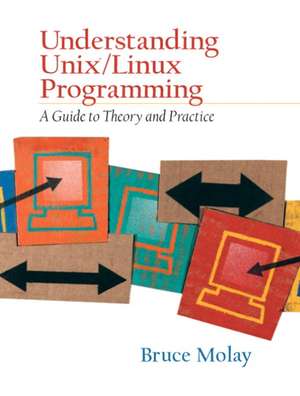
Understanding Unix/Linux Programming: A Guide to Theory and Practice
Autor Bruce Molayen Limba Engleză Paperback – 30 noi 2002
This book explains in a clear and coherent manner how Unix works, how to understand existing Unix programs, and how to design and create new Unix programs. The book is organized by subsystem, each presented in visual terms and explained using vivid metaphors. It breaks the information into manageable parts that can be presented, explained, and mastered. By using case studies and an extremely reader-friendly manner to illustrate complex ideas and concepts, the book covers the basics of systems programming, users, files and manuals, how to read a directory, using 1S, writing PWD, studying STTY, writing a video game, studying SH, environment and shell variables, I/O redirection and pipes, servers and sockets, writing a web server, license servers, and concurrent functions. For Unix system administrators and programmers, network programmers, and others who have used other operating systems and need to learn Unix programming to expand their skill sets.
Preț: 1103.67 lei
Preț vechi: 1433.34 lei
-23%
Carte tipărită la comandă
Livrare economică 27 noiembrie-11 decembrie
Specificații
ISBN-10: 0130083968
Pagini: 530
Dimensiuni: 179 x 234 x 31 mm
Greutate: 0.89 kg
Ediția:1
Editura: Pearson
Locul publicării:Upper Saddle River, United States
V-ar putea interesa
-
 C Programming LanguageDennis Ritchie-20%Preț: 385.95 lei482.43 lei
 -
 -20%Preț: 439.67 lei549.59 lei
 -
 -20%Preț: 330.38 lei412.98 lei
 -
 UNIX & Shell ProgrammingB. M. Harwani-20%Preț: 256.83 lei321.05 lei
 -
 The Practice of ProgrammingBrian Kernighan-20%Preț: 304.16 lei380.20 lei
 -
 Design and Implementation of the FreeBSD Operating System, TheGeorge Neville-Neil-20%Preț: 443.60 lei554.50 lei
 -
 Programming Language PragmaticsMichael Scott-40%Preț: 488.02 lei808.04 lei
 -
 Computer Systems: A Programmer's Perspective, Global EditionRandal E. Bryant-20%Preț: 652.59 lei815.74 lei
 -
 Operating Systems: Internals and Design Principles, Global EditionWilliam Stallings-20%Preț: 703.73 lei879.66 lei
 -
 Modern Operating Systems, Global EditionAndrew Tanenbaum-20%Preț: 669.46 lei836.83 lei
 -
 Linux Command Line and Shell Scripting BibleRichard Blum-20%Preț: 410.86 lei513.56 lei
 -
 Guide to UNIX Using LinuxMichael Palmer-20%Preț: 522.95 lei653.69 lei
 -
 Linux for BeginnersJason Cannon-20%Preț: 131.95 lei164.93 lei
 -
 Dive Into Systems: A Gentle Introduction to Computer SystemsSuzanne J Matthews-35%Preț: 407.65 lei625.36 lei
 -
 System Programming in Linux: A Hands-On IntroductionStewart Weiss-35%Preț: 481.65 lei739.15 lei
 -
 Building a DebuggerSy Brand-35%Preț: 337.38 lei518.40 lei
 -
 The Linux Command Line, 3rd Edition: A Complete IntroductionWilliam Shotts-34%Preț: 245.40 lei374.07 lei
 -
 UNIX in Easy StepsMike Mcgrath-20%Preț: 68.42 lei85.53 lei
 -
 Concurrent and Real-time ProgrammingManuel I. Capel-20%Preț: 353.05 lei441.31 lei
Descriere
This readable and comprehensive text clearly explains Unix programming and structure by addressing the solid fundamentals of Unix and providing different solutions to problems. All ideas and principles are introduced in the context of a practical problem, and excellent use is made of illustrations and listings in the text. Projects are solved by the development of complete programs, which are clearly commented on and integrated with explanations in the text.
Cuprins
1. Unix Systems Programming: The Big Picture.
2. Users, Files, and the Manual: Who Is First.
3. Directories and File Properties: Looking through ls.
4. Focus on File Systems: Writing pwd.
5. Connection Control: Studying stty.
6. Programming for Humans: Terminal Control and Signals.
7. Event-Driven Programming: Writing a Video Game.
8. Processes and Programs: Studying sh.
9. A Programmable Shell: Shell Variables and the Environment.
10. I/O Redirection and Pipes.
11. Connecting to Processes Near and Far: Servers and Sockets.
12. Connections and Protocols: Writing a Web Server.
13. Programming with Datagrams: A License Server.
14. Threads: Concurrent Functions.
15. IPC Roundup: Can We Talk?
Recenzii
"The material covered goes to the right depth to allow students to understand the UNIX operating system to program it. I wish a book of this calibre was available during my graduate studies as it would have helped me tremendously in learning to program the UNIX system." — Sam R. Thangiah, Slippery Rock University
"This text is one of the most accurate and articulate that I have read. It is easily readable." — Lawrence B. Wells, Dallas County Community College
"The material covered goes to the right depth to allow students to understand the UNIX operating system to program it. I wish a book of this calibre was available during my graduate studies as it would have helped me tremendously in learning to program the UNIX system." - Sam R. Thangiah, Slippery Rock University "This text is one of the most accurate and articulate that I have read. It is easily readable." - Lawrence B. Wells, Dallas County Community College
Notă biografică
Textul de pe ultima copertă
Understanding Unix(R)/Linux Programming explains how Unix and Linux work and shows how to write, programs at the system call level. Using nearly 100 complete programs and over 200 illustrations, the book demonstrates the basics as well as the advanced aspects of Unix systems programming.
Topics include:- file I/0
- device I/0
- timers
- process management
- stream and datagram sockets
- POSIX threads
- file systems
- the terminal driver
- signals
- pipes
- network programming
- semaphores
The text presents theory in practical contexts with detailed explanations of common Unix programs such as who, Is, pwd, sh, and httpd. Each example starts with a description of what the program does and how people use it. From there, the text discusses the underlying principles and mechanisms, and then uses those ideas to write a version of the program.
The book is designed for learning. Chapter summaries, memorable analogies, experiments, explorations, and varied exercises help the reader understand and program Unix as an integrated, logical whole.
Material in the book applies to all versions of Unix and Linux. The book assumes the reader knows the C programming language and is familiar with a modern operating system. The book is suitable as a class text, for self-study, and for reference, and it provides thorough coverage of information essential to students, Unix programmers, and system administrators.
Caracteristici
- Case-study approach to teaching—Each chapter is based on a specific Unix command or programming problem.
- Enables students to immediately see solutions to specific problems.
- Enables students to immediately see solutions to specific problems.
- Standard Unix-specific programs.
- Allows students to learn how to use the system at the same time they learn how to program it.
- Allows students to learn how to use the system at the same time they learn how to program it.
- Copious illustrations—Abstract ideas, structures, and procedures are depicted visually.
- Reinforces to students fundamental ideas and concepts in an easily understandable manner.
- Reinforces to students fundamental ideas and concepts in an easily understandable manner.
- Source code to complete programs—Every chapter solves the project(s) presented by developing complete programs.
- Encourages students to make sense of abstract ideas by showing them concrete examples.
- Encourages students to make sense of abstract ideas by showing them concrete examples.
- Humorous, memorable metaphors.
- Helps students to retain information with whimsical and unique models.
- Helps students to retain information with whimsical and unique models.
- Instructor's CD with extensive pedagogy—Includes lecture outlines, homework projects, blackboard slides, test bank, and solutions to most exercises.
- Enables instructors to present a complete curriculum, while tailoring the pedagogy to fit their needs.
- Enables instructors to present a complete curriculum, while tailoring the pedagogy to fit their needs.
- 3D model files.
- Allows students to explore ideas by enlarging, rotating, and modifying graphics.
- Allows students to explore ideas by enlarging, rotating, and modifying graphics.
- Web site—With online study guide, link to author's site, homework projects, additional code, and images.
- Enables students to download programs to further enhance their learning experience.
- Enables students to download programs to further enhance their learning experience.